
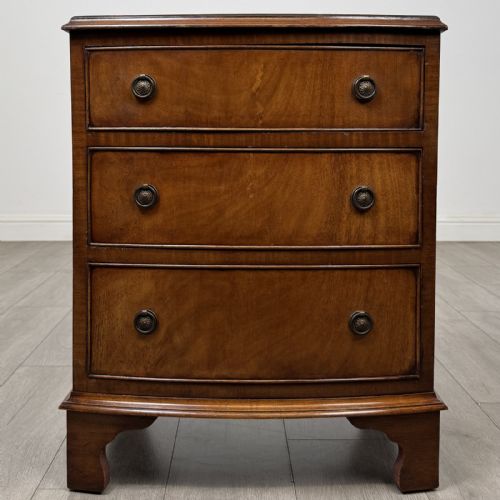
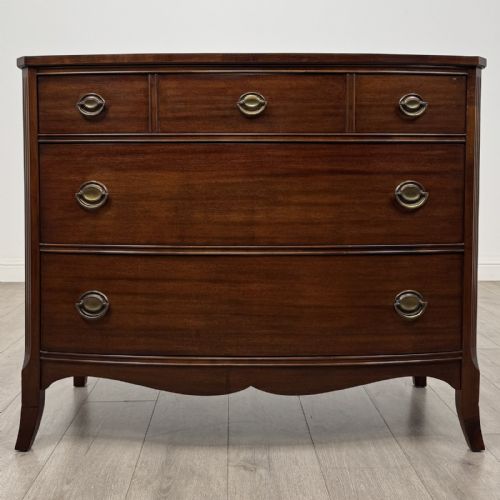
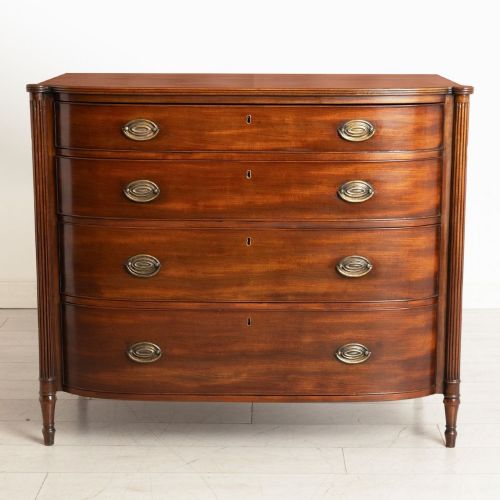
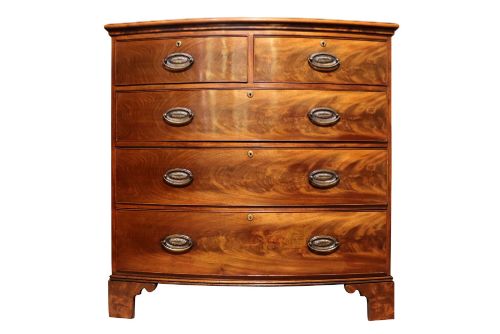
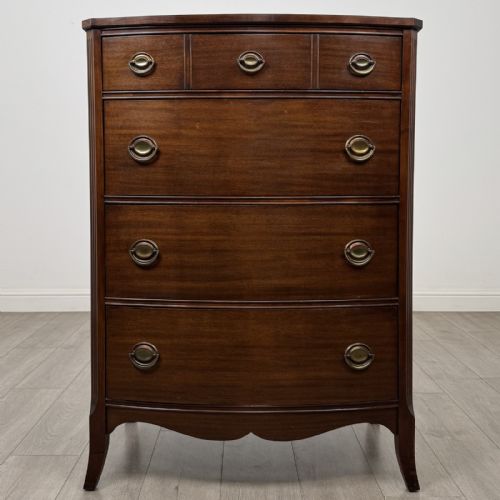
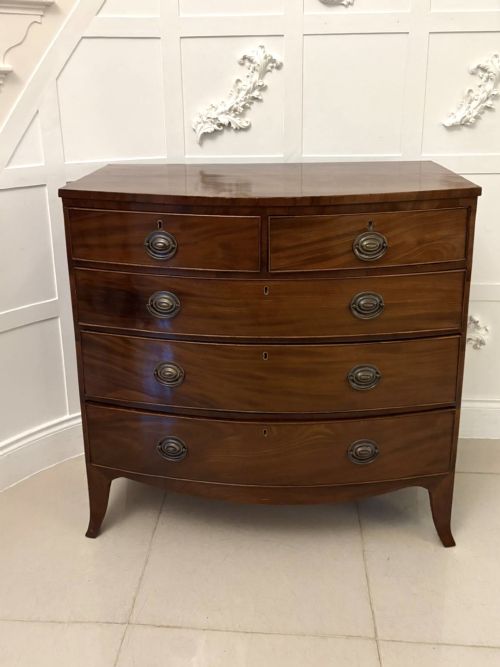
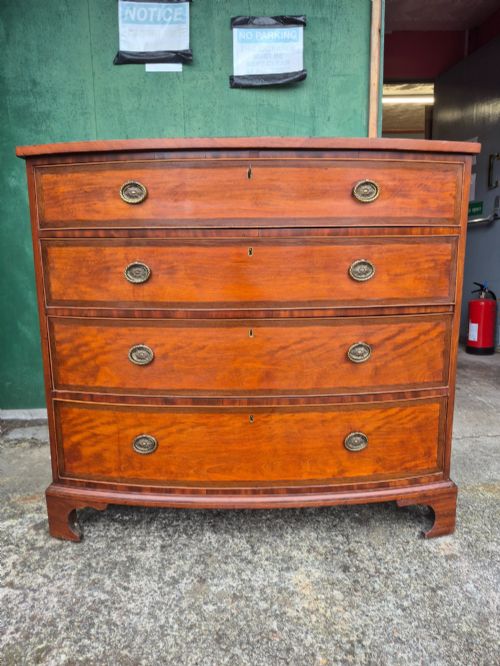
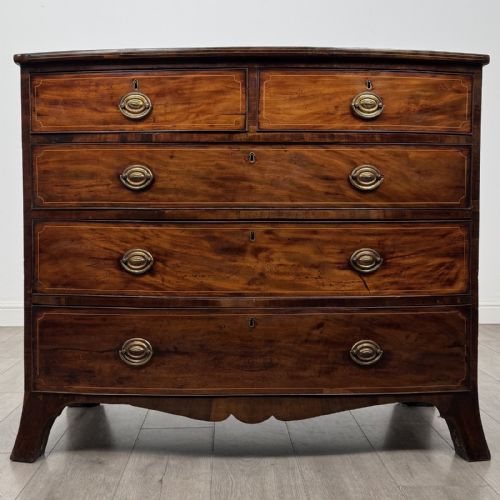

Bowfront Tallboy Drawers
Bowfront tallboy drawers combine vertical height with a curved projecting front, offering substantial storage capacity within a compact floor footprint.
Bowfront Tallboy Drawers
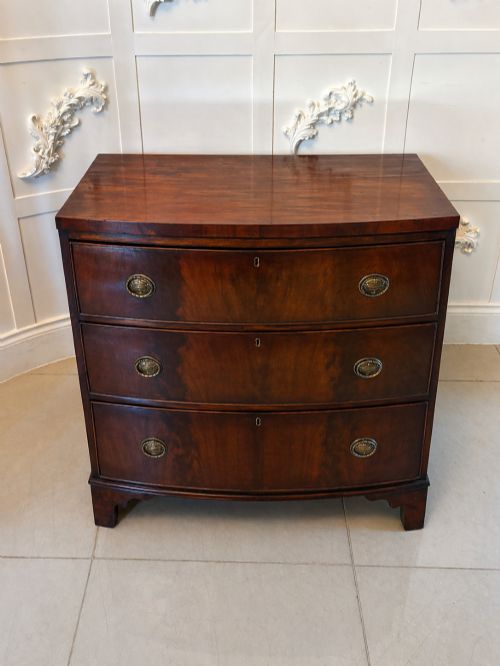
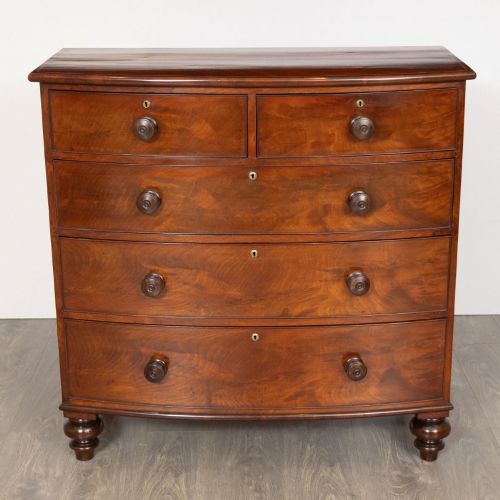
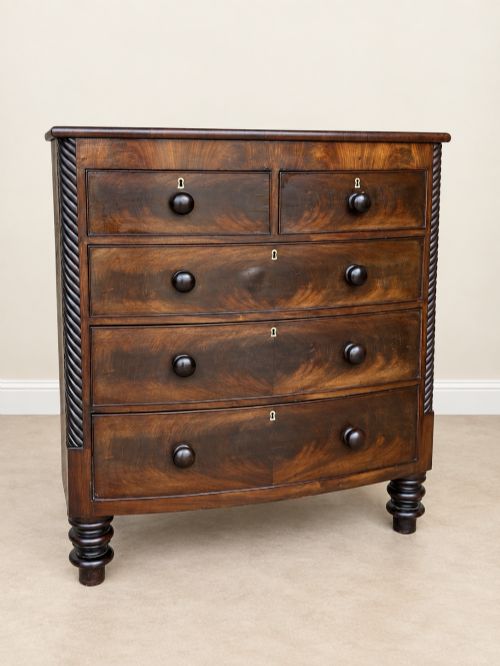
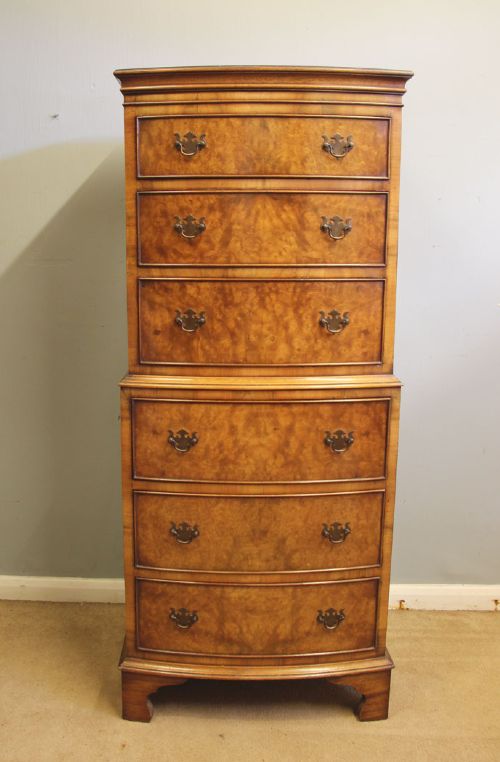
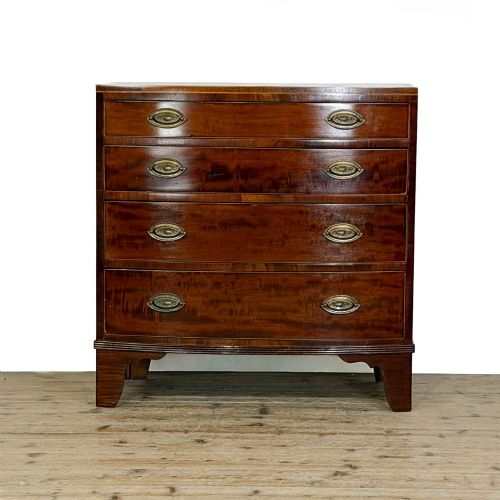
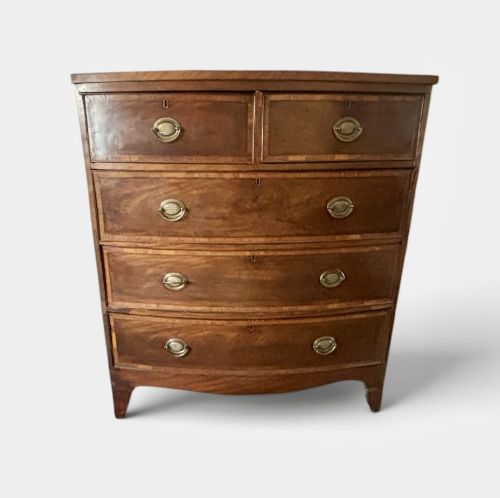
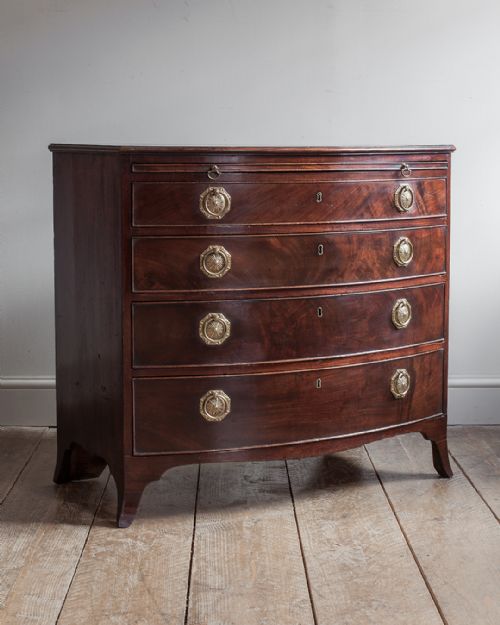
Bowfront tallboy drawers designate tall chests of drawers and chest on chest forms featuring a convex curved front profile. The selection centres on mahogany and walnut examples spanning the Georgian, Regency, and Victorian periods, alongside later twentieth century interpretations.
The pieces on this page primarily consist of mahogany chests of drawers with curved fronts, ranging from smaller proportions to towering double-body tallboys. Buyers will encounter various configurations including four or five graduated drawers and specialised caddy tops.
Judging the quality of manufacture
Quality reveals itself in the selection of wood veneers, where symmetrical grain matching on flame mahogany or burr walnut distinguishes superior cabinets from plain alternatives. The crispness of satinwood crossbanding and the retention of original brass fittings further elevate a piece.
Structural refinement shows in the smooth graduation of the drawers, the tight tolerances of the curved drawer fronts within their frames, and the integration of secondary woods like oak within the internal drawer linings.
Listings feature mahogany, burr walnut, and satinwood, spanning Georgian, Regency, and Victorian periods alongside early twentieth-century interpretations.
The Bowfront Tallboy Drawers Glossary
- Bowfront
- A convex curved cabinet front that projects outward in the centre. This shape softens the angular appearance of traditional case furniture.
- Tallboy
- A tall chest of drawers, often constructed in two stacked sections known as a chest on chest. It maximises vertical storage without demanding additional floor space.
- Crossbanding
- A strip of veneer applied to the border of a drawer front or top with the grain running perpendicular to the surrounding wood. This technique creates a distinct framing effect.
- Caddy top
- A raised tabletop design featuring moulded edges that resemble the lid of a tea caddy. It provides a finished architectural cap to smaller chests.
- Graduated drawers
- A series of drawers that systematically decrease in depth from the bottom to the top of the chest. This proportioning creates visual balance.
Bowfront Tallboy Drawers: Frequently Asked Questions
Where should I place a bowfront tallboy?
These tall chests suit bedrooms, hallways, or living spaces where vertical storage is required without occupying excessive floor space. Their curved profile softens corners and adds architectural interest to plain walls.
Ensure adequate clearance for drawer operation, particularly in narrow corridors or beside beds where the projecting curved front requires passing room.
How do I identify a Georgian bowfront?
Georgian and Regency examples typically exhibit dense, heavy mahogany timbers, hand-cut dovetails in the drawer boxes, and subtle satinwood stringing or crossbanding. Proportions tend to be elegant and understated.
Later twentieth-century reproductions or adaptations often utilise different internal secondary woods and machine-cut joinery while imitating these earlier stylistic traits.
Are tallboys practical for daily storage?
Tall chests and chest on chest configurations offer exceptional volume for folded clothing, linens, and accessories while maintaining a relatively small footprint. The upper drawers provide accessible storage for everyday items.
Because these pieces are tall, secure anchoring to a wall is advisable to prevent tipping, particularly in homes with children or pets.
What is the difference between a chest and a tallboy?
A standard chest of drawers sits at a lower height with a single tier of drawers, whereas a tallboy or chest on chest builds upward with stacked sections to reach greater heights.
Tallboys often incorporate a larger number of graduated drawers, sometimes dividing the unit into a smaller upper chest resting upon a wider base.