

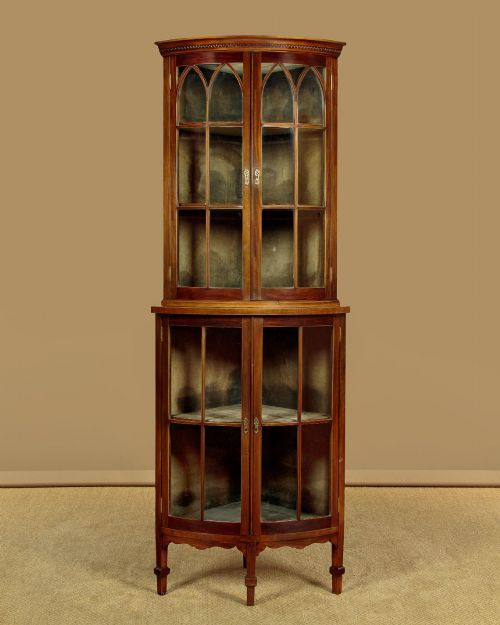


Bowed Glass Corner Cabinet
These bowed glass corner cabinet pieces turn awkward room junctions into display space, offering curved panes that soften the hard angles of period interiors.
Bowed Glass Corner Cabinet
A bowed glass corner cabinet is a specialised storage and display piece designed to fit neatly into the ninety-degree junction of a room while projecting a curved front outward. These items merge the practicality of a corner cupboard with the visual grace of glazed display doors.
The versions most commonly met on this page date from the Georgian period through to the 1930s, spanning Edwardian revivals and Victorian craftsmanship. They appear primarily as freestanding or hanging corner units made to house ceramics, glassware, or books.
Makers shaped these forms from timber frameworks fitted with curved glazing bars, often mounting the glazed door on brass hinges. Buyers find both single-piece hanging cupboards and taller two-piece floor-standing variants among the current selection.
How they were made
Cabinet makers constructed the structural frames of these pieces using mahogany, rosewood, and satinwood, frequently applying flame mahogany veneer or satinwood inlay to enrich the exterior surfaces. The curved front profile required specialist joinery to shape timber and glass into a consistent arc.
Glazing bars divided the glass panes within the bow front doors, while brass hardware served for locks and hinges. Interior surfaces sometimes featured fabric linings to provide a soft backdrop for displayed objects.
Bowed Glass Corner Cabinet Retail Price Guide 2026
Typical asking prices for bowed glass corner cabinet among the pieces listed under this phrase on Sellingantiques today, from the lower quarter to the upper quarter. They describe what is for sale here now, not the wider market.
These cabinets let you display your eccentric teapot collection in a curved glass bubble while reclaiming dead space behind the armchair.
What varies in quality
Quality in a bowed glass corner cabinet rests on the precision of the curved joinery and the selection of timber veneers. Pieces finished with finely figured flame mahogany or delicate satinwood inlay demonstrate superior craftsmanship compared to plainer counterparts.
The harmony of the proportions and the crispness of the glazing bars dictate the visual success of the piece. Finer examples integrate the curve of the glass seamlessly with the surrounding corner framework.
The Bowed Glass Corner Cabinet Glossary
- Bow front
- A convex curved front profile that projects outward from the main body of the cabinet. This shape softens the angular transition of a room corner.
- Glazing bars
- The wooden strips that hold individual panes of glass within a door or window frame. They create geometric patterns across the glazed display area.
- Satinwood inlay
- Contrasting timber details inserted into the primary wood surface for decorative effect. It appears frequently on Edwardian and Sheraton Revival pieces.
- Flame mahogany veneer
- A thin slice of mahogany timber showing a distinctive flame-like grain pattern. Cabinet makers applied this to prominent exterior surfaces to create visual movement.
Bowed Glass Corner Cabinet: Frequently Asked Questions
How do I hang a corner cabinet?
Most wall-hung variants require secure fixings into structural studs or masonry behind the plaster. The weight of the timber frame and glass demands robust internal mounting points.
Professional installation ensures the cabinet remains level and bears the load safely without pulling away from the wall angles.
What is the difference between Edwardian and Georgian cabinets?
Georgian pieces date from the eighteenth and early nineteenth centuries, utilising solid construction methods and classic timber proportions. Edwardian examples often revive these earlier styles with lighter frames and decorative inlay work.
Examining the secondary timbers and internal construction details helps distinguish the original period pieces from later revival items.
Can these cabinets stand on the floor?
Certain examples are built as freestanding or two-piece units designed to rest directly on the floor. These larger versions provide substantial storage capacity in the lower section alongside upper display space.
Checking the base configuration reveals whether a piece requires wall hanging or simply floor placement.
How should I clean the curved glass?
Curved glass requires gentle handling with standard glass cleaner applied to a soft cloth rather than sprayed directly. This prevents moisture from seeping into the surrounding wooden frame or glazing bars.
Regular wiping maintains the transparency needed to properly view items displayed inside the cabinet.