
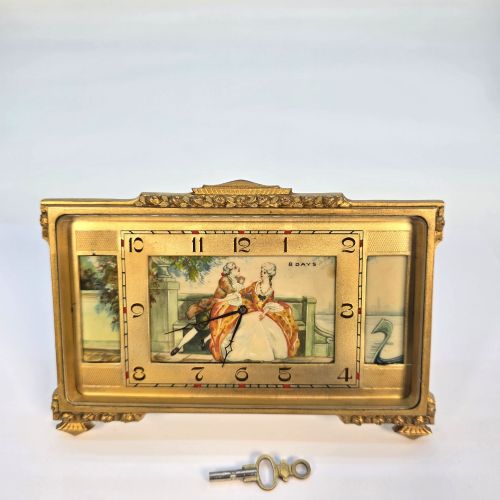


Boudoir Carriage Clock
These small timepieces bring refined timekeeping to a dressing table, offering charming portability and delicate craftsmanship for everyday use.
Boudoir Carriage Clock
A boudoir carriage clock sits neatly on a desk, mantel, or bedside table as a compact version of a standard travel clock. When searching for a boudoir carriage clock, a buyer encounters miniature timepieces spanning the nineteenth century through the Art Deco period.
The pieces appearing here include French designs alongside English examples hallmarked in Birmingham and London. Makers such as William Comyns, J Batson & Son, and Henry Matthews produced these domestic clocks during the Victorian, Edwardian, and Belle Epoque eras.
Forms range from simple leather or tortoiseshell cases to ornate Rococo Revival and Arts & Crafts metalwork. Enamel work, glass panels, and chased silver frequently appear across the selection of clocks.
Materials and construction
Silversmiths shaped sterling silver cases using techniques like chasing to create ornate surface patterns. Gilded brass and ormolu bronze provided robust frameworks for glass panels that revealed the intricate internal movements.
Enamel work, including blue guilloche and floral designs, added colourful decoration to dial faces and exterior panels. Travel and bedside versions utilised leather and tortoiseshell for durable, protective outer cases.
A tiny travel clock whispers through the night, keeping watch on the dressing table while everyone else sleeps.
Judging quality in domestic timepieces
Quality rests upon the crispness of the chased silver work and the precision applied to gilded brass casting. Superior examples display undamaged enamel panels free from hairline cracks and chips.
The presence of clear hallmarks from makers like Henry Matthews or William Comyns elevates a piece, confirming its origin and date. Well-preserved original leather or tortoiseshell outer cases also distinguish finer examples from standard items.
William Comyns·J Batson & Son·Henry Matthews
The Boudoir Carriage Clock Glossary
- Guilloche
- An ornamental engine-turned technique producing precise, intricate patterns beneath a translucent enamel layer. This method was widely used during the Edwardian period to add depth to clock faces.
- Chased
- A metalworking process where a silversmith depresses the surface with a hammer and punches to raise decorative low-relief designs. This technique gives silver cases texture and visual weight.
- Ormolu
- Gilded bronze used widely in French decorative metalwork and clock cases. It provides a rich gold-coloured finish that does not tarnish easily.
- Hallmark
- An official stamp applied to precious metals indicating standard of purity and origin. Birmingham and London marks frequently appear on English pieces from this group.
- Timepiece
- A clock that indicates the time without striking hours or quarters. Most examples in this category function as simple timepieces rather than striking clocks.
Boudoir Carriage Clock: Frequently Asked Questions
How do I wind a boudoir carriage clock?
Most miniature timepieces utilise a key inserted into the backplate to tension the mainspring.
Care should be taken not to overwind the movement, stopping as soon as resistance is felt.
Where were these clocks used?
Owners placed these compact timepieces in bedrooms, dressing rooms, and private sitting areas.
Their portable nature also allowed travellers to pack them securely in leather cases for journeys.
How do I tell Edwardian from Victorian pieces?
Victorian examples often favour heavier chased silver and Rococo Revival curves.
Edwardian and later pieces frequently embrace cleaner lines, lighter floral enamel, or Art Deco geometric forms.
Are these clocks French or English?
The selection includes both origins, with French pieces frequently featuring ormolu, bronze, and delicate enamel work.
English pieces are typically distinguished by silver cases bearing London or Birmingham assay office hallmarks.