

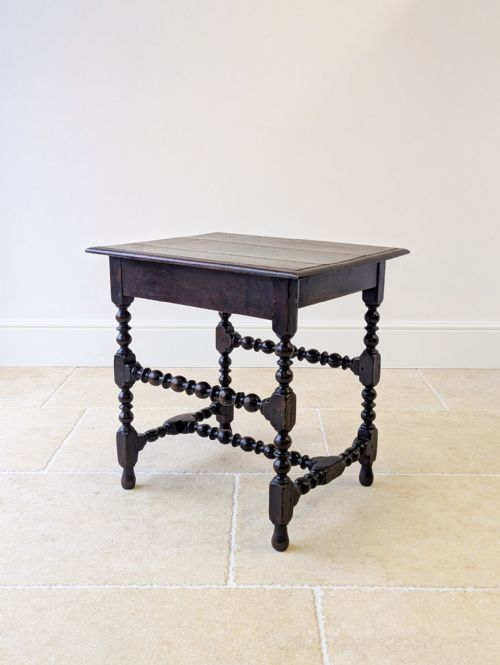
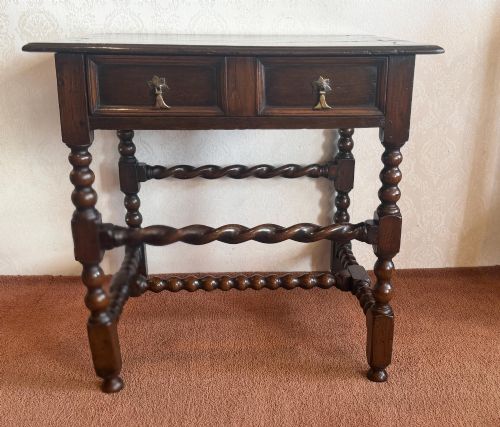


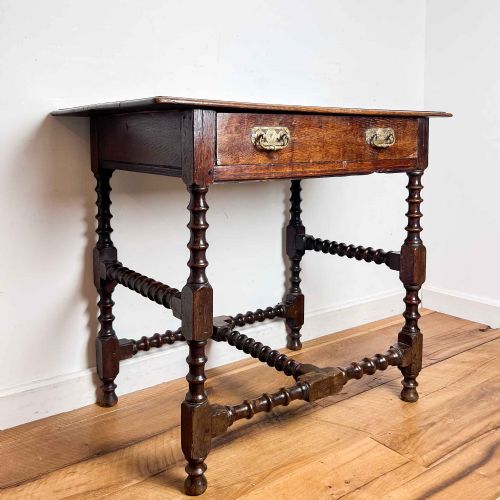
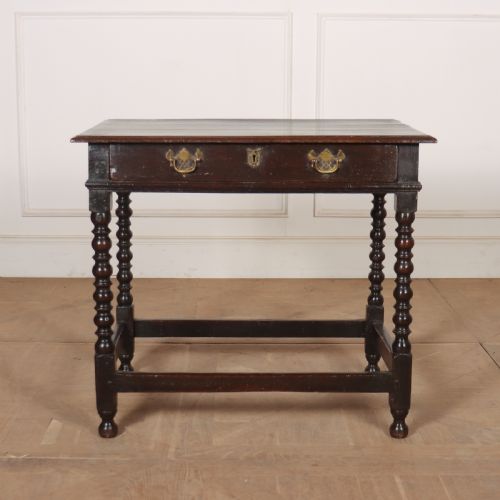
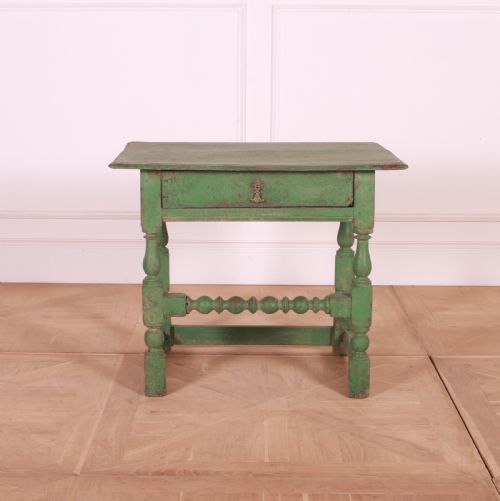


Bobbin Turned Stretcher Table
These bobbin turned stretcher table pieces unite seventeenth century turning with practical side and occasional forms that suit modern rooms.
Bobbin Turned Stretcher Table
A bobbin turned stretcher table brings distinctive spool-shaped legs and low bracing stretchers into side and occasional tables. These pieces serve as compact surfaces for lamps or books while displaying centuries of turning traditions.
Side and centre tables provide the main forms within this group, often incorporating single drawers or simple rectangular tops. English country and French provincial styles sit alongside Jacobean revival interpretations.
Materials and construction
Makers shaped dense native hardwoods such as oak, yew, elm, and cherry into rigid frames using traditional joinery. These timbers provide the structural strength needed to support slender turned components without warping.
The characteristic bobbin or spool turnings were produced on a lathe to create repeating rounded segments along the legs and lower stretchers. Pegged mortise and tenon joints secure the framework while allowing natural timber movement over time.
Listings span oak, yew wood, cherry, elm, pine, and rosewood across centuries from the seventeen hundreds onward.
Distinguishing quality
Quality rests in the crispness of the lathe work and the selection of timber figure, particularly in oak, yew, and rosewood tops. Sharply defined spool profiles indicate careful hand turning rather than hurried production.
Proportion and structural integrity define the better examples, where stretchers sit harmoniously to brace the turned legs. Original timber surfaces and honest patination carry greater weight than heavy restoration or re-polishing.
The Bobbin Turned Stretcher Table Glossary
- Bobbin turning
- A form of woodturning where a lathe cuts a series of rounded, spool-like shapes along the length of a leg or stretcher. This decorative technique creates strong visual rhythm in seventeenth century furniture.
- Stretcher
- A horizontal wooden brace connecting the legs of a table to provide structural rigidity. On these pieces, stretchers frequently feature the same spool turning as the legs.
- Side table
- A small functional table designed to stand against a wall or beside seating. These often include a single drawer beneath the top surface.
- Jacobean Revival
- A nineteenth century design movement that reinterprets seventeenth century English furniture styles. Pieces from this period borrow heavy turnings and dark oak timbers from the earlier era.
- Provincial
- Furniture made in regional workshops rather than metropolitan centres. These pieces utilise local timbers such as fruitwood, elm, or cherry.
Bobbin Turned Stretcher Table: Frequently Asked Questions
Where should I place a bobbin turned stretcher table?
These compact side and occasional tables fit easily beside armchairs, along hallways, or as lamp tables in living spaces. Their turned stretchers provide visual interest from lower angles, making them effective in open rooms.
Because they generally feature shallow depths, they occupy minimal floor space while offering a functional surface for everyday items.
How do I identify seventeenth century examples?
Early pieces typically show construction in solid oak with hand-pegged joints and deep patination accumulated over centuries. The turning profile tends to be irregular compared to later machine-made revivals.
Examination of the underside and drawer linings often reveals hand-tool marks and timber shrinkage consistent with age.
How do I care for antique hardwood tables?
Maintain the timber by keeping tables away from direct heat sources and sudden humidity changes to prevent splitting. Occasional application of a suitable wax helps nourish the surface without building up excessive residue.
Avoid using modern liquid polishes that can soften historic finishes and dull the natural grain.