
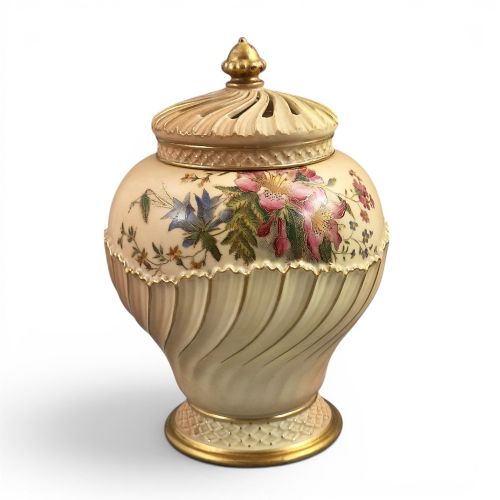


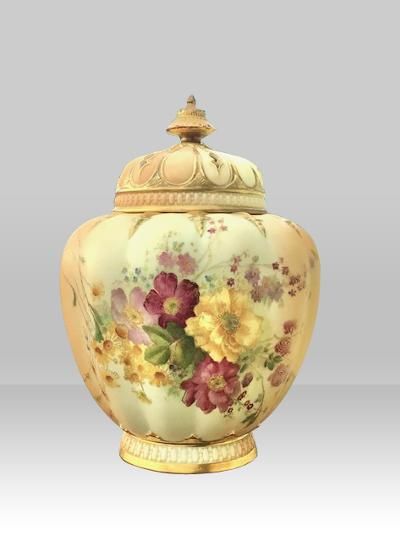


Blush Ivory Jar
These blush ivory jar pieces bring soft porcelain warmth and delicate gilding into a room.
Blush Ivory Jar
A blush ivory jar is a ceramic vessel defined by its soft, cream-toned porcelain ground and subtle painting, usually found in Edwardian forms like lidded pot-pourri jars, urns, and covered vases. These pieces date principally from the early twentieth century, spanning the years from eighteen ninety-eight through the nineteen twenties.
The objects listed on this page encompass lidded jars, pot-pourri vases with crown covers, and decorative urns. The aesthetic draws upon Victorian and Edwardian tastes, often featuring delicate floral motifs hand-painted directly onto the pale ceramic body.
How they were made
Makers shaped these pieces from fine ceramic porcelain, applying a pale, matte ivory glaze as the foundation for all subsequent decoration. Artisans then hand-painted floral subjects onto the surface before firing the ceramic to set the colours.
Gilding and gold leaf were applied by hand to accent rims, handles, and crown covers. Enamels were worked into the painted floral designs to add texture and depth to the foliage and petals.
Some pot-pourri jars feature crown covers shaped like tiny architectural domes.
What varies in quality
Quality in a blush ivory jar rests upon the crispness of the porcelain modelling and the skill of the hand-painted decoration. Pieces featuring named artists show superior brushwork in the floral details compared to standard factory output.
The presence of original matching crown covers and crisp gilding elevates the standing of a piece. Finer examples balance the soft ivory ground with precise enamel work and well-preserved gold leaf highlights.
Royal Worcester·Jas Stinton·Raby
The Blush Ivory Jar Glossary
- Blush ivory
- A matte, cream-coloured ceramic ground developed in the late Victorian era. It serves as a pale backdrop for hand-painted floral decoration.
- Pot-pourri jar
- A lidded ceramic vessel pierced on the cover to allow scented dried petals to fragrance a room. These often feature an inner lid beneath the decorative crown cover.
- Crown cover
- A pierced, dome-shaped lid associated with pot-pourri jars and urns. It mirrors the decorative style of the main body.
- Enamel
- A glassy substance fused to porcelain through firing. It provides raised, durable colour within the painted design.
- Gilding
- The application of gold leaf or gold paint to ceramic edges and handles. It provides a metallic contrast to the matte ivory body.
Blush Ivory Jar: Frequently Asked Questions
What is a blush ivory jar?
A blush ivory jar is a porcelain vessel with a soft cream-coloured matte glaze, typically decorated with hand-painted flowers and gilt highlights.
These pieces were produced in various forms, including lidded pot-pourri jars and urns during the Edwardian period.
How were pot-pourri jars used?
Pot-pourri jars were designed to hold dried scented plant material inside domestic interiors. The pierced covers allowed fragrance to disperse gently into the room.
Many examples feature an inner lid beneath a decorative crown cover to seal the vessel when needed.
How do I date these jars?
Dating relies on factory marks stamped to the underside of the porcelain, alongside stylistic indicators from the Victorian and Edwardian eras. Most pieces on record date from the early nineteen hundreds.
Design shapes and artist signatures also help place a piece within a specific decade.
How do I clean my jar?
Dust the porcelain gently with a dry, soft cloth to protect the delicate hand-painted enamel and gilding. Avoid using water or chemical cleaners on the matte surface.
Keep the piece away from direct sunlight to preserve the integrity of the painted colours.