


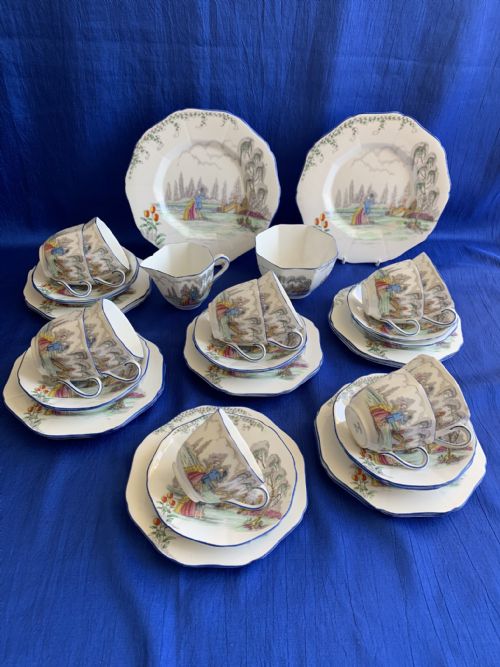
Blue White Pastoral Plate
These blue white pastoral plate selections bring rural English scenes to your table through transfer-printed earthenware and tin glaze.
Blue White Pastoral Plate
A blue white pastoral plate captures rural English life through printed or painted country scenes upon ceramic surfaces. These items range from Georgian transfer pottery to 18th century tin glazed examples.
The most common pieces found in this category date from the 19th century and Georgian periods, showcasing scenic patterns like The Cowman and Returning Woodman. Plates form the bulk of the selection alongside serving platters and tea sets.
Makers often drew inspiration from rural architecture, livestock, and agricultural workers to decorate the centre of each vessel. Collectors encounter variations spanning earthenware, pearlware, and bone china across these eras.
Materials and manufacture
Potters shaped these vessels using earthenware, pearlware, and bone china before applying cobalt pigment to create the blue decoration. Tin glaze provided an opaque white background on earlier pieces.
Transfer printing allowed workshops to apply detailed pastoral designs onto ceramic plates with remarkable consistency during the Georgian and 19th century periods. Artisans then fired the glazed ceramics in kilns to fix the pigment permanently.
Listings feature earthenware, pearlware, and bone china across the 18th century, Georgian, 19th century, and 1930 periods.
Assessing quality
The clarity of the transfer print and the depth of the cobalt pigment dictate the visual strength of each design. Finer examples display crisp pastoral details without blurring across the ceramic surface.
Early 18th century tin glazed wares exhibit distinct glaze pooling and hand-painted charm compared to later mass-produced transfer printed plates. The weight of the earthenware and the smoothness of the glaze also separate standard domestic items from superior output.
Pettys Co Leeds·Brameld Co·John Davenport
The Blue White Pastoral Plate Glossary
- Transfer printing
- A decoration technique where an engraved copper plate transfers a design onto tissue paper, which is then stamped onto the ceramic body before glazing. This method allowed intricate pastoral scenes to be reproduced efficiently.
- Pearlware
- A refined earthenware developed in the late 18th century featuring a thin glaze with a slight bluish tinge. It was designed to appear whiter than standard creamware.
- Tin glaze
- An opaque white glaze containing tin oxide used on early ceramic vessels to hide darker clay bodies. It creates a smooth surface suitable for painted blue decoration.
- Cobalt pigment
- A metallic oxide used by potters to achieve deep blue colouring under the glaze. It withstands high kiln temperatures without losing intensity.
- Earthenware
- Porous pottery fired at lower temperatures than stoneware or porcelain. It forms the structural base for the majority of these plates.
Blue White Pastoral Plate: Frequently Asked Questions
What periods do these plates come from?
The pieces span from the 18th century through the Georgian and 19th century eras up to the 1930s.
Most examples originate from the Georgian and 19th century periods when transfer printing flourished in English potteries.
How were the pastoral scenes created?
Potters used copper plate transfer printing to apply detailed rural imagery onto the ceramic surface.
Cobalt pigment provided the blue colour before a transparent glaze was applied and fired in a kiln.
Can I use these plates for dining?
These historical ceramics are primarily collected for display due to their age and delicate glaze surfaces.
Gentle hand washing is recommended if handled to preserve the transfer printed designs.