


Blue White China Tray
A blue white china tray brings centuries of crisp cobalt painting and practical service straight to the table.
Blue White China Tray
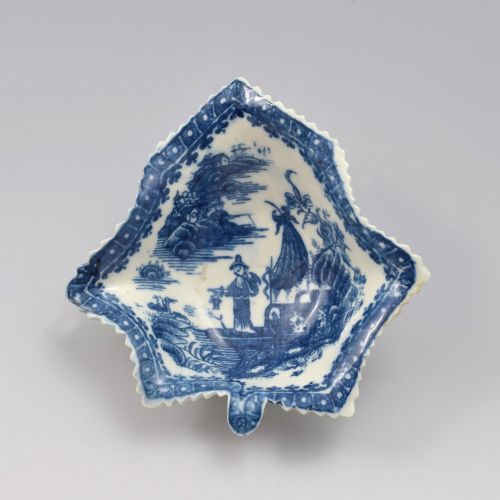
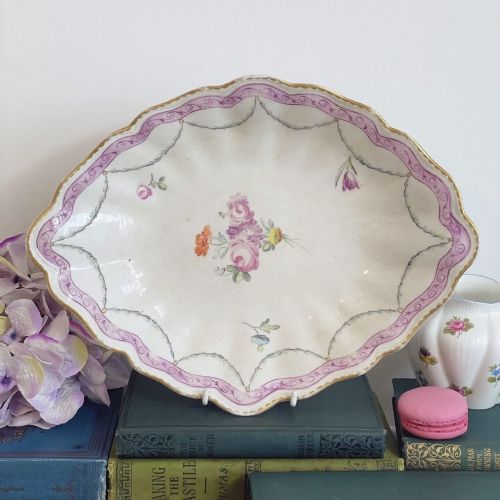
A blue white china tray encompasses practical serving dishes, platters, and leaf-shaped pickle trays executed in ceramic, porcelain, earthenware, and ironstone. These pieces span the eighteenth century, Georgian era, and Victorian periods, often decorated with Chinoiserie scenes or botanical motifs.
Most items you encounter take the form of large meat platters, dessert dishes, or specialised stands rather than small vanity trays. English factories like Caughley, Derby, Minton, and Mason's dominate the offerings alongside Chinese Export pieces.
Forms range from simple pierced pottery serving dishes to elaborate chestnut baskets with matching trays and pearlware platters with reservoirs. They bridge the gap between ornamental display and functional dining ware.
Materials and production methods
Potters utilised earthenware, soft-paste porcelain, and ironstone as bodies for these vessels, applying cobalt blue pigments beneath a clear glaze before firing. Ironstone offered a heavier, more durable alternative for large meat platters subjected to heavy carving use.
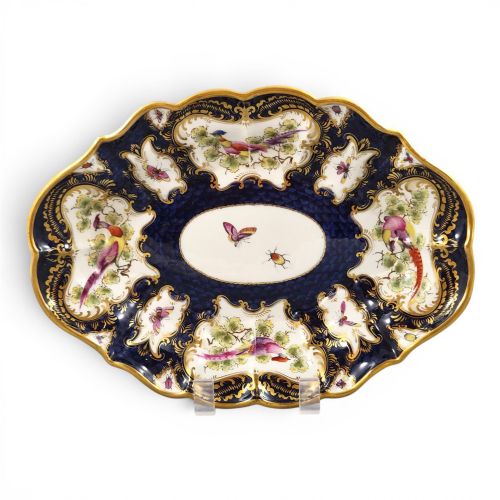
Decoration relied heavily on handpainting or transfer printing to apply intricate patterns such as the Fisherman, Net, or Indian Grasshopper designs. Certain pieces incorporate delicate touches of gold leaf alongside the characteristic blue and white palette.
Listings feature items spanning the eighteenth century through the Edwardian period, utilising earthenware, porcelain, ironstone, and soft-paste porcelain.
Evaluating craftsmanship and condition
Quality rests upon the crispness of the cobalt transfer or the skill of the handpainting, alongside the refinement of the ceramic body. Fine porcelain and soft-paste pieces display greater translucency and precision than heavier commercial earthenware.
The integrity of the glaze, the sharpness of moulded details like pierced rims or leaf veins, and the balance of the form dictate the standing of an individual piece.
Caughley Porcelain·Royal Worcester·Minton·Liverpool Pennington
The Blue White China Tray Glossary
- Ironstone
- A dense, durable type of earthenware patented in the nineteenth century. It resists chipping and provided a robust surface for large serving platters.
- Soft-paste porcelain
- An artificial porcelain mixture fired at lower temperatures than hard-paste. It possesses a warm tone and a slightly softer glaze texture.
- Pearlware
- A refined earthenware developed in the late eighteenth century featuring a bluish-white glaze that pooled in recesses. It served as a popular canvas for blue and white transfer printing.
- Chinoiserie
- A European stylistic interpretation of Chinese artistic motifs. It frequently appears on these trays depicting imaginary landscapes, pavilions, and figures.
- Transfer printing
- A mechanical method of applying complex designs to pottery using engraved copper plates and tissue paper. This technique enabled factories to produce uniform patterns efficiently.
Blue White China Tray: Frequently Asked Questions
How do I date an antique tray?
Dating relies on identifying backstamps, factory marks, ceramic bodies, and stylistic clues within the blue and white transfer print. Eighteenth-century pieces often show softer paste and handpainted details, while Victorian ironstone items are heavier and frequently stamped.
Examining the glaze characteristics and wear patterns on the base provides further confirmation of the period.
Can I use these platters for food?
Most antique ceramic and ironstone platters remain suitable for serving dry foods or chilled items. However, older lead-glazed earthenware requires gentle handling and should avoid acidic foods.
Handwashing is essential to preserve the historic glaze and any delicate gold leaf accents.
What is the difference between ironstone and porcelain?
Ironstone is a heavy, opaque, highly durable ceramic developed to withstand rigorous everyday dining use. Porcelain is finer, thinner, and often translucent when held to the light.
Porcelain trays tend to be decorative dessert or pickle dishes, whereas ironstone typically forms large meat platters.
How should I display a heavy platter?
Large meat platters require sturdy wall hangers specifically rated for heavy ceramics or secure tabletop plate stands with a wide base. Ensuring the weight distributes evenly prevents accidental slips.
Keep pieces away from high-traffic edges where they might be knocked.