


Blue Turquoise Gold Ring
A blue turquoise gold ring brings together bright robin-egg stones and warm metal, offering a distinct nineteenth or early twentieth-century character for daily wear.
Blue Turquoise Gold Ring
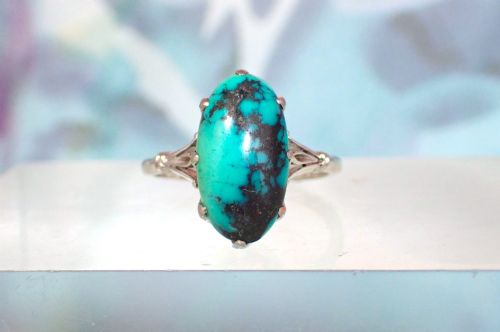
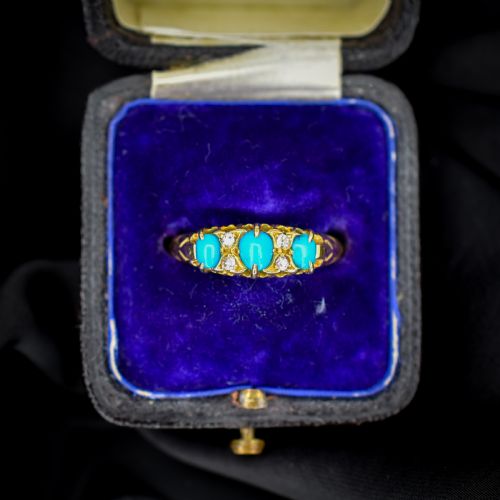
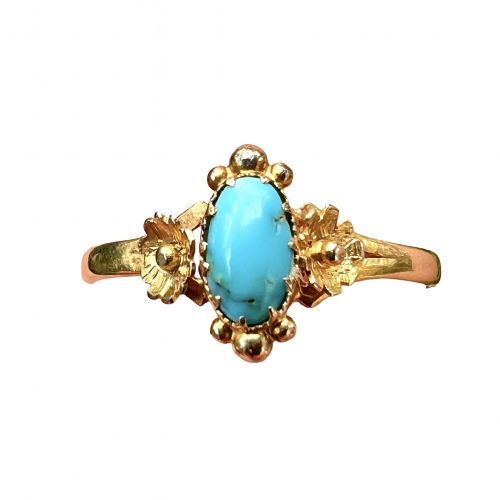
A blue turquoise gold ring centres on smooth cabochon turquoise set within yellow gold, white gold, or nine-carat gold mounts. These pieces span the Victorian, Edwardian, and Art Deco periods, ranging from simple bands to elaborate cluster designs.
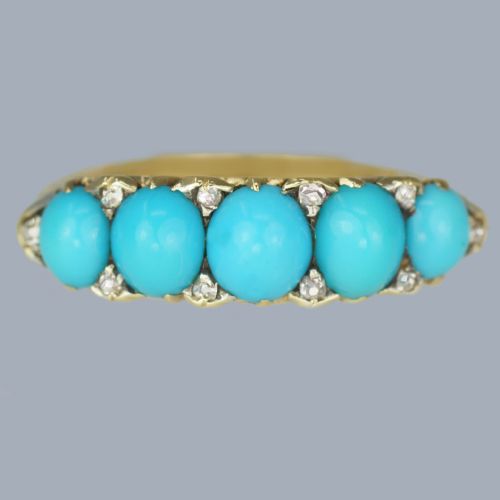
Makers frequently combined turquoise with diamonds, enamel, or blue zircon to create varied visual textures. Common forms include five-stone settings, floral motifs, star bursts, and scroll boat configurations dating from the late nineteenth century into the nineteen-twenties.
Victorian examples dominate the selection, often featuring rich yellow gold and hand-painted miniature work or intricate scrollwork. Later Art Deco pieces introduce white gold settings and geometric layouts that reflect changing tastes in jewellery design.
Materials and construction methods
Goldsmiths utilised eighteen-carat yellow gold, fifteen-carat gold, and nine-carat yellow or white gold to mount the stones securely. Metalwork often incorporates detailed chasing, claw settings, or bezel collars that hug the contours of each cabochon.
Turquoise stones are shaped into smooth cabochons or flat tablets, sometimes paired with rose-cut diamonds or blue zircons. Enamel work and miniature painting appear in select Victorian pieces to add intricate detail alongside the main gems.
Distinctions in standard and execution
Superior examples display an even, robin-egg blue colour across the turquoise without dark matrix webbing that distracts from the uniformity. The matching of stone sizes in multi-stone rings indicates careful selection by the original jeweller.
Mount construction reveals the underlying standard of the piece, with crisp casting, secure stone settings, and substantial gold weight defining finer specimens. Lower grades show uneven stone heights or simplified metalwork with minimal attention to detail.
The Blue Turquoise Gold Ring Glossary
- Cabochon
- A gemstone shaped with a smooth, rounded, convex upper surface and a flat base. This traditional cut is standard for turquoise as it highlights the natural colour and texture without faceting.
- Five stone ring
- A ring featuring a linear arrangement of five gems of similar size across the finger. This configuration was immensely popular during the Victorian and Edwardian eras.
- Cluster ring
- A design where a central stone is surrounded by a tight ring of smaller accent stones. In these pieces, turquoise centres are frequently bordered by diamonds or smaller gems.
- Rose cut
- A historic diamond cut featuring a flat base and a domed crown composed of triangular facets that meet in a point. It provides a soft, glowing reflection rather than intense brilliance.
- Scroll boat
- An elongated boat-shaped setting featuring curved, scroll-like metalwork along the shoulders. This style frames the central stones with architectural elegance.
Blue Turquoise Gold Ring: Frequently Asked Questions
What periods do these rings come from?
The pieces span the Victorian, Edwardian, and Art Deco eras, generally dating from the mid-nineteenth century through the nineteen-twenties. Victorian examples are the most common.
Each period brings distinct stylistic traits, from warm yellow gold floral clusters to geometric white gold Art Deco arrangements.
Are diamonds often found with turquoise?
Diamonds frequently accompany turquoise in cluster, star, and five-stone configurations. They provide a sparkling contrast to the opaque, robin-egg blue stones.
These diamond accents are typically cut in the rose-cut style common to the nineteenth century.
What gold purities are used?
Jewellers utilised various gold purities including eighteen-carat, fifteen-carat, and nine-carat variations in both yellow and white hues. The choice of metal often reflects the period of manufacture.
Earlier Victorian pieces favour higher-carat yellow gold, while later nineteen-twenties designs frequently employ white gold.