
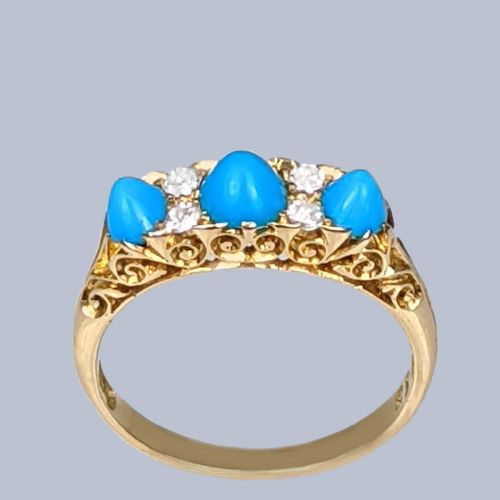
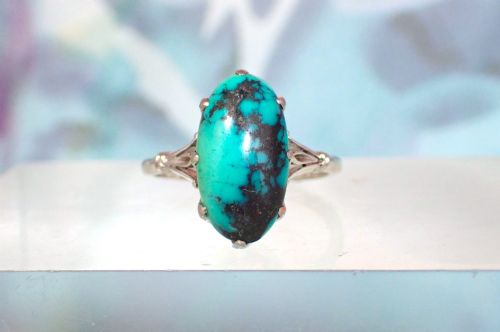
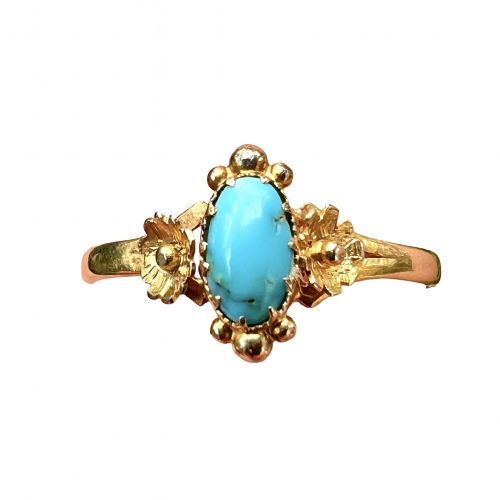


Cabochon Turquoise Gold Ring
A cabochon turquoise gold ring brings together smooth, polished blue stones and warm precious metal in designs spanning the Victorian era to the mid-century.
Cabochon Turquoise Gold Ring
The selections span several distinct periods including Victorian, Edwardian, Art Deco, and mid-century. Many examples incorporate supporting gems such as diamonds, seed pearls, or enamel alongside the central turquoise.
Common configurations include cluster rings, five-stone arrangements, trilogy settings, and full eternity bands. Specific regional styles like Victorian Arts and Crafts flower rings also appear across the selection.
How they were made
Goldsmiths shaped the mountings using various purities of gold, predominantly 9ct, 14ct, 15ct, and 18ct yellow, white, and rose gold. These precious metals provided the durable foundation needed to securely hold the stones.
Turquoise stones were cut and polished into smooth cabochons rather than faceted like diamonds. Artisans frequently combined these blue gems with old-cut diamonds, rose-cut diamonds, and seed pearls using traditional claw or bezel settings.
The inventory spans Victorian, Edwardian, Art Deco, and mid-century periods.
What varies in quality
The grade of the turquoise itself influences the character of the piece, with variations in natural matrix patterns, colour saturation, and surface polish. Even stones shaped into identical cabochons display distinct tonal depths.
The weight and purity of the gold setting, alongside the presence and quality of secondary gemstones like old-cut diamonds, dictate the overall craftsmanship level. Heavier bands and intricate detailing such as star motifs or buckle designs indicate higher production standards.
The Cabochon Turquoise Gold Ring Glossary
- Cabochon
- A gemstone shaped with a smooth, rounded, convex surface instead of being faceted. This cut suits opaque stones like turquoise by highlighting their natural colour and pattern.
- Trilogy ring
- A ring set with three stones, often representing the past, present, and future. In these pieces, turquoise frequently partners with diamonds in a three-stone layout.
- Cluster ring
- A ring design featuring a central stone surrounded by a border of smaller gems. Turquoise cluster rings typically place the blue cabochon at the focal point encircled by diamonds or pearls.
- Eternity ring
- A band set continuously with gemstones encircling the finger. Edwardian examples utilise multiple turquoise stones set alongside gold.
- Old-cut diamond
- A diamond cut by hand before modern machine-cutting standards, characterised by a smaller table and a high crown. These stones frequently accompany Victorian and Edwardian turquoise rings.
Cabochon Turquoise Gold Ring: Frequently Asked Questions
How do I clean a turquoise ring safely?
Turquoise is a softer, porous gemstone that absorbs liquids, meaning it requires gentle care compared to harder stones like diamonds. Wipe the cabochon clean with a damp, soft cloth and avoid chemical jewellery cleaners or ultrasonic baths.
Keep the gold band polished while protecting the stone from prolonged exposure to water, oils, and cosmetics to preserve its colour.
Are these rings suitable for daily wear?
While many antique rings were built to last, turquoise sits lower on the Mohs hardness scale than diamonds and corundum. Careful handling helps prevent scratches and preserves the smooth finish of the cabochon.
Consider removing the ring during rigorous physical activities, housework, or gardening to protect both the turquoise stone and the gold setting.
How can I tell a Victorian ring from a mid-century one?
Victorian pieces often feature romantic motifs like flowers, stars, buckles, and heavy yellow or rose gold settings, sometimes paired with seed pearls and old-cut diamonds. Mid-century examples tend to embrace cleaner modernist lines or substantial single turquoise stones in heavier yellow gold mounts.
Examining the overall design language and the cut of any accompanying diamonds helps clarify the period of manufacture.