


Victorian Turquoise Cabochon Ring
A victorian turquoise cabochon ring brings together vibrant robin-egg blue stones and warm gold settings that catch the eye instantly.
Victorian Turquoise Cabochon Ring
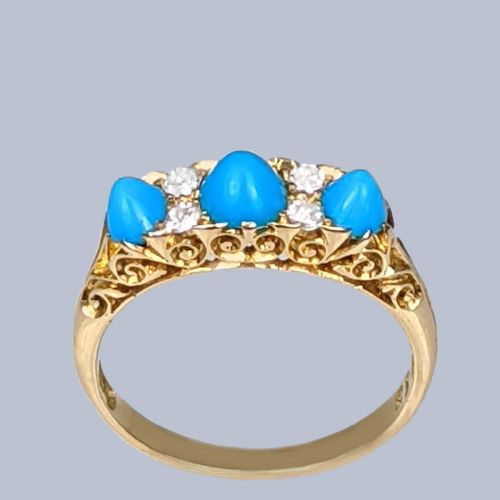
A victorian turquoise cabochon ring is primarily a ring featuring domed, smooth-cut turquoise stones set in gold. These pieces appear in forms ranging from simple five-stone bands to intricate cluster and star designs.
The pieces on this page are predominantly Victorian, accompanied by Edwardian examples and dates spanning from around eighteen-eighty to nineteen-twenty. Buyers frequently encounter gold settings paired with seed pearls, rose-cut diamonds, and old-cut diamonds.
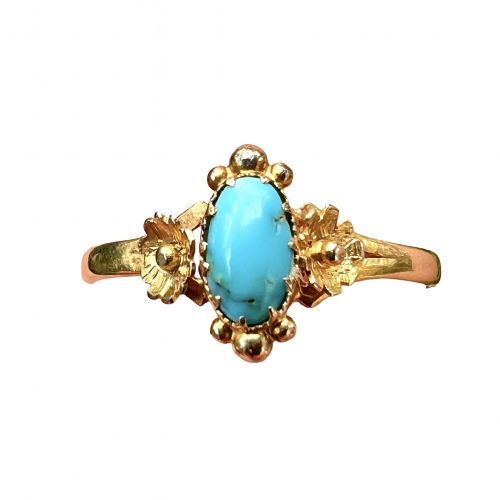
Styles range from classic Victorian configurations to Victorian Arts and Crafts floral motifs and symbolic evil eye or buckle designs. The primary focus remains the striking combination of polished turquoise and yellow, rose, or eighteen-carat gold.
Materials and construction
The structural foundation of these pieces relies on gold, specifically nine-carat, fifteen-carat, and eighteen-carat yellow and rose gold alloys. Goldsmiths shaped these metals into robust bands and delicate settings designed to cradle domed stones securely.
Victorian jewellers occasionally tucked tiny seed pearls into turquoise clusters simply to make flowers look as though they were dusted with morning dew.
Judging quality
Quality in these rings is determined by the natural colour consistency and matrix of the turquoise cabochons, alongside the weight and purity of the gold. Stones with uniform vivid blue tones and minimal surface interruption sit at the upper end of the scale.
The delicacy of the metalwork, whether in an Arts and Crafts flower motif or a star cluster, dictates the overall fineness of the piece. Superior examples show careful stone matching and secure, clean integration of secondary gems like diamonds and seed pearls.
The Victorian Turquoise Cabochon Ring Glossary
- Cabochon
- A gemstone shaped and polished with a smooth, convex domed surface rather than faceted. This cut was standard for turquoise to highlight its natural colour and opacity.
- Trilogy ring
- A ring set with three principal stones, often representing a past, present, and future or simply balancing a central gem with two side stones.
- Rose-cut diamond
- An antique diamond cut featuring a flat base and a domed crown consisting of triangular facets. It produces a soft, starry shimmer rather than modern brilliant sparkle.
- Seed pearl
- A very small, naturally small pearl used extensively in Victorian jewellery for delicate borders and floral accents. These tiny pearls add subtle texture around central turquoise stones.
- Old-cut diamond
- A hand-faceted diamond typical of the nineteenth century with a smaller table and a higher crown. These stones were cut individually by eye, giving each one a unique character.
Victorian Turquoise Cabochon Ring: Frequently Asked Questions
How do I care for a turquoise ring?
Turquoise is a relatively soft and porous gemstone that absorbs oils, cosmetics, and water easily. Avoid wearing your ring while washing hands, swimming, or applying lotions to protect the stone's colour.
Clean the metal gently with a soft cloth and avoid chemical jewellery dips entirely. Storing the ring away from hard gems prevents scratching.
Are these rings suitable for daily wear?
Many people wear antique rings daily, but turquoise requires more care than harder stones like diamonds or sapphires. Lower carat golds offer durability for the band, yet the softer cabochons demand mindfulness.
Consider removing the ring during heavy manual tasks or gardening. Gentle daily use is entirely appropriate if you protect the stones from sharp impacts.
How can I tell a Victorian ring from an Edwardian one?
Victorian pieces often display heavier gold weights, warmer yellow or rose gold tones, and robust cluster or star arrangements. The era favoured rich colours and symbolic motifs like buckles and flowers.
Edwardian jewellery frequently shifts towards lighter, airier designs and platinum accents, though nine-carat gold and symbolic themes continued into the twentieth century. Examining the specific alloy marks and construction style helps clarify the date.
What does a star setting mean on these rings?
Star settings involve hand-engraving radiating lines around a flush-set diamond or stone to create the illusion of a sparkling star. This technique was exceptionally popular during the late Victorian period.
It protected smaller stones securely within a thick gold background while adding visual brilliance. The combination of blue turquoise and star-set diamonds was a favourite romantic trope of the era.