


Victorian Turquoise Stone Ring
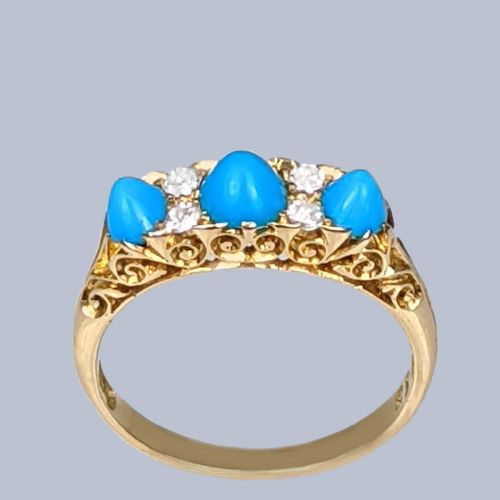
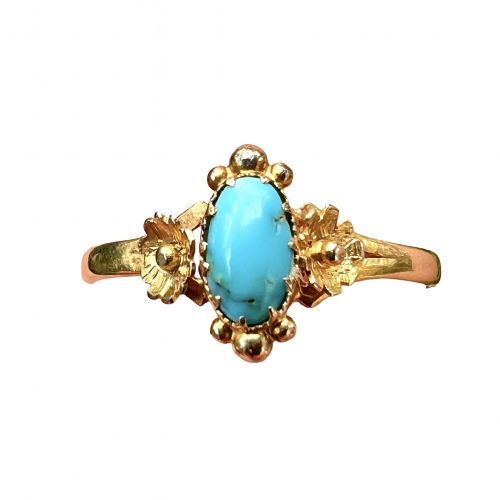
A victorian turquoise stone ring brings together bright robin-egg blue stones and warm gold in forms that span scroll boat outlines to star motifs.
Victorian Turquoise Stone Ring
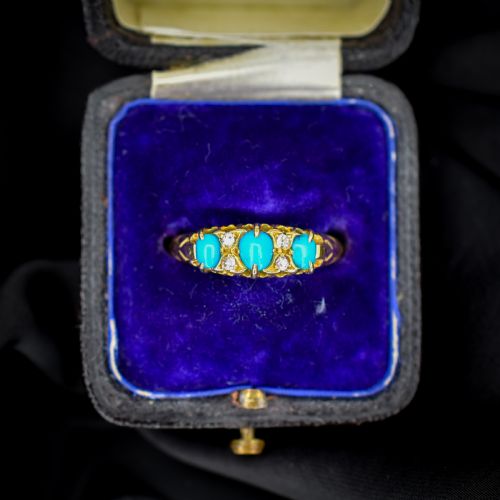
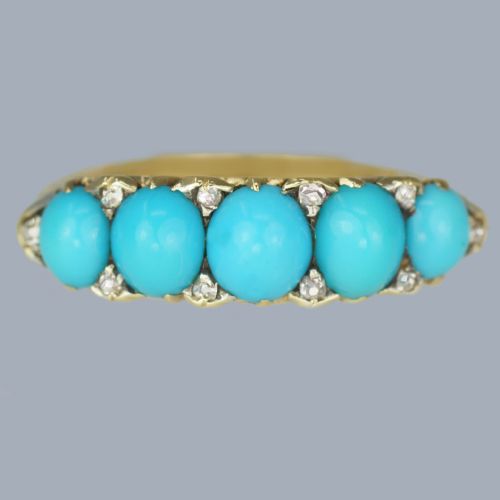
A victorian turquoise stone ring draws the eye with distinctive blue gems set into rich gold bands, often paired with small diamonds in clusters, trilogies, and five-stone arrangements. These pieces emerge predominantly from the Victorian era, alongside examples from 1890, 1900, the Edwardian period, and up to 1920.
Such rings served as sentiments of affection and remembrance, making them enduring tokens worn daily by past owners. Today, buyers seek them for their distinct historical character and the bright contrast of blue stone against yellow metal.
Materials and construction
Goldsmiths worked primarily with 18ct gold and 15ct yellow gold to form the shanks and settings for these gems. These higher-carat metals provided the necessary ductility and a deep, rich hue to frame the stones.
Turquoise stones take centre stage, frequently accompanied by old-cut diamonds and rose-cut diamonds set closely alongside the blue gems. Metalwork techniques included scroll shaping, gypsy settings, and cluster arrangements to secure each stone firmly within the gold.
Listings feature periods from the Victorian era through Edwardian times up to 1920, predominantly fashioned in 18ct and 15ct yellow gold.
Gradations of quality
Quality rests upon the preservation of the turquoise stones, noting whether the original polish remains intact and how evenly the blue colour is sustained across each gem. Variations also depend on the crispness of the gold mount, from simple bands to detailed flower and scroll work.
The integration of supporting diamonds, whether old-cut or rose-cut, elevates a piece when the stones are well-matched and securely held within the metalwork. Substantial gold weight in the shank and refined claw or flush settings separate the finest examples from standard production.
The Victorian Turquoise Stone Ring Glossary
- Trilogy ring
- A ring featuring three primary stones set in a row across the finger. This arrangement often pairs turquoise with diamonds.
- Scroll boat
- A boat-shaped setting featuring curved, scroll-like metalwork along the edges. It elongates the finger when worn.
- Gypsy setting
- A style where stones are flush-set directly into a thick, tapered gold band. This technique creates a smooth, continuous surface.
- Rose-cut diamond
- A vintage diamond cut featuring a flat base and a faceted dome that resembles an opening rosebud. It yields a soft, subtle glint rather than sharp brilliance.
- Old-cut diamond
- A hand-faceted diamond shape typical of the nineteenth century, characterised by a smaller table and a deep pavilion. These stones catch candlelight warmly.
Victorian Turquoise Stone Ring: Frequently Asked Questions
Are these rings durable enough for daily wear?
These rings survived more than a century because makers used substantial 18ct and 15ct gold mounts to protect the stones.
Turquoise is softer than diamond, so modern wearers typically remove these rings during heavy manual tasks to preserve the polish on the blue stones.
How do I identify a Victorian piece?
Victorian pieces often display specific hallmarks, distinct gold carats like 15ct, and hand-cut stones such as old-cuts or rose-cuts.
Design motifs like starbursts, scroll boat settings, and rich yellow gold hues further point to nineteenth-century production.
What does a five-stone arrangement look like?
A five-stone ring places five gems in a straight graduating line across the top of the finger. Turquoise and diamonds frequently alternate in these antique settings.
This symmetrical layout was widely favoured for engagement and sentiment rings during the late nineteenth century.
How should I clean my antique ring?
Gentle maintenance involves using a soft dry cloth to remove everyday oils from the gold and the stones.
Submerging turquoise in water or ultrasonic cleaners can damage the porous structure and historical settings, so professional advice is recommended for deep cleaning.