


Blue Patterned Accent Chair
These blue patterned accent chair examples bring period character and pattern into a room through nineteenth-century and early twentieth-century designs.
Blue Patterned Accent Chair
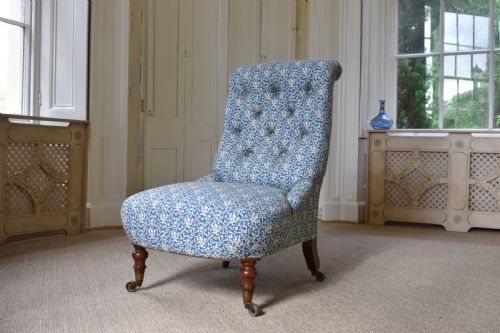
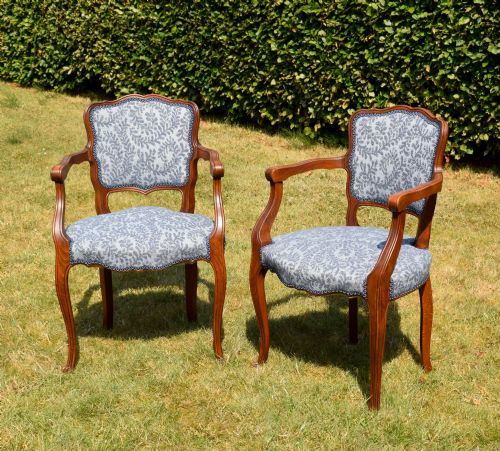
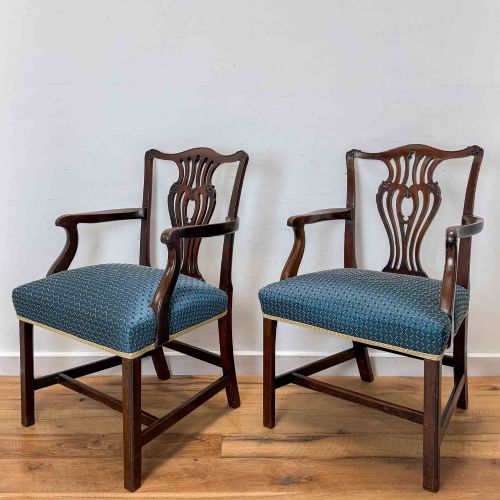
A blue patterned accent chair brings distinct seating forms into a room, ranging from deep-seated slipper chairs to library and bedroom chairs. When exploring a blue patterned accent chair, buyers encounter pieces from the Victorian, Edwardian, and Regency periods alongside specific revivals like Louis XV and Chippendale style.
The selection on this page centres heavily on nineteenth-century and early twentieth-century pieces, including open armchairs, tub armchairs, and wingback armchairs. Makers such as Howard and Sons and Whytock and Reid appear across these forms, offering various scales from small bedroom chairs to larger library seating.
Support structures and frames vary across these periods, utilising turned front legs with castors, carved mahogany, and claw and ball feet. The upholstery utilises new geometric fabrics alongside traditional textile finishes to update these historic chair forms.
Materials and construction methods
Frames rely on traditional timbers including mahogany and walnut, shaped into carved details, turned front legs, and structural supports. Brass components frequently appear on castors attached to nineteenth-century chair legs.
Upholstery relies on fabric, cotton, and specialised upholstery textiles applied to webbed and sprung interiors. Makers employed button back techniques and deep-seated construction to shape the final profile.
Some Victorian slipper chairs hide tiny brass castors beneath their turned front legs for sudden midnight room rearrangements.
Assessing quality in period seating
Quality rests in the integrity of the wooden frame, the crispness of carved details in mahogany or walnut, and the stability of joints. Finer pieces demonstrate careful proportion in library and wingback chairs.
The execution of upholstery work and the retention of original maker stamps or labels influence the standing of a chair. Subtleties in turned front legs and brass castors distinguish standard production from superior workshop output.
Howard and Sons·Whytock and Reid·William Morris
The Blue Patterned Accent Chair Glossary
- Bergère style
- An enclosed upholstered armchair with exposed wooden framing around the back and sides. This French-inspired form often incorporates cane or fabric panels.
- Slipper chair
- A low-set upholstered chair traditionally used in bedrooms for dressing. These pieces feature deep seats and lack standard armrests for ease of movement.
- Tub armchair
- A seating form featuring a rounded, enclosed back that curves continuously into low arms. This compact design offers supportive upright seating.
- Wingback armchair
- A large chair featuring protective wings attached to the back panel to deflect draughts. Early examples frequently incorporate claw and ball feet.
- Castor
- A small wheel attached to the base of furniture legs to aid movement. These brass or metal additions appear on nineteenth-century seating.
Blue Patterned Accent Chair: Frequently Asked Questions
What is a slipper chair?
A slipper chair is a low-seated upholstered chair designed originally for dressing rooms and bedrooms. These pieces provide compact seating without obstructive armrests.
They appear frequently in nineteenth-century forms with turned front legs and deep seats suited to modern bedroom placement.
How do I identify a Victorian armchair?
Victorian armchairs are identified through characteristic details like button-backed upholstery, turned mahogany legs, and brass castors. These pieces date from the mid to late nineteenth century.
Construction methods from this era often include robust timber frames paired with sprung interiors and heavy textile coverings.
What defines Edwardian seating?
Edwardian seating tends to feature lighter proportions and refined woodwork compared to heavier Victorian predecessors. Library chairs and bedroom chairs from this period emphasise comfort and domestic scale.
They utilise mahogany frames and traditional upholstery finishes suited to early twentieth-century interiors.
Where should I place an accent chair?
An accent chair functions effectively in bedrooms, libraries, or living spaces as a supplementary seating option. Smaller slipper chairs and side chairs fit easily into corners or dressing areas.
Larger wingback or library chairs serve as focal points when paired with complementary furniture.