


Blue Glaze Table Lamps
These blue glaze table lamps bring rich colour and converted history into a room, spanning eras from the eighteenth century onwards.
Blue Glaze Table Lamps
When you search for blue glaze table lamps, you find a diverse collection of converted vessels, ranging from Chinese porcelain and Japanese wares to European Delft and faience. Many of these pieces began life as vases, jars, or urns before being adapted for electrical illumination in later decades.
The selection on this page relies heavily on eighteenth-century and nineteenth-century forms, including crackleware vases, figural ceramics, and tobacco jars. Buyers frequently encounter pairs alongside monumental single pieces, offering distinct options for lighting living spaces and hallways.
Origins span widely across Asian export wares and European pottery traditions like Burmantofts and Dutch Delft. This variety means each lamp carries unique decorative motifs, from traditional Chinoiserie scenes to deep cobalt monochrome finishes.
How they were made
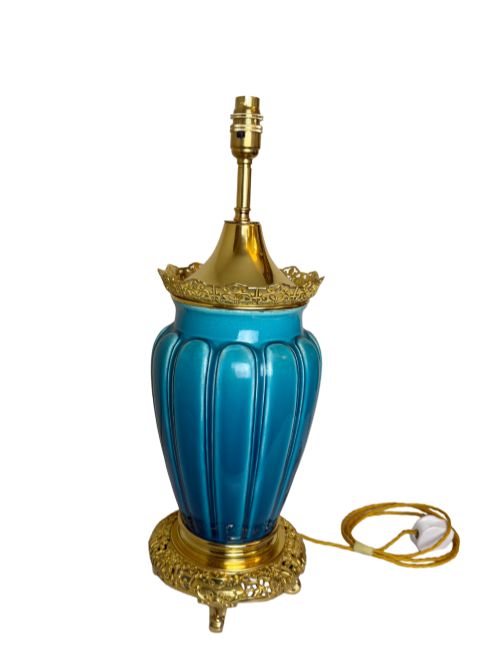
Ceramic bodies form the primary substrate for these lamps, shaped by hand or on a wheel before receiving rich turquoise, cobalt, or celadon glazes. Artisans fired these pieces in kilns, where chemical reactions in the glaze produced characteristic crackle effects or smooth vitreous finishes.
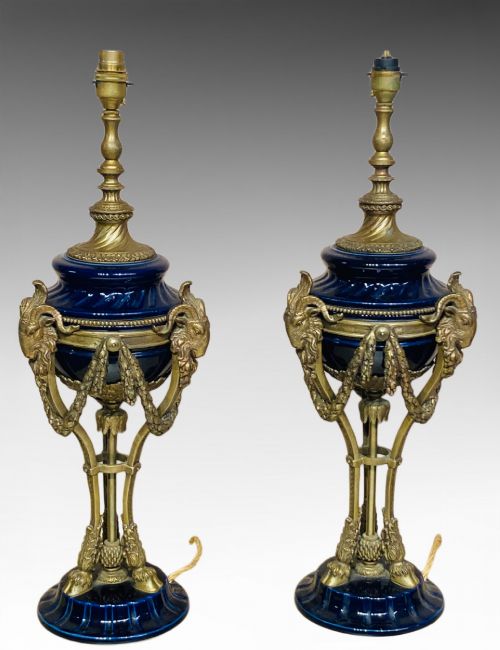
Many of the listed lamps incorporate metal mounts, utilising brass, gilt bronze, or ormolu to frame the ceramic base and support the electrical fittings. These metal elements were cast and chased separately before being secured to the transformed vessels.
The inventory spans the eighteenth century through to the mid twentieth century.
What varies in quality
The refinement of the glaze application and the depth of the colour heavily influence the visual impact of each lamp. Pieces featuring hand-painted details or controlled kiln transformations stand apart from simpler monochrome productions.
The integration of metal mounts and the retention of original ceramic bodies dictate the overall coherence of the conversion. Lamps where ormolu or brass trim complements rather than overpowers the ceramic demonstrate superior decorative balance.
Burmantofts Faience·Royal Doulton
The Blue Glaze Table Lamps Glossary
- Ormolu
- Gilded bronze mounts applied to furniture and ceramics. This technique was widely utilised in French decorative arts to add ornate metal framing.
- Crackleware
- Pottery featuring a network of fine cracks in the glaze. These intentional surface fractures are often accentuated with dark pigments during manufacturing.
- Celadon
- A pale green or grey-green glaze originating in East Asia. The term also describes ceramic wares finished with this specific translucent coating.
- Faience
- European tin-glazed earthenware decorated with opaque colours. Workshops across the continent produced these vessels before later adapting them for modern lighting.
- Chinoiserie
- European interpretations of Chinese and East Asian artistic traditions. This decorative style appears frequently on ceramic designs from the eighteenth and nineteenth centuries.
Blue Glaze Table Lamps: Frequently Asked Questions
Are these lamps recently converted?
Many vessels were adapted from older vases and jars, with wiring updates occurring at various points in their history.
Buyers often find pieces noted as rewired to meet modern standards while retaining their antique ceramic bodies.
How do I style a pair?
Symmetrical pairs of ceramic lamps work effectively on matching sideboards or mantelpieces. Their height and rich blue tones provide strong vertical anchors in a room.
Consider the shade proportions to ensure the ceramic base remains the visual focus.
What periods are represented?
The selection includes pieces originating from the eighteenth and nineteenth centuries, alongside early twentieth-century examples.
Dates reflect the age of the base ceramic vessel rather than the electrical conversion.
Do shades come included?
Listings vary regarding whether fabric shades are included with the ceramic base.
Review individual descriptions to check if the lamp is sold with a shade or as the base alone.