





Blue and White Jasperware
Blue and white jasperware brings together fine matte stoneware and sharp white neoclassical reliefs for anyone seeking classic nineteenth-century British ceramic ornament.
Blue and White Jasperware
Blue and white jasperware encompasses a distinctive group of unglazed ceramic vessels and decorative objects shaped in various shades of blue and adorned with applied white classical reliefs. Buyers searching for blue and white jasperware will encounter nineteenth-century pieces alongside items from later twentieth-century decades.
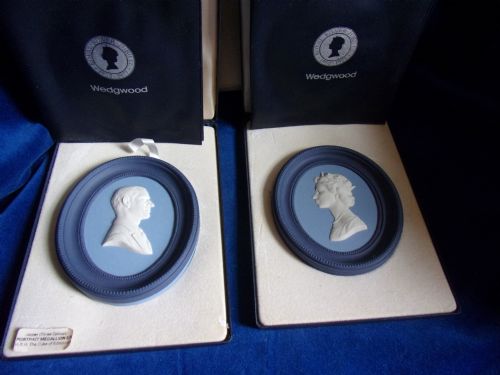
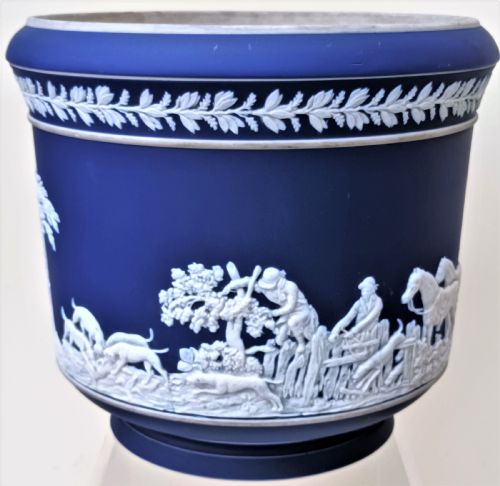
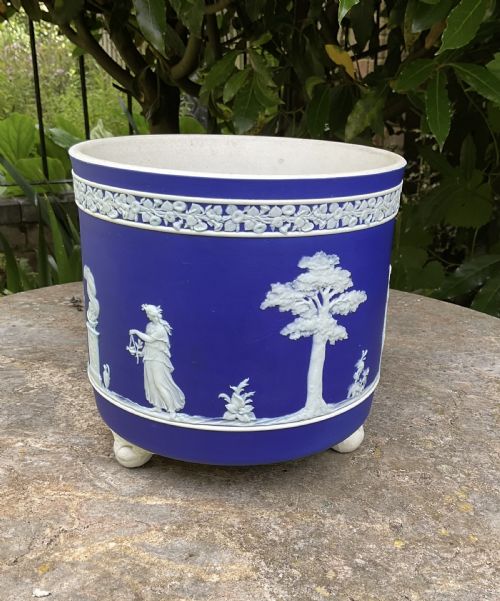
The selection on this page ranges from practical household vessels such as teapots, biscuit barrels, and jardiniere planters to small personal ornaments like brooches, patch boxes, and portrait medallions. Most items reflect Victorian neoclassical tastes, spanning table accessories, decorative urns, and candlesticks.
Originating largely from English potteries, these pieces demonstrate enduring popularity through varied forms including cheese domes and decorative plaques. The inventory captures both functional containers and purely ornamental items produced across the nineteenth and twentieth centuries.
Materials and production methods
Jasperware is a fine-grained stoneware or earthenware body dyed blue throughout or dipped in a blue slip before firing, creating a distinctive matte surface. Artisans shaped the base clay through moulding or throwing before applying separately modelled white stoneware reliefs.
The white classical figures and floral borders were moulded individually, dampened, and carefully pressed onto the blue body by hand prior to kiln firing. Certain pieces incorporate additional elements such as metal mounts, silver collars, or fitted velvet linings.
Blue and White Jasperware Retail Price Guide 2026
Typical asking prices for blue and white jasperware among the pieces listed under this phrase on Sellingantiques today, from the lower quarter to the upper quarter. They describe what is for sale here now, not the wider market.
Recorded object forms range from tiny portrait medallions and patch boxes to large campana urns and jardiniere planters.
Distinctions in craftsmanship and finish
The precision with which white ornaments are aligned against the blue background determines the visual harmony of the piece. Additionally, the presence of subsidiary materials like silver collars or matched pedestals distinguishes standard production items from more ambitious works.
William Adams And Sons·Copeland Spode·Wedgwood·Staffordshire
The Blue and White Jasperware Glossary
- Jasperware
- A fine stoneware body developed by Josiah Wedgwood, characterised by its unglazed matte finish and capability of being coloured by metallic oxides. It serves as the primary medium for the blue and white pieces found here.
- Bas-relief
- Low-relief sculptural decoration that projects slightly from the flat background. In these pieces, white stoneware figures stand out in low relief against the blue ground.
- Dip
- A technique where a pale clay body is dipped into a darker coloured slip to achieve the desired surface hue. This method contrasts with solid-coloured jasperware.
- Neoclassical
- A style inspired by the classical art and architecture of ancient Greece and Rome. It defines the decorative motifs seen on these nineteenth-century ceramics.
- Jardiniere
- An ornamental ceramic pot or stand designed to hold growing plants or flowers. Several nineteenth-century examples appear in this category.
Blue and White Jasperware: Frequently Asked Questions
What is jasperware made of?
Jasperware is a fine-grained ceramic stoneware developed to take colour evenly throughout its unglazed body. The matte surface is achieved without traditional glass glazes.
Applied white ornaments are made from the same white stoneware paste, shaped separately and attached before firing to create the characteristic contrasting relief.
How do I date jasperware pieces?
Dating relies on maker marks, colour saturation, and stylistic details recorded across the nineteenth and twentieth centuries. Victorian pieces often feature impressed factory marks and registration numbers.
Later twentieth-century items, such as mid-century portrait medallions, display different base stamps and cleaner, more uniform paste bodies compared to earlier wares.
How were cheese domes used?
Large cheese domes and stands served on Victorian dining tables to keep large wedges of cheese moist and protected during meals. The heavy ceramic cover trapped humidity while resting on a matching tray.
These functional pieces combined practical dining utility with elaborate neoclassical decoration suitable for formal dining rooms.
Are all blue shades the same?
Blue shades vary considerably across different pieces, ranging from pale academic blue to rich dark blue body colours. Some items use a surface dip over white clay, while others are solid blue throughout.
Changes in oxide mixtures during production created these tonal differences between Victorian items and later twentieth-century productions.