



Blue and Gold Garniture
A blue and gold garniture brings together matching vases and urns in rich cobalt and gilt, offering a classic symmetrical centrepiece for a mantelpiece.
Blue and Gold Garniture
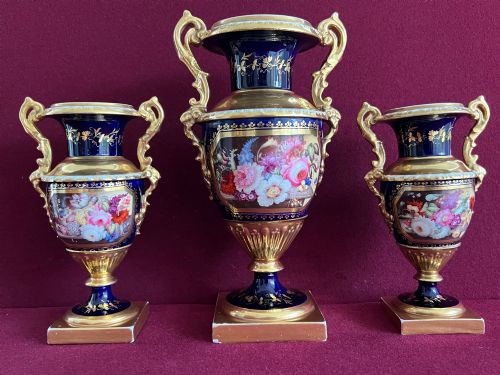
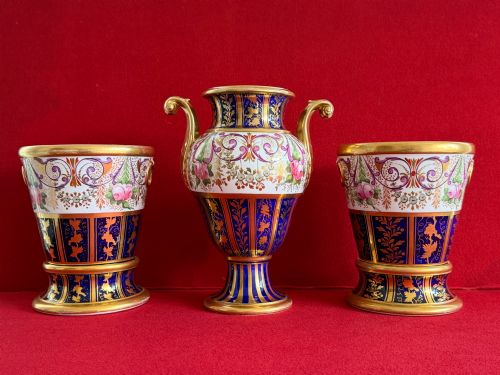
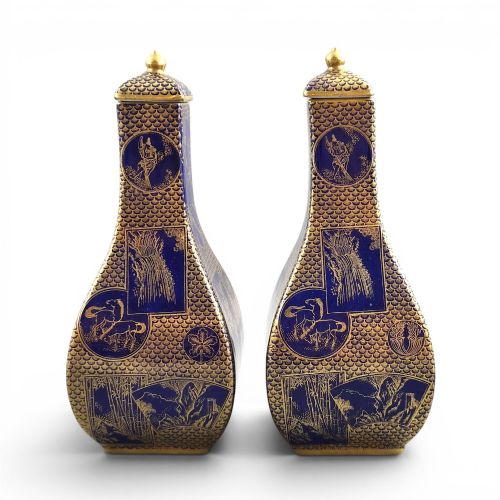
A blue and gold garniture comprises matched sets of porcelain or earthenware vases, urns, and occasionally clock sets designed to be displayed together on a mantelpiece or sideboard. These decorative groups bring formal symmetry and vibrant colour to a room, utilising deep blue grounds highlighted with gilded detailing.
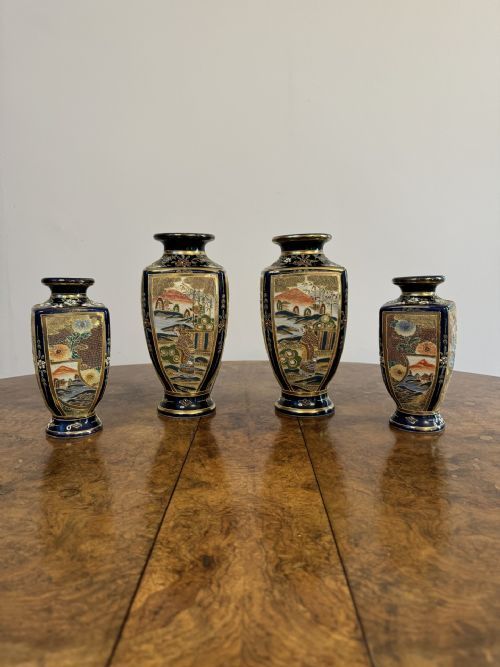
The pieces appearing on this page span from the Georgian and Regency eras through to the Victorian period and the early twentieth century, alongside Japanese Satsuma work. Makers such as Spode, Minton, Mason's, and Royal Vienna produced these sets across different international traditions, encompassing styles from Neoclassical and Empire to French Rococo Revival.
Vases and urns form the core of these listings, often presented as pairs, groups of three, or sets of four. Buyers encountering these sets will find both British porcelain factories and continental European porcelain houses represented, alongside Japanese export wares.
How they were made
Makers utilised fine porcelain, ironstone, and earthenware as the foundational bodies for these garnitures, shaping them into classical amphorae, urns, and baluster vases. Enamel and rich glazes, particularly deep mazarine blue, were applied to the ceramic surfaces to create the signature ground colour.
Gilt bronze mounts, gold leaf, and hand-applied gilding embellished the pieces, catching the light and framing the painted scenes or decorative motifs. Skilled hands signed some works, such as those by Thomas Steel and F. Koller, demonstrating the level of artistry involved in the finest porcelain decoration.
Blue and Gold Garniture Retail Price Guide 2026
Typical asking prices for blue and gold garniture among the pieces listed under this phrase on Sellingantiques today, from the lower quarter to the upper quarter. They describe what is for sale here now, not the wider market.
Some Victorian households arranged their mantel garnitures strictly by height, terrified that a lopsided shelf would offend contemporary notions of domestic harmony.
What varies in quality
Quality in a blue and gold garniture rests upon the crispness of the porcelain body, the depth and consistency of the blue glaze, and the precision of the gilding. Superior sets display meticulous hand-painting and substantial metal mounts rather than simple printed transfers.
The completeness and integrity of a multi-piece set dictate its standing, as garnitures rely on matching elements surviving together over the centuries. Finer examples bear the marks of esteemed factories or named decorators, reflecting greater ambition in their design and execution.
Spode·Minton·Mason's·Vienna Porcelain·Royal Vienna
The Blue and Gold Garniture Glossary
- Garniture
- A set of matched vases, urns, or vessels designed to be displayed together as a decorative scheme on a mantelpiece or sideboard.
- Mazarine Blue
- A deep, rich shade of blue glaze frequently used as a ground colour on nineteenth-century ceramics.
- Amphora
- A classical two-handled vase with a narrow neck, often adapted in porcelain during the Empire and Neoclassical periods.
- Gilt Bronze
- Bronze that has been treated with gold leaf or mercury gilding to impart a golden metallic finish to mounts and decorative hardware.
- Ironstone
- A sturdy type of earthenware patented in the nineteenth century that mimics the durability and appearance of true porcelain.
Blue and Gold Garniture: Frequently Asked Questions
What is a garniture?
A garniture is a coordinated set of ceramic vessels, typically consisting of three or more matching vases and urns created to sit together on a mantelpiece.
Historically, these sets provided balanced decoration for grand rooms, filling architectural spaces with symmetrical colour and form.
How do I style a garniture?
Displaying a complete garniture involves placing the tallest piece in the centre with the matching smaller vessels arranged symmetrically on either side.
They sit particularly well upon mantelpieces, console tables, and sideboards where their matching profiles can be appreciated without crowding.
How can I tell the period of a piece?
Dating relies on examining the factory marks stamped or painted on the base, the style of the gilding, and the ceramic body used.
Georgian and Regency examples often feature hand-painted botanical or landscape panels, while later Victorian and twentieth-century pieces incorporate different revival styles.
Were these sets purely decorative?
Most garniture vases and urns served an ornamental function rather than holding flowers, designed specifically to enhance the interior architecture of a room.
Clock sets integrated within these groupings combined practical timekeeping with the decorative symmetry of the wider set.