
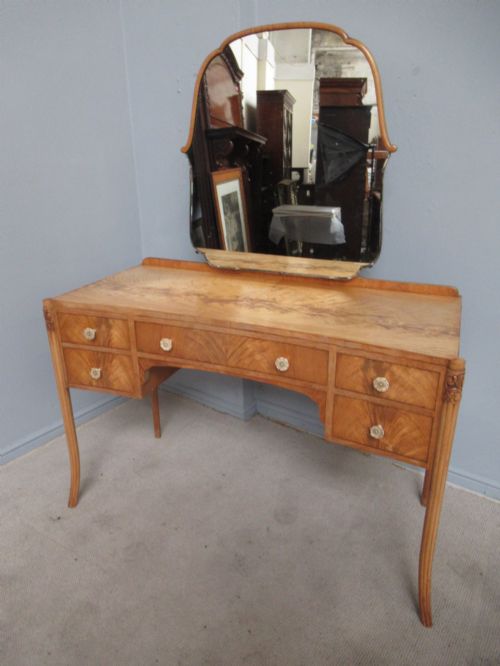
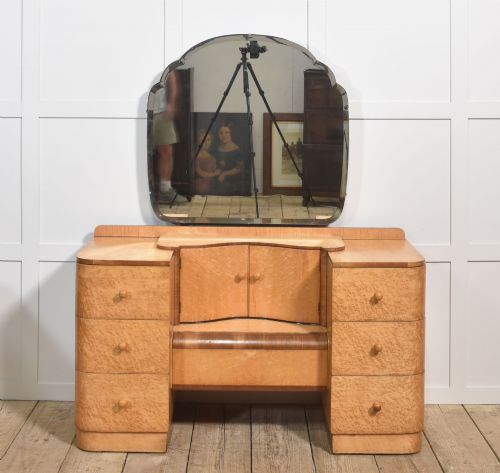


Blonde Maple Dressing Table
A blonde maple dressing table brings pale timber and clean geometry into a room, offering a functional surface shaped by twentieth-century design.
Blonde Maple Dressing Table
A blonde maple dressing table centres on light wood surfaces, spanning forms from the Georgian period through to the 1930s. Buyers searching for a blonde maple dressing table frequently encounter Art Deco interpretations that pair figured timber with integrated mirrors.
The selection includes variations in timber tone, incorporating birds eye maple, pale mahogany, and walnut alongside the principal maple surfaces. These pieces often arrive with complementary seating such as side chairs or stools, completing the vanity grouping.
Construction and Materials
Cabinetmakers constructed these dressing tables using solid and veneered hardwoods, selecting maple and birds eye maple for their distinctive grain patterns. Timber selection dictated the visual weight of the furniture, allowing pale surfaces to reflect light across geometric forms.
Mirrored elements formed an integral part of the construction, utilising heavy glass plates set into matching wooden frames. Joinery methods combined traditional carcase building with curved veneers suited to the Art Deco and Swedish Grace styles.
Birds eye maple gets its speckled pattern from tiny knots where the tree tried to sprout extra branches.
Assessing Quality
Quality rests upon the selection and matching of the veneer, where continuous grain patterns across drawer fronts and curved surfaces demonstrate superior cabinetmaking. Pieces attributed to prominent makers such as Harry and Lou Epstein or Hille exhibit refined proportions and careful timber selection.
The integration of original mirrors and hardware distinguishes a cohesive design from a later assembly. Subtleties in the handling of curved edges and the crispness of the inlaid details reveal the maker's skill.
Harry and Lou Epstein·Hille
The Blonde Maple Dressing Table Glossary
- Birds Eye Maple
- A figure in maple wood resembling tiny swirling eyes caused by depressions in the growing rings. This figuring is highly valued for decorative veneer work on twentieth-century furniture.
- Art Deco
- A design style dominant in the 1920s and 1930s characterised by sleek geometric shapes, streamlined forms, and modern materials. It represents a significant portion of the furniture seen in these listings.
- Swedish Grace
- A refined classicist style popular in Sweden during the 1920s that preceded international functionalism. It combines traditional craftsmanship with pared-back geometric elegance.
- George III
- The period of British design lasting from 1760 to 1820 known for neoclassical restraint and fine proportions. Pieces from this era employ classic cabinet woods like burr maple and mahogany.
Blonde Maple Dressing Table: Frequently Asked Questions
What periods do these dressing tables come from?
The pieces span several distinct eras, stretching from the Georgian period through early twentieth-century decades like 1910 and 1920 up to the 1930s. Art Deco examples from the interwar years form a significant portion of the available items.
Earlier examples include Georgian pieces alongside Victorian items, showing how pale maple and related timbers were adapted across changing stylistic movements.
How do I care for maple surfaces?
Maple benefits from being kept away from direct sunlight and excessive heat fluctuations to prevent the light timber from darkening or splitting. Regular dusting with a soft, dry cloth maintains the finish without needing harsh polishes.
For mirrored components, use a gentle glass cleaner applied to a cloth rather than directly sprayed onto the glass, protecting the surrounding wooden frame from moisture damage.
Are matching chairs usually included?
Some listings incorporate matching stools or side chairs designed in the same aesthetic, particularly among the Art Deco pieces. These secondary seating items share the wood types and geometric lines of the main vanity.
When a dressing table lacks a seat, standalone side chairs from the same period offer a complementary pairing based on shared materials like maple or mahogany.
How do I identify Art Deco pieces?
Art Deco dressing tables display streamlined silhouettes, symmetrical waterfall curves, and distinctive veneers like birds eye maple. They frequently incorporate large circular or arched mirrors as a central design element.
Construction from this era often highlights the natural grain of light woods rather than relying on heavy dark stains or elaborate carving.