




Black Gilt Centre Table
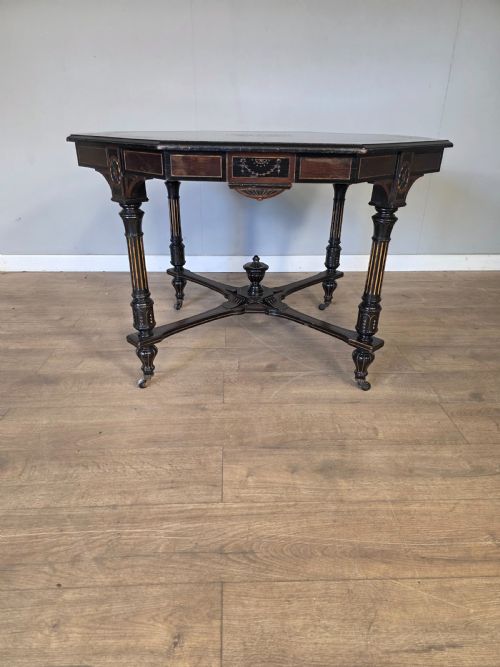
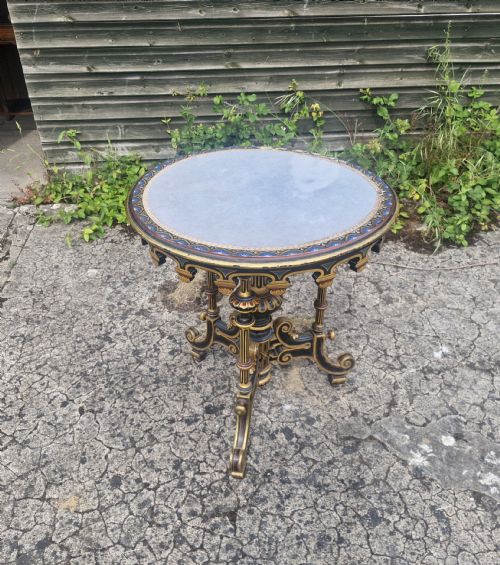
A black gilt centre table anchors a room with dark contrast and metallic flash, bringing architectural presence right to the middle of the floor.
Black Gilt Centre Table
A black gilt centre table brings together dark surfaces and metallic highlights, standing free in a room rather than pushed against a wall. The pieces collected here span the nineteenth century into the early twentieth century, showing periods from Regency and Victorian through to French Napoleon III, Empire, and Louis XVI styles.
Most examples function as centre tables, occasional tables, or coffee tables, with forms ranging from grand specimen marble tops to lacquered low tables. You encounter influences from French, Florentine, Venetian, and Chinese traditions, executed in ebonised wood and dark timber.
Makers such as Maison Millet and Paul Sormani appear in the record alongside unmarked regional pieces. Buyers select these tables for their bold silhouette and the striking visual weight of ebonised and parcel gilt finishes.
How they were made
Workshops achieved the signature dark finish using ebonised wood and ebonised timber, a process of treating cheaper woods to resemble ebony or staining dense hardwoods deeply black. This dark ground provided a stark contrast for applied giltwood, gold leaf, and ormolu mounts.
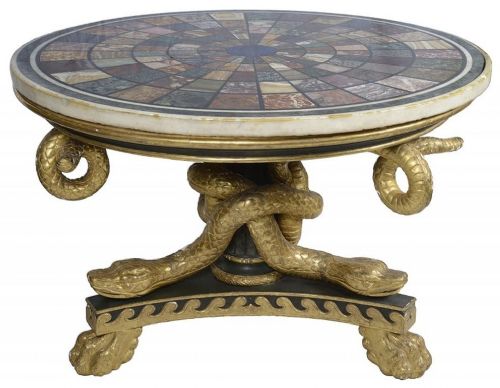
Structural surfaces incorporated stone work, notably specimen marble and pietra dura inlay, set into timber frames with brass details. Cabinets applied fine marquetry, bone inlay, and painted or lacquered decoration on top of the black substrate.
Listings feature works spanning the nineteenth and early twentieth centuries, including Regency, Victorian, and Louis XVI styles.
What varies in quality
Quality rests in the precision of the ebonisation and the crispness of the parcel gilding, where hand-applied gold leaf catches the light along carved mouldings. Superior examples display depth and restraint in their decorative carving rather than heavy, indistinct ornamentation.
The choice and execution of the top material elevate a piece significantly, moving from straightforward painted wood to complex pietra dura stone inlay or multi-toned specimen marble. Joinery and structural stability underneath determine how securely these heavier tabletops rest on their pedestals or legs.
Maison Millet·Paul Sormani
The Black Gilt Centre Table Glossary
- Ebonised
- Wood treated with stain or polish to imitate genuine ebony, creating a dense, matte black surface. This finish became popular in nineteenth-century revival styles to mimic expensive tropical hardwoods.
- Parcel gilt
- Woodwork where only specific raised details, carvings, or mouldings receive a layer of gold leaf. This technique highlights architectural lines against the dark ebonised background.
- Ormolu
- Cast bronze that has been mercury-gilded, producing a bright gold finish used for decorative mounts on furniture. It adds metallic weight and distinct texture to the corners and legs of tables.
- Pietra dura
- An inlay technique using cut and fitted polished coloured stones to create pictorial designs on a dark stone background. Florentine workshops mastered this method for tabletop surfaces.
- Specimen marble
- A tabletop composed of numerous small geometric or architectural samples of different coloured marbles arranged in patterns. Each individual marble piece is bordered by micro-mosaics or slate.
Black Gilt Centre Table: Frequently Asked Questions
Where should a centre table go?
A centre table stands in the middle of a room, intended to be viewed from all sides rather than pushed against a wall. It functions as a visual anchor, often holding lamps, books, or decorative objects.
Because these tables lack a designated front or back, placement requires adequate clearance for walking around the perimeter. They suit large hallways, reception rooms, and spacious living areas.
How do I care for ebonised wood?
Ebonised surfaces require gentle dusting with a soft, dry cloth to prevent micro-scratching on the dark finish. Avoid chemical polishes that leave a greasy residue or build up over time.
Keep these tables away from direct sunlight and heat sources, which can fade the black stain and dry out the underlying timber. Use coasters to protect the polish from moisture rings.
What is the difference between Regency and Victorian styles?
Regency tables, dating from the early nineteenth century, lean towards neoclassical restraint with clean architectural lines, classical motifs, and restrained use of gilt. They often feature robust pedestals and high-status materials like marble.
Victorian pieces, emerging later in the century, embrace revivalism with heavier proportions, elaborate carving, and diverse influences like Gothic or Renaissance details. The ornamentation becomes denser and more varied across different woods and inlays.
Can I use a low table as a coffee table?
Low tables originating from nineteenth or early twentieth-century traditions adapt well to modern seating arrangements. Their lower height aligns with contemporary sofas and soft furnishings.
When using an antique table for daily living, ensure drinks are protected with coasters and heavy loads are avoided to preserve fragile inlaid tops and delicate gilt edges.