
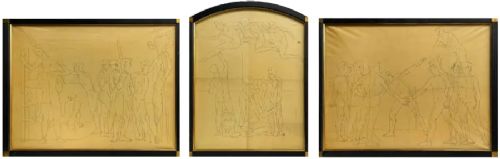
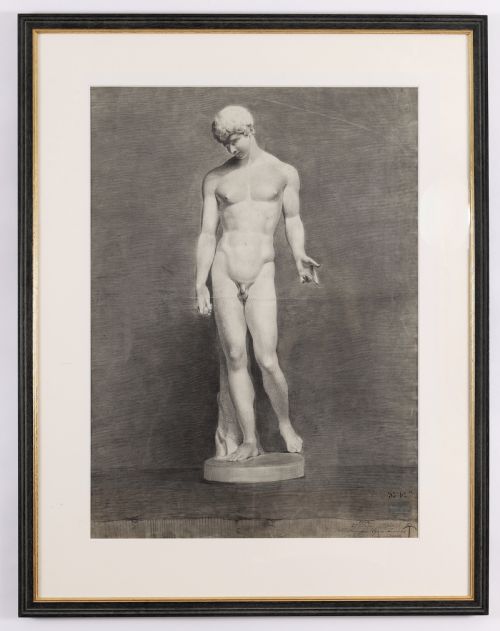
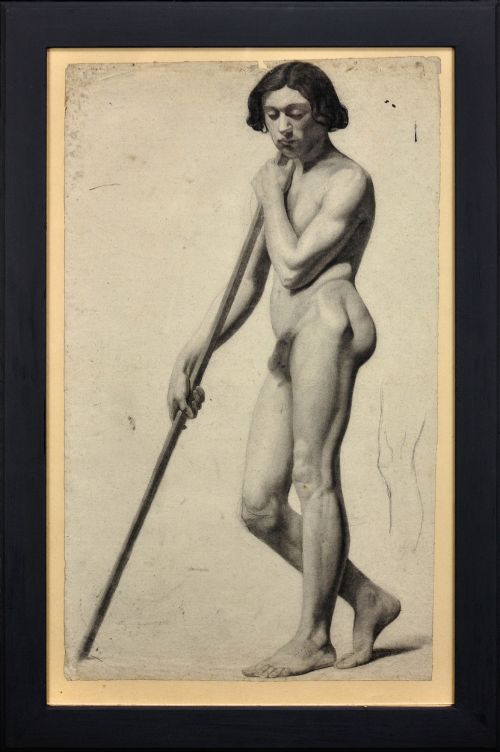


Black Framed Figure Drawing
A black framed figure drawing brings stark draftsmanship and human form together on the wall, anchored by dark moulding.
Black Framed Figure Drawing
A black framed figure drawing focuses on the human body through academic study, portraiture, and modern interpretation, set within a dark wooden or glazed border. These works span the nineteenth and twentieth centuries, taking the form of original charcoal, graphite, ink, and chalk studies on paper.
Buyers encounter academic life studies of male and nude figures alongside twentieth-century modernism, cubist compositions, and intimate portraits. The framing provides a severe, contrasting boundary that isolates the monochrome or tinted lines of the artist's hand.
The selection ranges from precise nineteenth-century renderings of classical antiques to avant-garde sketches and mid-century anatomical drawings. Each piece records a distinct period of draughtsmanship, from strict academic realism to expressive studio practice.
Materials and construction
Artists executed these works on paper using charcoal, red chalk, graphite, and ink, sometimes building forms with pastel over lithograph. These dry media allowed rapid tonal shading and precise contour lines essential for capturing the human anatomy.
Makers housed the sheets behind protective glass within wooden frames finished in black pigment, often complemented by brass fixings or simple mats. The heavy dark moulding serves to concentrate the viewer's eye entirely upon the paper study within.
Listings feature works spanning from the nineteenth century through the 1960s, executed in charcoal, ink, graphite, and red chalk on paper.
Distinguishing quality
The degree of anatomical precision and the confidence of the draughtsman's line separate standard school exercises from master works. A skilled hand captures muscle, shadow, and bone with economy, whereas lesser work relies on laboured correction.
The preservation of the paper and the integrity of the original framing elements influence the desirability of the piece. Clean paper free from heavy foxing, combined with period dark frames, preserves the intended visual balance of the artwork.
Henry Arthur Roberts·Demetrios Galanis·Lucien Freud·Winifred Eugene Ballard·Sonia Lawson R.A.
The Black Framed Figure Drawing Glossary
- Academic Realism
- A style of painting and drawing produced under the influence of European academies of art, prioritising strict anatomical accuracy and classical proportions. This approach forms the basis of many nineteenth-century life studies.
- Charcoal
- A dry drawing medium made from organic charred material that produces rich, velvety blacks and broad tonal ranges. It is frequently employed for expressive figure studies.
- Graphite
- A form of crystalline carbon used in pencils to create fine, precise grey lines and subtle shading. It allows for meticulous detail in anatomical and portrait drawings.
- Lithograph
- A printmaking process based on the repulsion of oil and water, capturing the fine nuances of a drawn mark. Artists sometimes applied pastel or ink over these prints.
- Neoclassical
- A Western cultural movement drawing on the art of classical antiquity, visible in drawings referencing ancient statues and heroic forms. It emphasises austere linear design.
Black Framed Figure Drawing: Frequently Asked Questions
What is an academic life study?
An academic life study is a drawing executed from a live human model, traditionally produced within an art school or academy setting.
These pieces demonstrate the artist's mastery of proportion, shadow, and human anatomy.
How do I hang a dark framed drawing?
A dark framed drawing requires neutral wall space where the heavy moulding can create a strong focal point without competing with surrounding decor.
Keep the artwork away from direct sunlight to protect fragile paper and dry media from fading.
Are these drawings original works?
Many of the pieces listed are original unique works on paper created in charcoal, ink, graphite, or chalk by individual artists.
Some examples incorporate print techniques such as lithography with hand-applied pastel or ink details.
How do I identify the period of a drawing?
Period identification relies on the style of draughtsmanship, the paper type, and the framing materials used at the time of creation.
Academic realism typically points to the nineteenth century, while cubism and abstraction align with twentieth-century movements.