

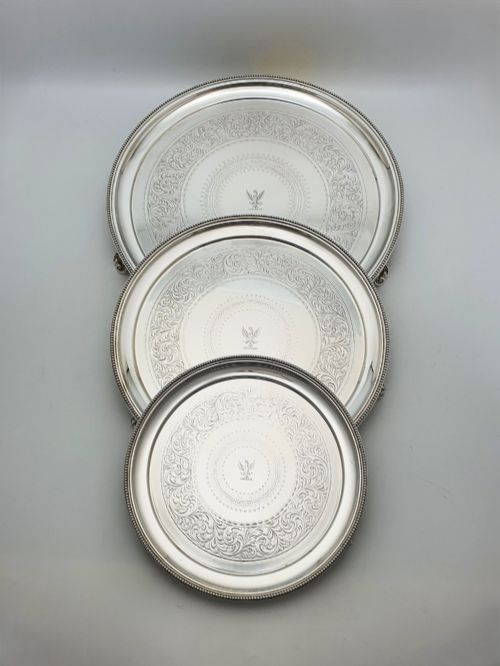


Beaded Silver Tray
A beaded silver tray brings a sharp, disciplined edge to a room, catching light along its rim.
Beaded Silver Tray
A beaded silver tray appears across Victorian and Edwardian periods, taking the form of serving dishes, platters, salvers, and cocktail trays. These pieces serve practical dining needs while displaying decorative borders formed of small, uniform metallic beads.
The versions most commonly met on this page span the late nineteenth and early twentieth centuries, including work by makers such as Elkington and Walker & Hall. They range from circular cocktail trays to large oval serving pieces and knife trays.
Makers fashioned these trays in silver, Old Sheffield Plate, and electroplated nickel silver, often pairing the metal with glass or mirrored glass bases. The objects function as drinks service items, display surfaces, and dining accessories.
How they were made
Silversmiths utilised silver, silver plate, and Old Sheffield Plate, applying fusion methods or electroplating techniques like EPNS to coat base metals such as copper. Workshops also incorporated glass and mirrored glass inserts for plateau mirrors and serving surfaces.
Craftsmen applied decorative beaded borders around the edges of trays and salvers, sometimes combining this detailing with hand engraving across the central surface. Handles were soldered or cast onto the body to support heavier loads during service.
Knife trays kept dining tables tidy between courses, proving that even cutlery once enjoyed its own dedicated transport.
What varies in quality
The definition and crispness of the beaded border separate fine examples from simpler production, as worn or poorly cast beads lose their rhythmic punch. Heavier gauge metalwork provides greater structural rigidity, preventing the tray from flexing under the weight of a decanter.
The durability of the underlying plating and the depth of any hand engraving determine the longevity of the finish. Maker attribution to known firms like Elkington or Walker & Hall adds distinction to the piece.
Elkington·Walker Knowles·Walker & Hall·Peters Hamburg·Smith & Sharp
The Beaded Silver Tray Glossary
- Beaded border
- A decorative edge pattern resembling a string of small metal spheres. This detail frequently frames the perimeter of Victorian and Edwardian salvers.
- EPNS
- Electroplated Nickel Silver. A common base of nickel, zinc, and copper coated with a thin layer of silver through electrolysis.
- Old Sheffield Plate
- A fused composite material made by melting a sheet of silver onto a thicker copper core. This technique predates modern electroplating.
- Salver
- A flat metal tray used for serving drinks or presenting items. These pieces often stand on small feet.
- Plateau mirror
- A mirrored tray designed as a table centrepiece for holding ornaments or candelabra. The reflective surface doubles the visual impact of the items placed upon it.
Beaded Silver Tray: Frequently Asked Questions
What is a beaded silver tray used for?
These trays handle drinks service, carry entree dishes, and act as decorative display bases on sideboards and tables. Their raised borders prevent glassware and decanters from sliding off during movement.
Historically, larger salvers and platters moved food and drink between rooms while smaller circular trays stayed on side tables for cocktail service.
How do I clean a silver plated tray?
Clean silver plated items with a soft cloth and a dedicated silver polish designed not to strip the thin metallic coating. Avoid harsh abrasives that expose the base copper or nickel underneath.
Regular, gentle wiping preserves the integrity of the electroplate and keeps the beaded border bright without wearing down the high points of the design.
How can I tell Victorian from Edwardian trays?
Victorian pieces often display heavier proportions, darker patination, and deeper hand engraving across the body of the tray. Makers working in this era frequently employed Old Sheffield Plate or early electroplating techniques.
Edwardian trays tend to feature lighter frames, brighter silver finishes, and more restrained ornamentation that suits early twentieth-century dining habits.
Are these trays made of solid silver?
Most pieces listed here consist of silver plate, EPNS, or Old Sheffield Plate over a base metal such as copper or nickel silver. Solid silver examples occur less frequently due to the high cost of the material.
Silver plating allowed Victorian and Edwardian households to own large, substantial serving pieces at a fraction of the cost of solid silver equivalents.