
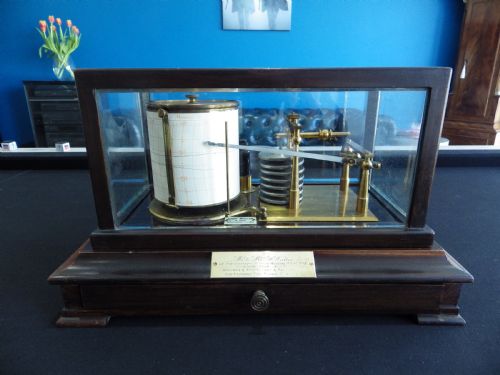


Barograph Chart Recorder
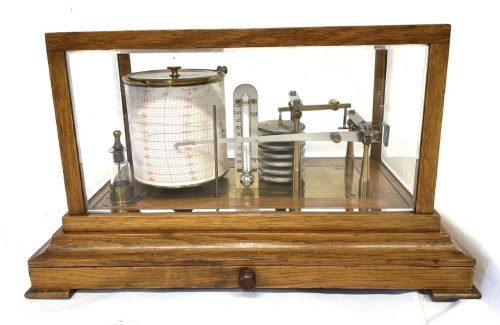
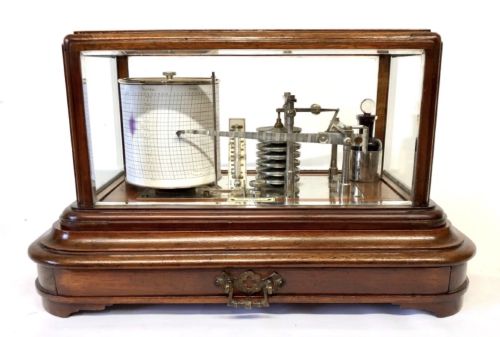
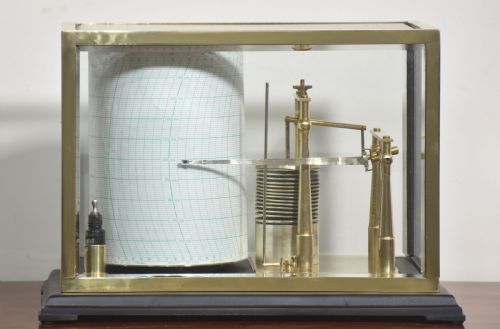
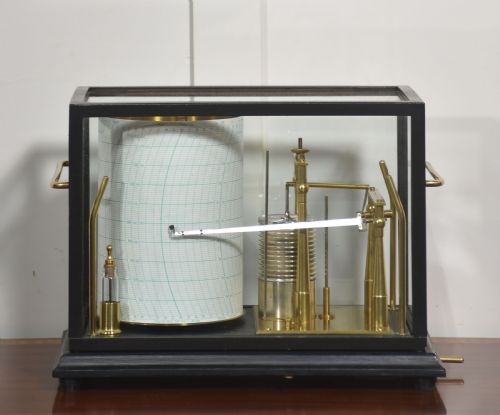
A barograph chart recorder is a self-recording meteorological instrument housed in a glazed timber case that captures atmospheric pressure on paper charts.
Barograph Chart Recorder
When you search for a barograph chart recorder, you are looking at scientific instruments designed to trace continuous barometric readings onto paper over the course of a week. These devices combine mechanical barometers with clockwork drums to provide a visual history of weather changes.
The versions you are most likely to meet on this page span the Victorian, Edwardian, and interwar periods. They predominantly take the form of oak or mahogany five-glass cases, frequently featuring fitted chart drawers and accompanying thermometers.
Originating largely from British makers and retailers active in the late nineteenth and early twentieth centuries, these instruments reflect the era's reliance on domestic meteorological tracking. Variations include combined barometer and thermometer dials mounted alongside the rotating drum mechanism.
How they were made
The structural housings rely on solid timber frames in mahogany, oak, and walnut, constructed to enclose precision brass and steel internal movements beneath bevelled glass panels. Woodworkers joined these cases with fitted drawers to store spare paper charts, while craftsmen secured brass carrying handles and feet to the exterior.
The recording mechanism utilises stacked metallic aneroid diaphragms linked to a pivoted arm holding an ink nib, which rests against a clockwork-driven paper cylinder. Brass and steel components regulate the mechanical expansion and contraction driven by atmospheric fluctuations.
Listings span the Victorian, Edwardian, and interwar periods, utilising oak, mahogany, and walnut cases fitted with brass movements and bevelled glass panels.
What varies in quality
The distinction between standard examples and superior instruments rests in the refinement of the maker's movement and the quality of the timber enclosure. Retailers and makers known for precision chronometry supplied robust clockwork drums that maintain steady rotation and accurate pressure translation.
Cabinetwork execution further separates the output, with superior pieces displaying carefully fitted bevelled glass panes, rich mahogany or figured oak grains, and integrated lower drawers designed to hold seasonal weather records. The presence of signed brass beds and named retailer plaques adds provenance to the instrument.
Short & Mason·Negretti & Zambra·Casella London·Jules Richard·R Fuess·Gaupp & Co·Dobbie Son And Hutton·Harrods Of London
The Barograph Chart Recorder Glossary
- Barograph
- A self-recording barometer that maps atmospheric pressure onto a rotating paper chart. It translates movement from aneroid chambers via a pivoted arm.
- Aneroid
- Operating without liquid. These barometers use flexible metal bellows that expand or contract as pressure shifts.
- Chart drawer
- A shallow compartment built beneath the main instrument platform. It stores spare weekly recording papers and spare ink bottles.
- Five-glass case
- A glazed timber housing with glass panels on top and all four vertical sides. This configuration allows observation of the internal mechanism from any angle.
- Clockwork drum
- A cylindrical brass drum containing a spring-driven movement that rotates once every seven days. The paper chart is wrapped around this cylinder.
Barograph Chart Recorder: Frequently Asked Questions
How does a barograph record the weather?
A stack of metallic vacuum chambers expands or contracts as air pressure rises and falls. This movement transfers through a series of levers to an inked arm that traces a line onto a rotating paper cylinder.
The cylinder contains a clockwork mechanism that turns the chart once every seven days, leaving a continuous trace of meteorological changes for the week.
Where were barographs placed in a home?
These instruments typically sat upon desks, sideboards, or library tables where household members could monitor incoming weather shifts. Their polished wood cases and glass viewing panels served both a decorative and practical function in period interiors.
Owners placed them away from direct heat sources and open windows to ensure the internal aneroid mechanism responded solely to general barometric pressure.
How do I read a paper chart?
The vertical axis on the paper chart shows atmospheric pressure measured in inches or millibars, while the horizontal grid lines mark the days of the week and hours of the day. A rising ink line indicates improving weather conditions, whereas a falling line points towards approaching storms.
Charts were replaced weekly, and historical records were often filed in the fitted drawer beneath the instrument base for future reference.
How do I date an antique barograph?
Dating relies on the style of the timber case, the lettering on the paper charts, and the maker's signatures engraved on the brass bedplate. Victorian and Edwardian examples often feature heavy mahogany or oak frames with bevelled glass, while later interwar pieces exhibit simpler geometric lines.
Maker signatures and retailer stamps active during specific decades provide a reliable window into the period of manufacture.