
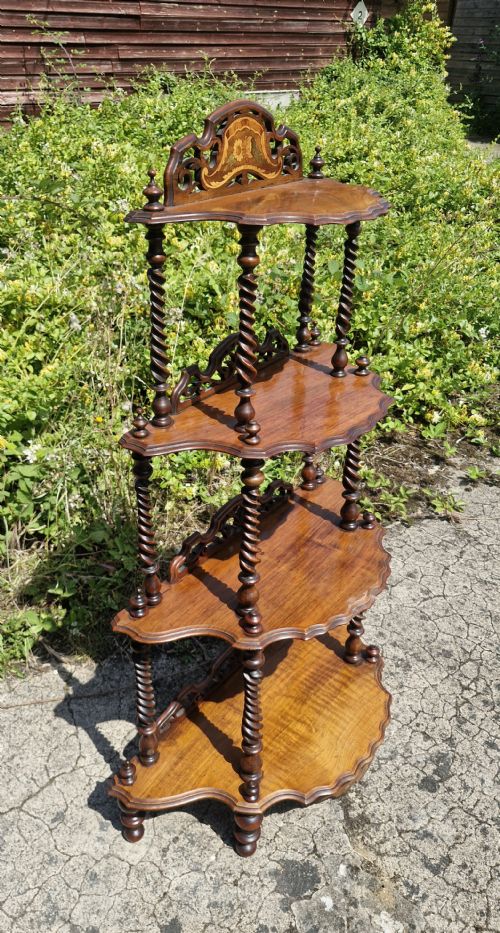
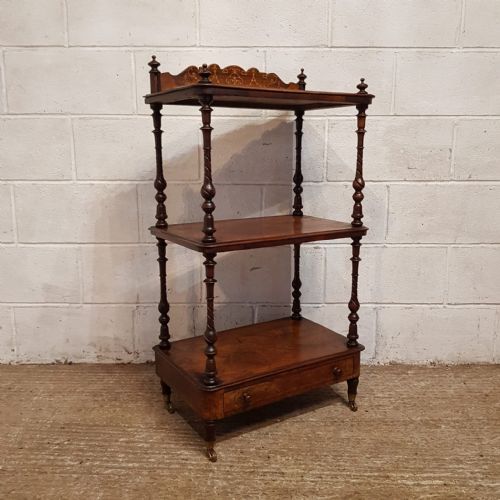


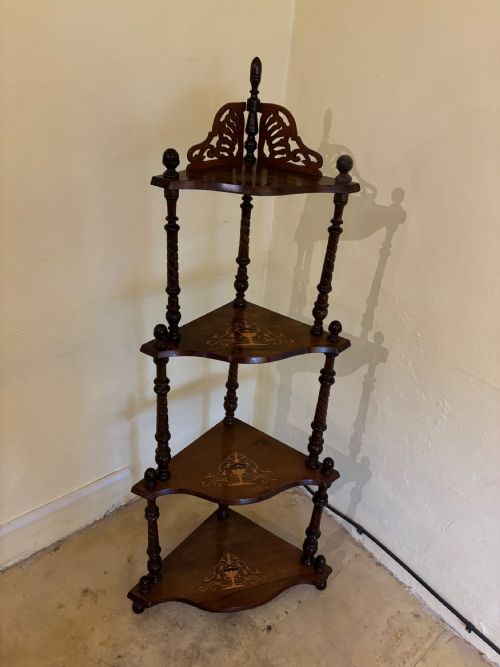


Barley Twist Corner Stand
A barley twist corner stand brings architectural turned timber to awkward room angles, offering tiered display space for objects and plants.
Barley Twist Corner Stand
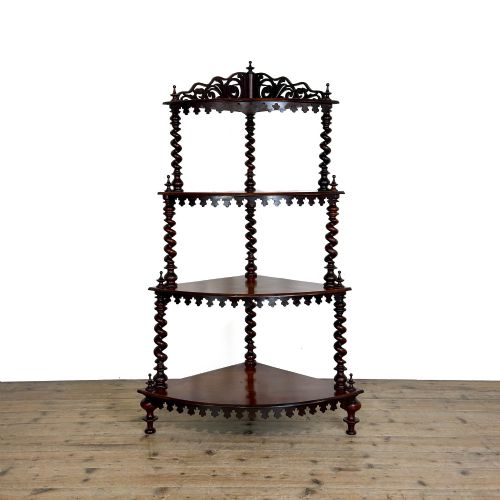
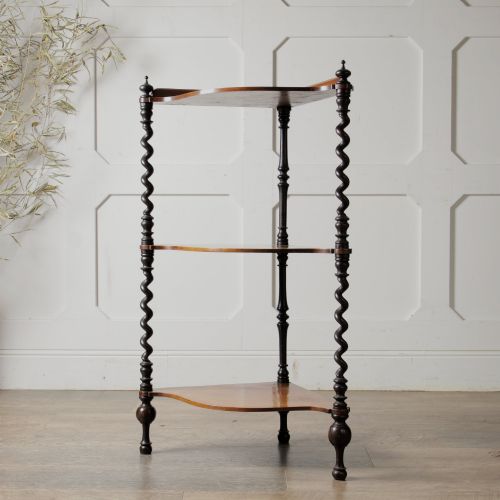
When you search for a barley twist corner stand, you encounter multi-tiered display furniture designed to fit the junctions of rooms. The listings show these pieces principally as Victorian and nineteenth century corner whatnots, shelving units, and etageres utilising angled platforms.
Most examples appear in walnut, burr walnut, rosewood, and mahogany, spanning from four to six tiers supported by turned columns. You also meet occasional variations including oak plant stands and painted French pieces, alongside demi-lune display console tables.
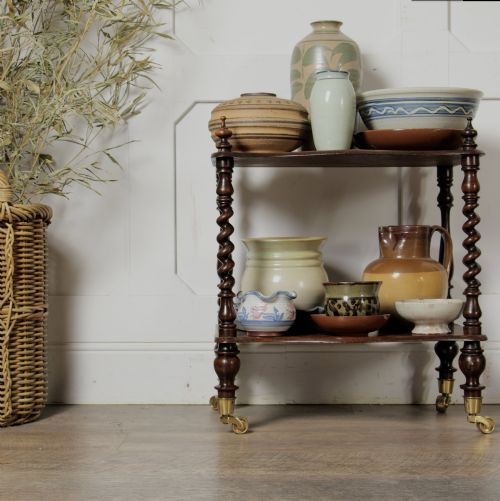
These stands served primarily for displaying ornaments and books in nineteenth century interiors, making efficient use of overlooked corner space. The form combines practical vertical storage with the decorative turnery characteristic of the period.
How they were made
Cabinet makers constructed these stands using dense timbers such as mahogany, rosewood, and walnut, frequently selecting burr walnut veneers for figured surfaces. Turned components, including the distinctive spiral twist columns, required precise lathe work to maintain uniform pitch and depth along the uprights.
Construction techniques involved joining multiple tiered shelves to vertical turned supports using traditional joinery methods suited to weight distribution. Decorative enrichment on these pieces often included wood inlay and brass fittings, integrating structural support with surface ornamentation.
What varies in quality
Quality in these stands is determined by the selection of timber veneers and the crispness of the turned spiral uprights. Superior examples display carefully matched burr walnut or rich rosewood grain across every tier, whereas simpler versions rely on plain mahogany or oak.
The architectural execution of the turning and the joinery connecting the shelves to the uprights set the grades apart. Heavier tier construction and refined edge mouldings distinguish finer display stands from utilitarian shelving units.
The Barley Twist Corner Stand Glossary
- Barley twist
- A form of spiral turning resembling a twisted rope, used extensively for the vertical supports on Victorian stands. This decorative woodwork technique adds texture and movement to the silhouette of the furniture.
- Whatnot
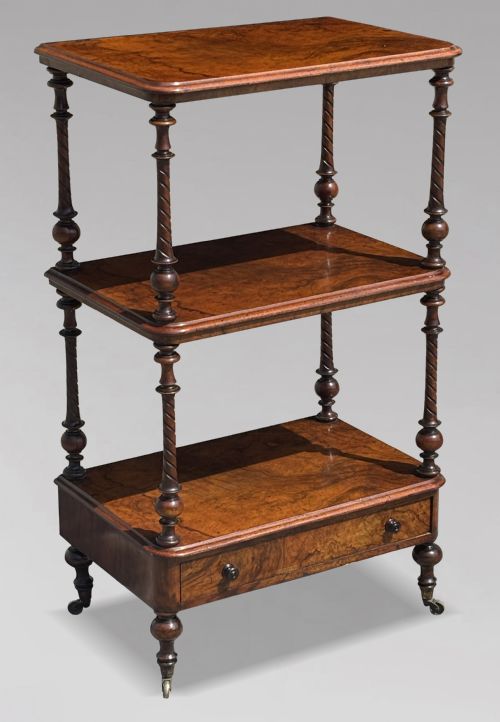
- An open multi-tiered piece of furniture designed for displaying ornaments, books, or bric-a-brac. These items became popular in nineteenth century drawing rooms for vertical storage.
- Etagere
- A piece of furniture consisting of a set of open shelves for displaying small objects. The term frequently overlaps with whatnot in period descriptions.
- Demi-lune
- A half-moon shape used for table tops and console units designed to sit flush against a wall or in a corner. This curved profile softens the transition between intersecting walls.
- Burr walnut
- Walnut timber taken from a tree growth or burl, yielding complex, swirling grain patterns. Cabinet makers prized this veneer for high-status display furniture fronts and tops.
Barley Twist Corner Stand: Frequently Asked Questions
What is a barley twist corner stand used for?
These stands provide tiered open shelving specifically shaped to occupy room corners efficiently. Historically, they held porcelain, small books, and decorative objects in domestic interiors.
Today, they serve the same display function while adding period character to empty wall junctions. Their vertical format makes them suitable for rooms with limited floor space.
How do I date a corner whatnot?
Dating relies on timber choices, turning styles, and construction details associated with nineteenth century cabinet making. Victorian examples frequently feature rosewood, walnut, or mahogany with spiral turned columns.
Later pieces from the early twentieth century often utilise oak and display different proportions. Comparing the shelf edge profiles and joint methods helps confirm the production period.
Are these stands sturdy enough for heavy items?
Most tiers are built to support standard decorative objects, small porcelain pieces, and books rather than heavy loads. The corner configuration provides natural structural stability by anchoring into two intersecting walls.
Distributing weight evenly across the lower shelves helps maintain balance on multi-tiered versions. Heavier items should remain on the bottom platform close to the floor.
What is the difference between a whatnot and an etagere?
The terms are often used interchangeably in nineteenth century furniture descriptions to denote open tiered shelving. Etageres frequently emphasise decorative display, while whatnots historically accommodated a broader range of household objects.
Both forms utilise multiple levels supported by vertical columns or legs. On this page, you find them applied to similar corner-fitting display units.