



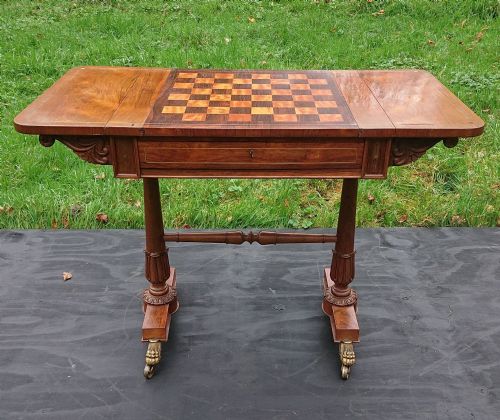


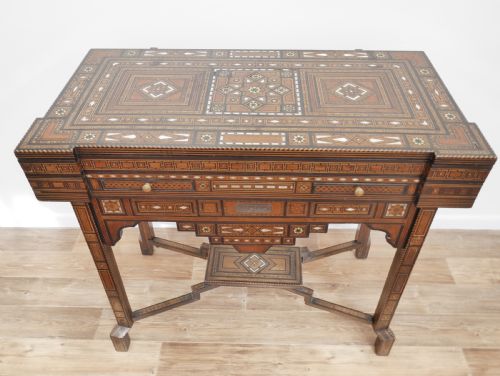

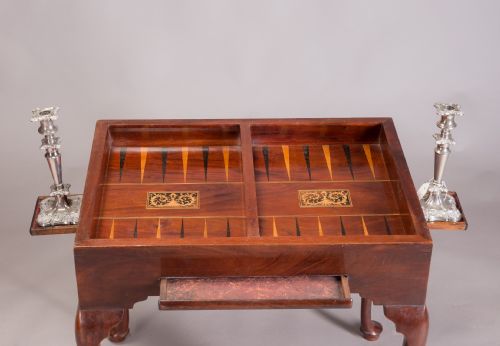
Backgammon Games Table
These backgammon games table pieces combine surface play with domestic storage, offering foldover and swivelling tops designed for multiple pastimes.
Backgammon Games Table
A backgammon games table provides a dedicated surface for board play, frequently incorporating chess, cribbage and card playing alongside its primary function. These pieces serve as functional furniture designed for nineteenth-century drawing rooms and parlours, uniting leisure with cabinetmaking.
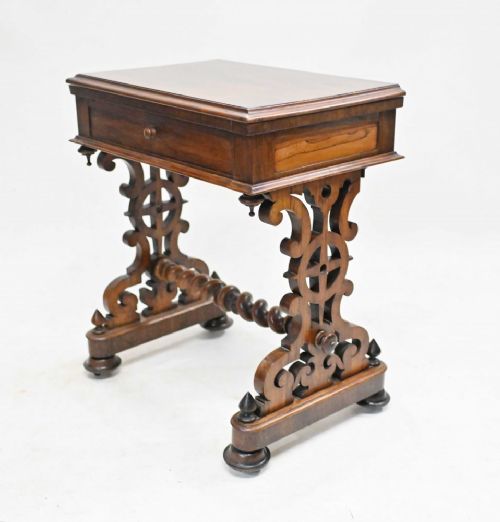
The most common examples encountered on this page date from the Victorian and Regency periods, rendered in woods such as walnut, burr walnut and rosewood. Many pieces also combine sewing or work table compartments beneath the playing surface, housing wools and threads alongside counters.
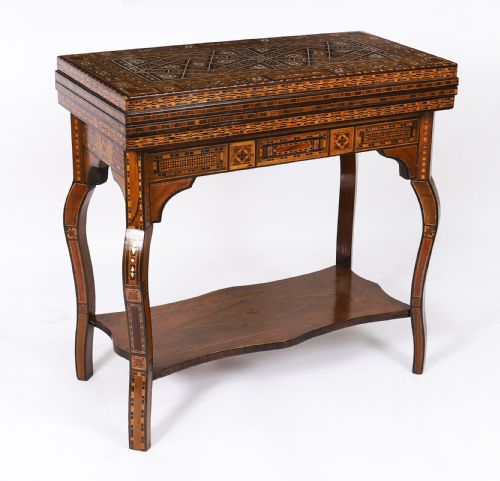
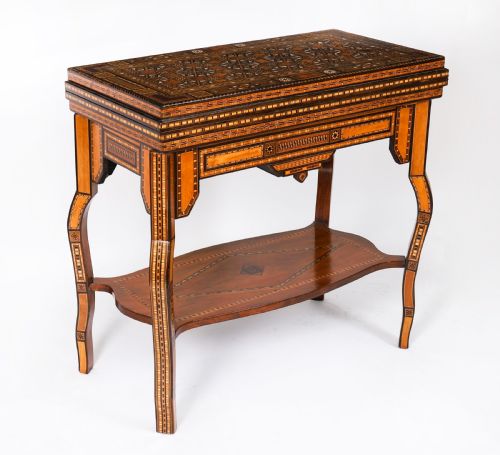
Middle Eastern and Levantine traditions also appear through Damascus and Syrian pieces, featuring intricate wood inlay, bone and mother-of-pearl work. These examples introduce alternative decorative schemes and geometric designs that contrast with standard British cabinet formats.
What separates the fine from the ordinary
Quality rests upon the selection of timber figure, evident in the choice of burr walnut veneers and the precision of the marquetry inlay. Superior examples display seamless alignment when the top folds or swivels, ensuring the inlaid chess and backgammon boards meet without disruption.
The complexity and variety of games accommodated within a single piece distinguish finer workshops, particularly those combining backgammon with chess, cribbage and sewing compartments. The integration of contrasting materials such as bone and mother-of-pearl further elevates the standard of execution.
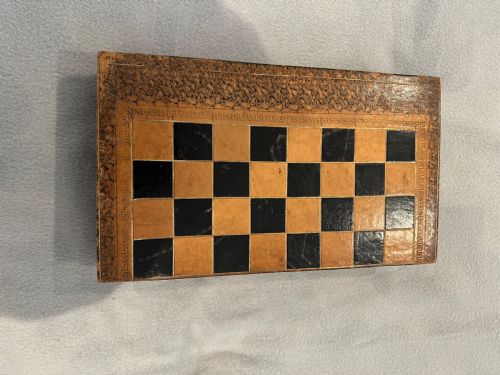
The furniture forms span multi-game folding tables, leather bound faux book boards, and oversized counters dating up to nineteen hundred.
The Backgammon Games Table Glossary
- Marquetry
- Decorative woodwork where pieces of veneer are fitted into a ground to form geometric or floral designs. This technique decorates many Victorian and Levantine surfaces.
- Swivelling Top
- A table top designed to rotate on a central pivot before folding open to reveal a hidden compartment or playing board. It allows a compact console to double in surface area.
- Cribbage Board
- A scoring track integrated into the game table surface or board, usually featuring small holes for pegs. It accommodates traditional card game scoring alongside backgammon.
- Work Table
- A domestic table incorporating a suspended fabric bag or wooden box for sewing implements and needlework. These often double as backgammon and chess tables.
- Levantine
- Pertaining to the eastern Mediterranean region, describing furniture featuring intricate geometric bone and wood inlay. These pieces frequently combine chess and backgammon layouts.
Backgammon Games Table: Frequently Asked Questions
How do you open a games table?
Many tables utilise a swivelling mechanism where the top rotates ninety degrees before folding outward to reveal the interior playing surface. Other versions feature lift-off boards or foldover leaves supported by pivoting frame sections.
Once opened, the internal compartment or backgammon layout becomes accessible, often exposing subsidiary boards for chess or card play beneath the primary panel.
What games do these tables play?
These multifunctional pieces primarily accommodate backgammon, chess and cribbage through reversible or inlaid boards built directly into the top. Card playing surfaces and poker layouts also appear on folding models.
Many Victorian examples combine these board games with sewing table compartments, holding counters, dice and dice shakers within the concealed wells.
Where were Damascus games tables made?
Damascus tables originate from Syrian and Levantine workshops, where artisans practised traditional mosaic woodwork. These pieces travelled through international trade routes to European markets during the nineteenth and early twentieth centuries.
They are distinguished by dense geometric patterns constructed from wood inlay, bone and mother-of-pearl.
How do I date a games table?
Dating relies on stylistic markers, timber choices and construction techniques characteristic of specific eras such as the Regency or Victorian periods. Regency examples often feature rosewood with formal classical lines, while mid-Victorian pieces favour burr walnut and floral marquetry.
Later nineteenth and early twentieth-century examples include Syrian import pieces marked by intricate mother-of-pearl and bone mosaic work.