


Autumn Landscape Oil Painting
An autumn landscape oil painting captures the warm, fading light of the year through layered pigments on canvas or wood panel.
Autumn Landscape Oil Painting
An autumn landscape oil painting focuses on the seasonal transformation of woods, rivers, and fields. These works range from late nineteenth-century British and European rural scenes to mid-century modernist interpretations.
The most common examples on this page are framed canvas and wood panel paintings depicting woodland views, river valleys, and pastoral farmsteads during the autumn months.
How They Were Made
Artists built these compositions using oil paint applied to stretched canvas, board, or wood panels, often utilising gesso as a preparatory ground layer.
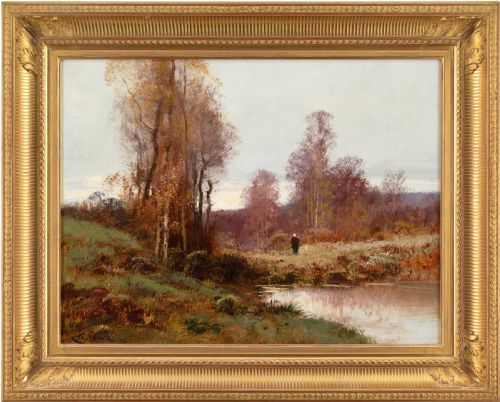
Frames frequently incorporate gilded wood and ornate mouldings, which complement the rich palette of russet, gold, and green pigments characteristic of the seasonal subject matter.
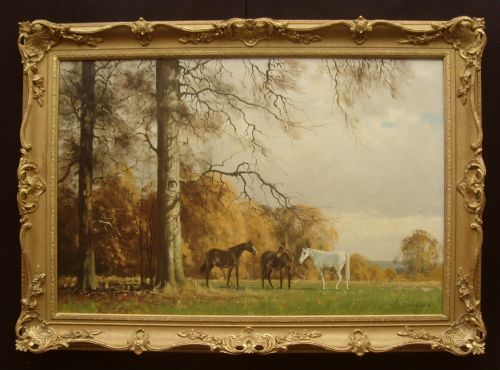
A solitary horse plows a Yorkshire field while autumn leaves quietly drift across the canvas.
What Varies in Quality
The handling of light and atmospheric depth distinguishes accomplished regional and academic works from more formulaic decorative output. Brushwork ranges from tight, academic realism to loose, expressive impressionism.
The integration of the original frame with the canvas, along with the subtlety of the colour palette used to render autumn foliage, marks the difference between standard studio production and a distinguished composition.
Frederick Marriott·Charles Clair·Arthur Herbert Rigg·Owen Bowen·William Mellor·John Falconar Slater·Frederick W. Jackson·Ernest Higgins Rigg·Ernest Moore·Augustus William Ennes·Percy Lancaster·Frank Walton·Alfred Oliver·William Greaves·Karl Heffner·Rudolf Bissen·Fred Lawson·James Torrington Bell·Ernst Ludwig Von Aster·Abraham Hulk Junior·Emil Wennerwald·Sigurd Solver Schou·Leon Marie Benoit·David Mead·Peter Wishart
The Autumn Landscape Oil Painting Glossary
- Oil on Canvas
- A traditional painting medium where oil-based pigments are applied to a woven fabric support stretched over a wooden frame.
- Wood Panel
- A rigid wooden support used by artists instead of canvas, often seen in nineteenth-century works.
- Gesso
- A white paint mixture consisting of a binder mixed with chalk, gypsum, or pigment, used to prepare a substrate for painting.
- British Impressionism
- A painting style influenced by the French movement, characterised by visible brushstrokes and an emphasis on light in British landscapes.
- Gilded Wood
- Wood treated with gold leaf or a gold-coloured metallic finish, commonly used for traditional picture frames.
Autumn Landscape Oil Painting: Frequently Asked Questions
How do I date an autumn landscape oil painting?
Dating relies on stylistic clues, framing methods, and the type of canvas or wood panel used by the artist. Signatures and exhibition labels on the reverse also provide firm chronological markers.
Changes in painting technique from nineteenth-century realism to mid-century expressionism help place a work within a specific decade.
Where were these landscape paintings produced?
The works originate from British, French, Danish, and German schools, reflecting regional approaches to rural scenery. Artists frequently painted specific river valleys and woodlands in Yorkshire, Scotland, and continental Europe.
Local topography often appears in the titles, identifying exact locations depicted by the artists.
How should I display an oil painting at home?
Hang paintings away from direct sunlight and steady heat sources to protect the oil pigments and the wooden stretcher or panel. Proper wall placement prevents warping of the canvas and damage to the gilded wood frame.
Allow adequate space around larger framed works so the composition commands the wall without crowding.
What subjects besides trees appear in these works?
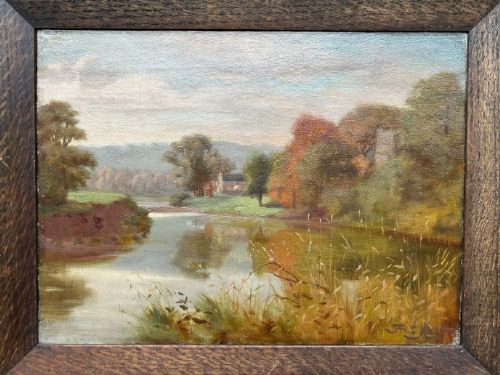
Beyond woodland scenes, compositions frequently include rivers, lakes, farmsteads, cattle, horses, and figures harvesting crops or walking through rural paths. Waterways and reflections of autumn foliage form a central motif in many river landscape pieces.
Architectural elements such as distant cathedrals, country houses, and park statues also feature in selected works.