
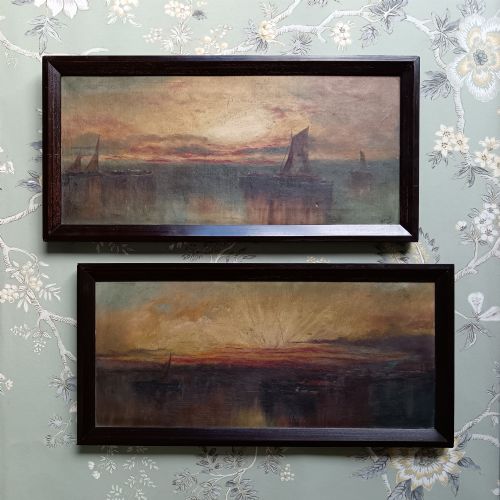


Atmospheric Landscape Wall Artwork
Atmospheric landscape wall artwork captures sweeping horizons and changing weather, offering an immediate sense of place for any room.
Atmospheric Landscape Wall Artwork
Atmospheric landscape wall artwork spans coastal scenes, riverbanks, and mountain views created across several distinct periods. Buyers searching for atmospheric landscape wall artwork encounter works originating from the nineteenth century through to the mid-twentieth century.
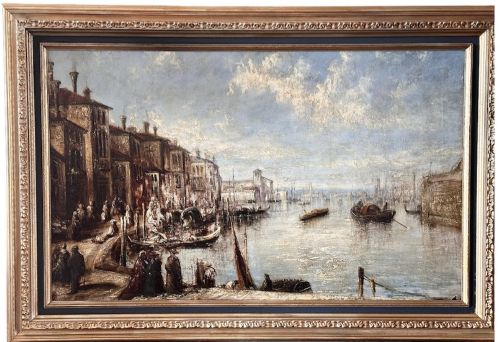
The selection includes British Impressionism, Victorian pieces, and later Modernism. Subjects range from tranquil marine sunrises to moody northern harbours and bustling cityscapes.
Compositions often focus on natural light, water, and vast skies. These paintings bring historic breadth and varied regional character directly to domestic interiors.
Materials and techniques
Artists relied primarily on oil on canvas, oil on board, and watercolour on paper. Canvases and wooden boards provided robust surfaces for layered oil pigments, while watercolour allowed for fluid washes in depicting coastal air and mist.
Framed glass frequently protected works on paper, preserving delicate watercolours against environmental moisture. Wood served widely as a stable backing material for smaller oil paintings.
Listings feature works executed in oil on canvas, oil on board, and watercolour on paper across various nineteenth and twentieth-century periods.
Factors of quality
Quality rests upon the artist's ability to manipulate light, tone, and brushwork to convey weather and distance effectively. Stronger examples display confident handling of pigment that creates genuine depth within the scene.
Condition of the canvas or paper surface, along with the retention of original framing, influences the overall standing of each piece. Works bearing clear signatures or established stylistic traits command closer attention from collectors.
Francis Moltino·Robert Leslie Howey·George Weatherill·Gudrun Sibbons·H. Hadfield Cubley·Edward Seago·Owen Bowen·Frank Shenton·Herbert John Finn·William Kay Blacklock·James Kay
The Atmospheric Landscape Wall Artwork Glossary
- Oil on canvas
- Pigment suspended in drying oil applied to a woven fabric support. This technique allows for rich texture and deep colour saturation.
- Watercolour
- A paint consisting of colour suspended in a water-soluble vehicle, typically used on paper. It creates luminous, transparent washes ideal for capturing skies.
- Board
- A rigid flat panel, often wood or compressed material, used as a painting support instead of stretched fabric.
- British Impressionism
- A painting style focusing on light and everyday subjects through visible brushstrokes. It developed distinct regional characteristics across the British Isles.
- Modernism
- An artistic movement departing from traditional representation in favour of simplified forms and expressive colour. It emerged strongly in the early twentieth century.
Atmospheric Landscape Wall Artwork: Frequently Asked Questions
How do I hang atmospheric landscape wall artwork?
Position the artwork at eye level to allow comfortable viewing of the horizon and fine details. Ensure adequate wall space is given so the composition is not crowded by surrounding furniture.
Secure proper fixings into the wall appropriate for the weight of the frame and canvas. Keep paintings away from direct heat sources and strong sunlight to protect the pigments.
What periods do these landscape artworks cover?
The selections span from the Victorian nineteenth century through Edwardian times and into mid-century modernism. Each era brings distinct framing styles and handling of light.
Twentieth-century examples often lean towards British Impressionism or modernist abstraction. Nineteenth-century pieces tend to focus on topographical accuracy and traditional marine scenes.
Are watercolours as durable as oil paintings?
Watercolours on paper require glass protection and careful placement away from direct light to prevent fading. When properly framed, they remain stable and retain their delicate washes.
Oil paintings on canvas or board offer greater physical resilience against environmental moisture. Both mediums have survived well across past centuries with standard domestic care.
How do I identify a Victorian landscape painting?
Look for detailed brushwork, narrative elements involving figures like fishermen, and traditional canvas supports. Subject matter often centres on British coastal landmarks or dramatic river views.
Heavier gilded frames frequently accompany these pieces, reflecting nineteenth-century interior tastes. Signatures may appear subtle or distinct depending on the academy training of the artist.