
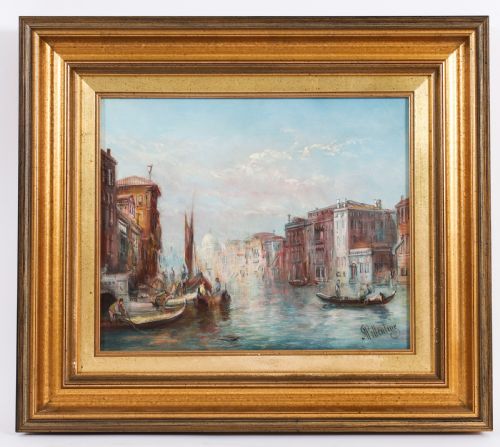
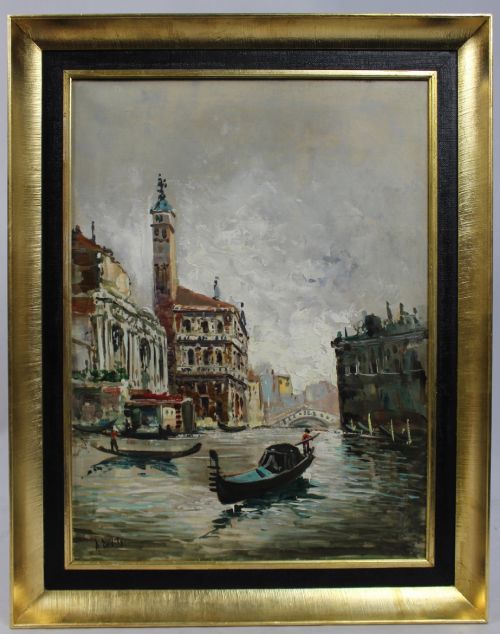


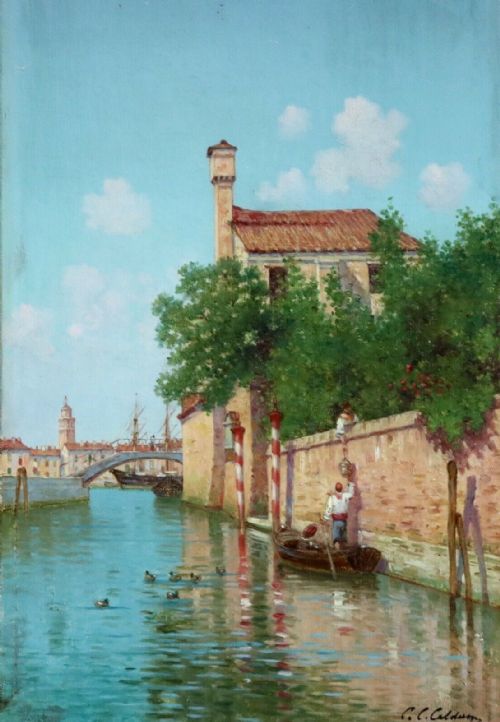
Gondola Canal Scene Painting
These gondola canal scene painting works capture the light and architecture of Venice across the nineteenth and twentieth centuries.
Gondola Canal Scene Painting
When you search for a gondola canal scene painting, you are looking at depictions of Venetian waterways featuring the city's iconic boats and architecture. The pieces available here span from the Victorian era through the mid-twentieth century, including works from the nineteenth century, 1880, 1910, 1920, 1930, and 1960.
The most common forms you will meet are oil paintings on canvas and watercolour paintings on paper, alongside pastel, gouache, and ink pen drawings. These range from detailed nineteenth-century fine art compositions to Impressionist and French Post-Impressionist interpretations.
Subjects frequently centre on specific Venetian landmarks such as the Grand Canal, the Mocenigo Palace, and the Bridge of Sighs. Painters capture these scenes under various lighting conditions, from bright daylight to moonlight.
How they were made
These works rely primarily on oil paint applied to canvas or watercolour and gouache applied to paper. Artists built up their compositions using brushes to capture the reflections of light on the water and the textures of historic stone and plaster.
Many of these paintings are housed in their original or period-appropriate frames made of wood, giltwood, or gilded wood. The framing materials complement the visual weight of the canvas and protect the edges from wear.
The listings span from the Victorian period through the 1960s, utilising oil paint, canvas, watercolour, paper, and giltwood frames.
What varies in quality
Quality in these Venetian scenes is determined by the artist's handling of light and atmospheric perspective across the water. Finer works demonstrate a confident command of colour and brushwork that brings the Venetian atmosphere to life.
The choice of medium and the condition of the support also define the piece. Well-preserved oil on canvas works and crisp watercolours retain their original vibrancy, whereas compromised pieces show fading or surface damage.
Alfred Pollentine·Antonio DeVity·F.D. Campo·Marc Aldine·Jane Vivian·Vittore Zanetti Zilla·Antoine Bouvard Senior·Charles Clement Calderon
The Gondola Canal Scene Painting Glossary
- Gondola
- A traditional, flat-bottomed Venetian rowing boat central to these canal scenes. It is navigated by a gondolier using a single oar.
- Oil on Canvas
- A painting medium where pigments are suspended in a drying oil, applied to stretched fabric. This combination allows for rich colour blending and texture.
- Watercolour Painting
- A medium where coloured pigments are suspended in a water-based solution, typically applied to paper. It produces transparent layers of colour.
- Giltwood
- Wood that has been treated with a thin layer of gold leaf or gold paint. It is commonly found on the frames surrounding these paintings.
Gondola Canal Scene Painting: Frequently Asked Questions
How do I date a Venetian canal painting?
Dating relies on stylistic clues, clothing styles of figures such as gondoliers, and framing materials. Signatures and artist biographical dates also provide a clear timeframe.
Works from the nineteenth century often feature more rigid academic realism, while early twentieth-century examples lean towards impressionistic brushwork and lighter palettes.
Are these paintings original or prints?
The pieces listed are original works, including oil paintings on canvas, watercolours, pastels, gouaches, and ink drawings. Each item is a unique hand-painted or hand-drawn creation.
Close inspection under magnification reveals the individual brushstrokes, pigment thickness, and paper or canvas texture characteristic of original art.
How should I hang and light an oil painting?
Hang your painting on an interior wall away from direct sunlight and sudden temperature fluctuations. This protects both the canvas and the wooden frame from warping or cracking.
Use low-heat picture lights or ambient room lighting to illuminate the surface without exposing the pigments to harmful ultraviolet radiation.
What is the difference between oil and watercolour?
Oil paint uses a drying oil binder that sits on top of the canvas, allowing for thick impasto application and deep, luminous colour blending. Watercolour uses a water-soluble binder on paper, creating translucent washes.
Watercolours require protective glass framing to prevent moisture damage, whereas oil paintings on canvas remain open to the air.