


Asian Wooden Hall Table
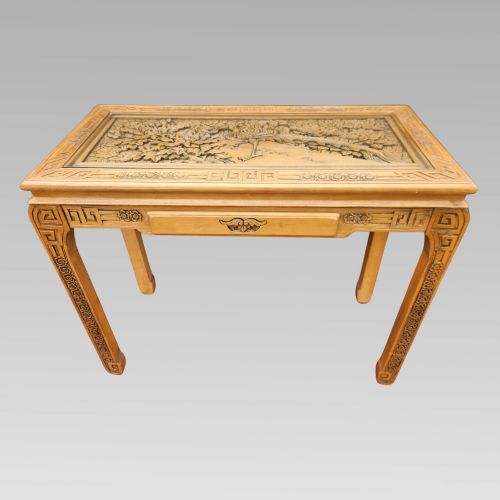
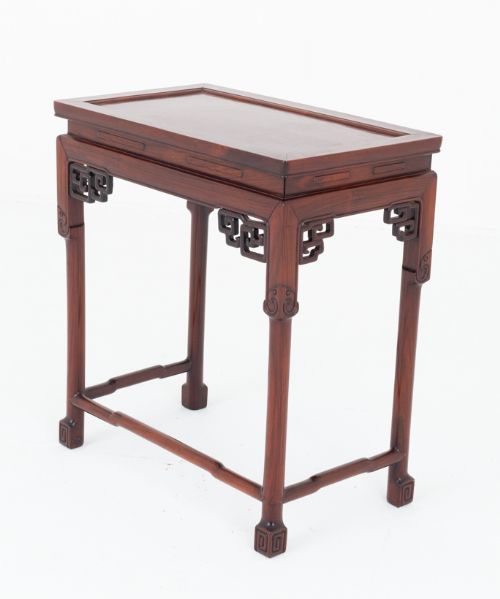
An asian wooden hall table brings carved elm, camphorwood, and rich hardwood into an entranceway, offering surface and presence.
Asian Wooden Hall Table
When you search for an asian wooden hall table, you encounter console tables, side tables, altar tables, and occasional tables originating from Chinese traditions. These forms date from the nineteenth century through the early decades of the twentieth century, including pieces linked to the Qing dynasty and Chinese provincial workshops.
The version most commonly met on this page is the elm console or side table, often featuring carved details and functional drawers. Alongside these sit larger altar tables, writing desks, and centre tables constructed from dense hardwoods and amboyna.
These tables serve narrow spaces, entrance halls, and living rooms where a low profile and strong timber grain provide both utility and decorative weight. The assortment spans simple provincial work to heavily carved oriental pieces.
How they were made
Cabinetmakers utilised indigenous timbers such as elm, camphorwood, and dense Asian hardwoods, sometimes applying lacquer or incorporating brass and glass elements. Elm supplies a pronounced grain, while heavier hardwoods provide the structural integrity required for large console and altar forms.
Joinery relied on traditional framing and pegging methods rather than modern fasteners, allowing the timber to expand and contract naturally. Carved ornament on apron rails and legs was executed by hand, defining styles from Chinese provincial to Qing dynasty pieces.
Listings span the nineteenth century, 1900, 1910, 1920, and 1930, utilising elm, hardwood, brass, glass, lacquer, camphorwood, amboyna, and metal.
What varies in quality
The distinction between standard and superior pieces rests on the choice of timber and the crispness of the hand carving. Denser hardwoods and figured elm command greater attention than utilitarian softwood frames.
Proportion and structural retention also separate examples, where clean lines, original brass hardware, and intact lacquer surfaces preserve the integrity of the piece over centuries.
The Asian Wooden Hall Table Glossary
- Elm
- A durable timber with a distinct open grain frequently chosen for Chinese provincial furniture. It responds well to carving and ages with a warm patina.
- Altar table
- A traditional elevated form featuring upturned flanges at the short ends, originally designed for ritual use. These tables now function as narrow console tables in domestic interiors.
- Console table
- A wall-mounted or freestanding table designed to stand against a flat surface in a hallway or reception room. They typically offer a shallow depth to save floor space.
- Chinoiserie
- European interpretation and imitation of Chinese artistic traditions and motifs, applied to furniture and decorative arts. It reflects a long-standing Western fascination with oriental design.
Asian Wooden Hall Table: Frequently Asked Questions
Where should I place an altar table?
An altar table suits narrow hallways, entrance spaces, or against a living room wall where its shallow depth and characteristic upturned ends can be appreciated.
Because these tables were originally built for display rather than heavy dining use, they function best holding lamps, ceramics, or decorative objects.
How do I care for elm furniture?
Elm furniture benefits from a stable indoor environment away from direct heat sources and strong sunlight, which can dry out the timber.
Dust the surface regularly with a soft dry cloth and apply a quality natural wax occasionally to nourish the grain.
What is the difference between a console and a side table?
A console table is traditionally designed to stand directly against a wall, often featuring decorative work primarily on the front and sides.
A side table is generally a more versatile freestanding piece that can be moved easily around a room to serve as a surface.
How can I tell the age of these tables?
Dating relies on observing construction methods, timber shrinkage, wear patterns, and the stylistic markers associated with nineteenth-century or early twentieth-century workshops.
Examining the underside and joinery reveals hand-tool marks and traditional construction techniques consistent with the period.