


Art Nouveau Glass Plate
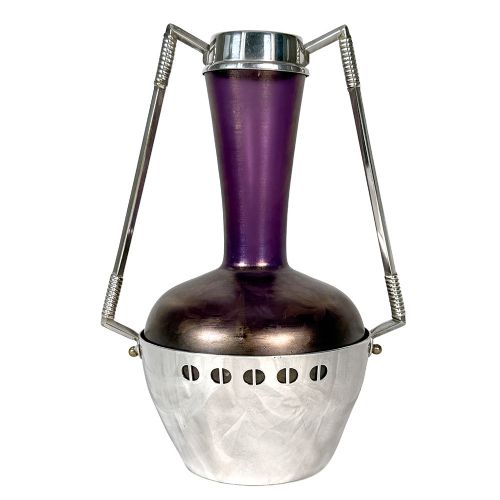
An art nouveau glass plate brings flowing botanical lines and iridescent colour into a room, combining tactile moulded glass with gleaming metal mounts.
Art Nouveau Glass Plate
When you search for an art nouveau glass plate, you enter a field defined by organic curves, whiplash lines, and naturalistic motifs characteristic of the turn of the twentieth century. These decorative items range from flat presentation dishes to deep bowls and baskets designed to hold fruit or flowers on a table.
The pieces appearing on this page draw from periods spanning the late Victorian era into the 1920s, with a strong concentration around nineteen hundred. German, English, and French makers dominate the record, producing domestic tablewares that merge functional glass vessels with elaborate metal frameworks.
You will encounter various formats, from simple moulded glass inserts resting in metal stands to elaborate figural centrepieces and pedestal dishes. The glass itself serves multiple roles, functioning as a standalone decorative plate or as a coloured liner within a silver-plated or pewter mount.
Materials and production methods
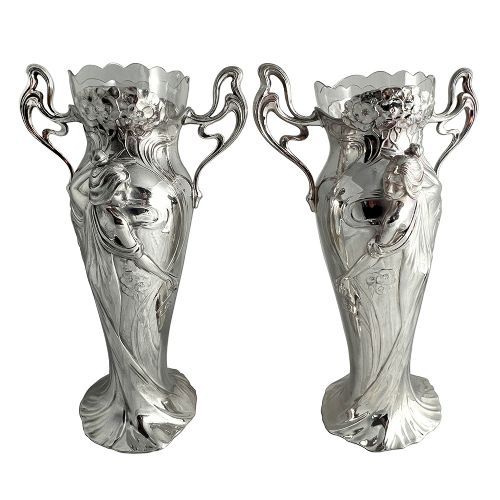
Makers combined glass and metal through specialised casting and plating techniques, pairing blown or moulded vessels with silver plate, pewter, and silvered bronze. The metal mounts often took the form of sinuous stems, curling leaves, or stylised maiden figures that cradled the glass securely.
The glass elements utilise distinctive coloration and surface treatments, including vaseline glass, ruby glass, cranberry glass, and sepia staining. Acid etching and applied trails provided additional texture and pattern to the transparent surfaces.
Several items feature cast maidens with cascading hair who appear to hold up the glass dishes with quiet patience.
What separates examples
Quality rests upon the crispness of the metal casting and the harmony between the glass insert and its mount. Superior examples display deeply chased details on the silver plate or silvered pewter, where figures and plant stems appear sharply defined rather than soft or smoothed over from worn moulds.
The integration of the original glass liner dictates the integrity of the piece. Matching coloured glass vessels that fit their metal stands precisely demonstrate higher desirability than later replacement liners or mismatched components.
WMF·Rene Lalique·Hukin & Heath·Christofle et Cie
The Art Nouveau Glass Plate Glossary
- Vaseline glass
- A type of glass coloured with uranium oxide that exhibits a distinct yellow-green fluorescence under ultraviolet light. It appears frequently in nineteen-hundred tablewares.
- Jugendstil
- The German manifestation of the Art Nouveau movement, translating as youth style. It emphasises floral motifs and linear abstraction.
- Silvered pewter
- A metal alloy coated with a thin layer of silver, commonly utilised by continental European manufacturers for sculptural stands and mounts. It offers a muted metallic sheen.
- Centrepiece
- A large decorative vessel placed in the middle of a dining table. These often combine glass bowls with elaborate metal figural pedestals.
- Sepia stain
- A brownish pigment applied to moulded glass surfaces to highlight relief details. It creates tonal depth across figural scenes.
Art Nouveau Glass Plate: Frequently Asked Questions
What is an art nouveau glass plate used for?
These items functioned primarily as decorative serveware, holding fruit, biscuits, or floral arrangements during dining occasions. They sat upon sideboards or dining tables as ornamental centerpieces.
Today, owners utilise them to display decorative objects or retain them as standalone aesthetic items within a room.
How do I identify a piece from this period?
Look for characteristic design elements such as asymmetrical floral patterns, whip-like curves, and stylised female figures. The presence of silvered pewter or heavy silver plate alongside coloured glass points towards the turn of the twentieth century.
Maker stamps on the metal mounts provide definitive confirmation of origin and date.
What are the common glass colours found?
The listings show a preference for vibrant hues, including green vaseline glass, deep ruby, cranberry, and clear glass treated with acid etching or sepia stain. These colours enhanced the decorative impact under dining room lighting.
Many vessels feature textured surfaces or applied trails that catch the light from various angles.
How should I care for metal and glass combinations?
Clean the glass gently with warm soapy water, removing the insert from its metal mount whenever possible to prevent moisture accumulation. Avoid abrasive polishes on silver-plated or silvered pewter surfaces.
Handle figural metalwork with care to protect delicate cast details and patination.