
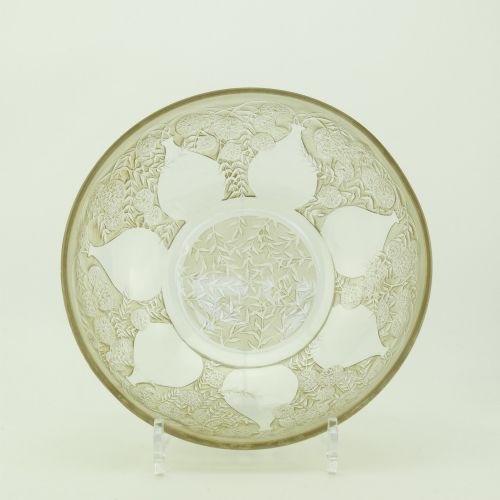


Decorative Glass Charger
These decorative glass chargers are striking statement pieces designed to command attention on a table or wall.
Decorative Glass Charger
A decorative glass charger is a large display plate or salver created to hold its own as a centrepiece rather than serve functional dining purposes. These pieces emerge primarily from the early twentieth century, spanning the nineteen twenties and nineteen thirties.
The versions most commonly met on this page showcase the dramatic geometric lines of the Art Deco style alongside the flowing, organic motifs of Art Nouveau. They manifest as shallow bowls, salvers, and wide plates intended strictly for visual appreciation.
Makers from France dominate this category, shaping heavy, sculptural table art from pressed and moulded blanks. Each charger relies on sheer scale and texture to create an immediate focal point in a room.
Manufacturing methods and materials
Production relies heavily on moulded glass, utilising heavy iron or steel presses to shape molten material into thick, resilient blanks. This technique allows for deep relief work and complex three-dimensional patterns on the underside of each charger.
Makers manipulate light through frosted glass finishes and opalescent glass formulations that shift in tone depending on the angle of illumination. Sepia stain is frequently applied to recessed areas to create high contrast and highlight the intricate details of the design.
Early twentieth-century French glass makers often captured entire schools of fish or bustling hunting scenes frozen permanently beneath thick, glowing roundels.
Distinctions in quality
Quality rests primarily on the crispness of the moulded relief and the depth of the inner design. Superior pieces maintain sharp, highly defined motifs where every feather, scale, or floral petal remains distinct against the surrounding glass.
The treatment of the material itself separates standard examples from exceptional ones. Opalescent qualities that throw vibrant blue and amber tones in direct light, combined with masterfully wiped sepia stains, elevate a piece far above simpler clear glass productions.
Rene Lalique·Sabino
The Decorative Glass Charger Glossary
- Opalescent glass
- Glass that displays a milky, translucent quality with shifting tones of blue and amber when viewed in direct light. This optical effect is achieved by adding specific chemical agents to the molten batch before pressing.
- Moulded glass
- Glass shaped by being pressed into a metal or wooden form under heavy pressure. This technique permits the rapid production of deep relief patterns across heavy tablewares.
- Sepia stain
- A dark brownish pigment applied to the recessed portions of a glass design and then partially wiped away. The remaining stain settles into the crevices to accentuate the underlying moulded relief.
- Frosted glass
- Glass rendered opaque and non-reflective through acid etching or sandblasting. This matte surface texture diffuses light softly across the decoration.
- Salver
- A flat, broad serving vessel or decorative tray used for display. In glass manufacture, it denotes a substantial charger with a raised rim.
Decorative Glass Charger: Frequently Asked Questions
What is a decorative glass charger?
A decorative glass charger is a wide, substantial plate or salver made for display rather than everyday dining.
These pieces use heavy moulded glass and striking surface treatments to act as visual centrepieces.
How were these glass chargers used?
They were designed as ornamental objects intended to sit upon sideboards, tables, or walls where light could pass through them.
Owners prized them for their ability to catch and refract ambient light within a room.
How do I style a glass charger?
These chargers look best placed flat on a dark wooden surface or mounted securely on a wall bracket with dedicated illumination.
Keeping them away from high-traffic areas protects their heavy moulded surfaces from accidental knocks.
How can I tell the Art Deco pieces apart?
Art Deco chargers feature strict symmetry, geometric patterns, and stylised depictions of animals or human figures.
They stand distinct from earlier organic forms by embracing rigid lines and industrial strength.