





Art Nouveau Credenza
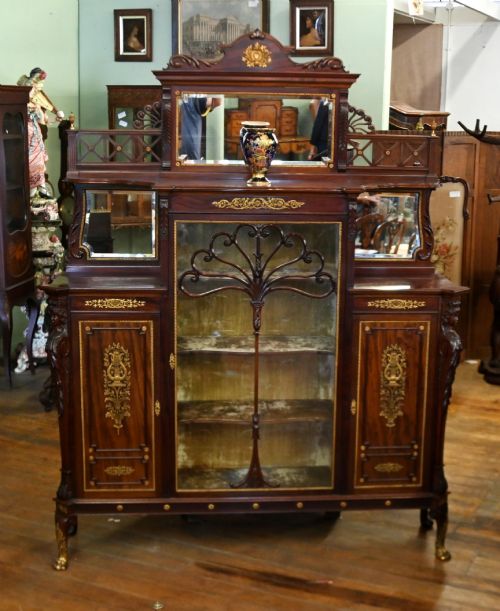
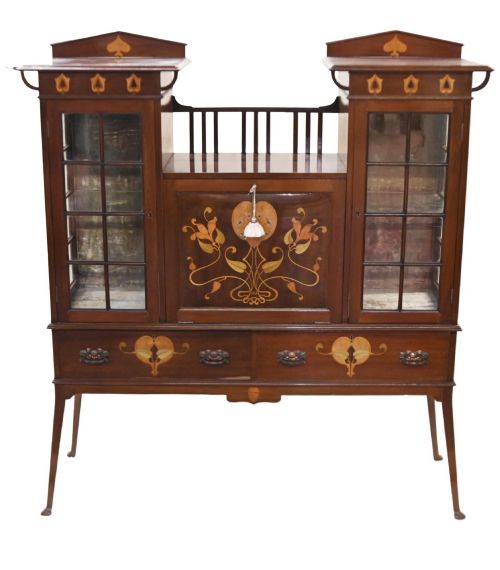
These art nouveau credenza selections are statement timber storage pieces that bring organic curves and copper highlights to a dining room.
Art Nouveau Credenza
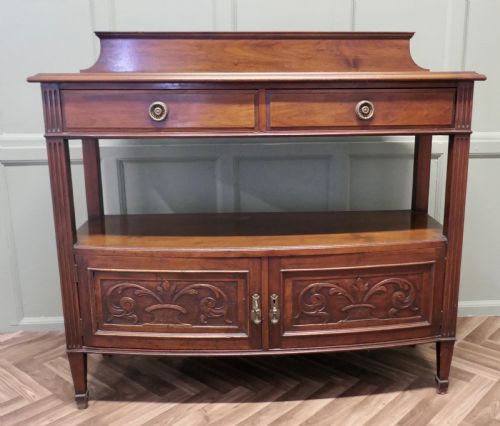
An art nouveau credenza generally appears in oak, mahogany, or walnut, functioning primarily as a sideboard, buffet, or display cabinet with storage. You meet these pieces most frequently in Edwardian, Victorian, and nineteenth-century forms, often sharing stylistic ground with the Arts and Crafts movement.
The dominant formats on this page span carved sideboards, mirror-back cabinets, and dresser combinations. Regional variations stretch from British workshops to continental makers such as the Amsterdam School in Holland.
Materials and construction
Maker workshops built these pieces using solid timbers like oak, walnut, and mahogany, frequently enhanced by decorative wood inlay. Structural embellishments often incorporate brass and copper hardware alongside bevelled glass mirrors.
Carving and cabinet-making techniques define the surface work, tying standard sideboard forms into the flowing, organic lines characteristic of the period.
Art Nouveau Credenza Retail Price Guide 2026
Typical asking prices for art nouveau credenza among the pieces listed under this phrase on Sellingantiques today, from the lower quarter to the upper quarter. They describe what is for sale here now, not the wider market.
Several sideboards come equipped with mirror backs that were originally intended to bounce candlelight around a dim Victorian dining room.
Assessing quality
Quality rests upon the ambition of the timber carving and the integration of auxiliary materials like copper mounts and mirror glass. Pieces displaying distinct regional attribution or complex transitional styles tend to stand apart from simpler utility storage.
The sophistication of the wood inlay and the crispness of the carved details dictate the overall standing of an individual sideboard or display cabinet.
Shapland and Petter
The Art Nouveau Credenza Glossary
- Credenza
- A sideboard or buffet used for storage and serving, often featuring cupboards and display space. In this context, the term covers related sideboard and cabinet forms.
- Secessionist
- A stylistic offshoot of the period originating in central Europe, marked by geometric restraint and linear interpretation of organic themes. It appears alongside standard Art Nouveau and Arts and Crafts pieces.
- Amsterdam School
- A twentieth-century Dutch architectural and design movement focused on expressive brickwork and elaborate timber craftsmanship. Continental sideboards on this page connect to this tradition.
- Wood inlay
- The technique of inserting contrasting strips of wood into a solid surface to create decorative patterns. It frequently decorates the drawer fronts and cabinet doors of these pieces.
- Mirror back
- An upright wooden superstructure holding a reflective glass panel above the main sideboard surface. This feature adds light and visual depth to display cabinets.
Art Nouveau Credenza: Frequently Asked Questions
What is an art nouveau credenza?
These pieces are large wooden storage items, typically taking the form of sideboards, display cabinets, or buffets equipped with cupboards and sometimes mirror backs.
They combine practical dining room utility with the characteristic flowing lines, botanical carvings, and metal mounts of the period.
How do I date these sideboards?
Dating relies on identifying the underlying style, such as Victorian, Edwardian, or specific nineteenth-century manufacturing traits, alongside timber choices like oak and mahogany.
Design overlaps with the Arts and Crafts movement and Secessionist ideals also help place the piece within its historical window.
Where were these cabinets made?
Production spans British workshops and continental European centres, with specific pieces attributed to Dutch makers like the Amsterdam School.
Regional differences appear in the timber selection, the treatment of mirror frames, and the execution of the wood inlay.
How do I live with one?
These substantial timber items require adequate wall space in a dining room, hallway, or living area to function as focal storage points.
Their glass doors and mirrored backs naturally reflect light, making them useful for brightening darker corners while holding tableware or decorative objects.