


Art Deco Enamel Pin
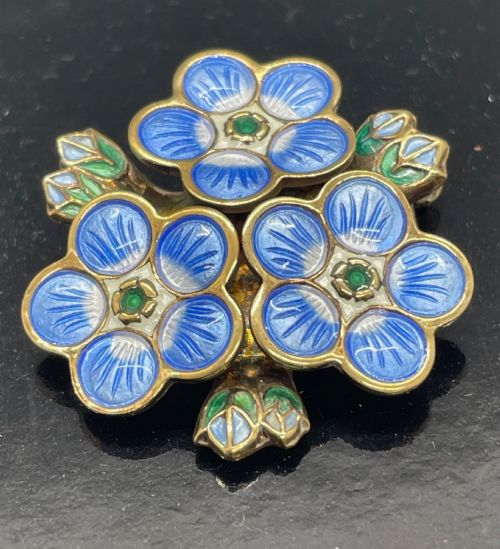
These art deco enamel pin pieces bring geometric lines and vivid colour, catching the eye as sharp lapel highlights or functional closures.
Art Deco Enamel Pin
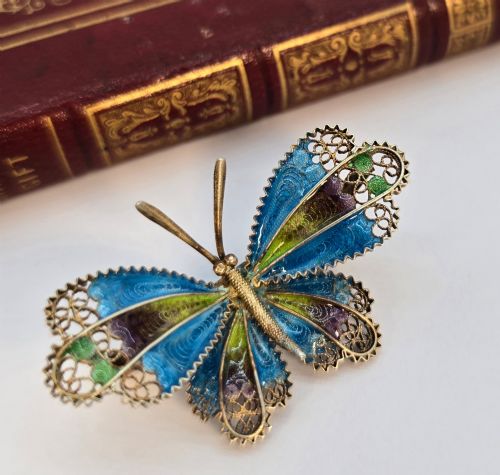
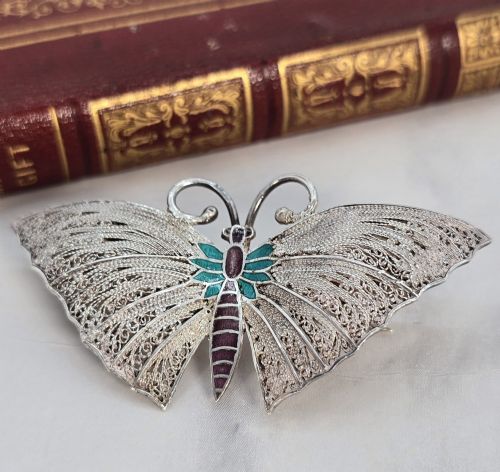
When searching for an art deco enamel pin, a buyer encounters geometric dress accessories, tie pins, and insect brooches originating from the nineteen-twenties and nineteen-thirties. The selection spans delicate butterfly and dragonfly motifs alongside bold enamel highlights set in silver or chrome.
Continental, Chinese export, and Scandinavian workshops produced many of the butterfly and floral brooches seen here. English makers tended to focus on gentleman's tie pins and small personal accessories using similar vitreous techniques.
Materials and construction methods
Makers fused powdered glass onto sterling silver, silver gilt, or base metals at high temperatures to create smooth vitreous surfaces. Guilloche enamel required a precise engine-turned pattern beneath translucent coloured glass to reflect light across the piece.
Filigree wirework often outlined the wings of insect brooches, framing the coloured enamel sections by hand. Silver framing provided structural support while chrome or brass served in utilitarian tie pins and novelty pieces.
Listings feature sterling silver, brass, and chrome alongside vitreous enamel and butterfly wing materials dating strictly to the interwar period.
Assessing quality in enamelled metalwork
The precision of the engine-turned guilloche pattern beneath the glaze distinguishes finer items from simpler output. Crisp geometric regularity and depth in the translucent enamel indicate superior workshop execution.
The retention of original gilding and the absence of chipping in the glass surface mark the better examples. Fine silver filigree work requires delicate soldering that remains intact under magnification.
David Andersen·Henry Clifford Davis·Crisford and Norris·Turner and Simpson·Mappin and Webb·William Neale and Son·Cohen and Charles·Walker Hall
The Art Deco Enamel Pin Glossary
- Guilloche
- An ornamental engraving technique that etches precise repetitive geometric patterns into metal before applying transparent enamel.
- Vitreous enamel
- Glass powder melted at high heat onto a metal substrate to form a durable, glossy coloured coating.
- Silver gilt
- Silver objects coated with a thin layer of gold to give a warm yellow metal appearance.
- Filigree
- Delicate ornamental work consisting of fine twisted silver wire soldered together in open patterns.
- Tie pin
- A small decorative pin used to secure a necktie to the shirt front.
Art Deco Enamel Pin: Frequently Asked Questions
Were these pins worn by men or women?
Both genders wore these items depending on the specific form. Tie pins and small geometric bars served men's tailoring, while larger butterfly brooches and decorative pins belonged to women's dress.
Utility and fashion often overlapped in the nineteen-thirties, leading to shared use of smaller lapel ornaments.
How can I date an art deco pin?
Hallmarks stamped on silver mounts provide the most reliable date markers, revealing the assay office and assay year. Stylistic cues such as streamlined symmetry and specific colour palettes point to the interwar decades.
Comparing construction techniques with known workshop output helps narrow the production window further.
What is butterfly wing jewellery?
Butterfly wing jewellery uses iridescent scales trapped beneath a clear glass or quartz cover to form the wings of depicted insects. This technique gained popularity during the early twentieth century alongside standard enamel work.
Artists arranged the natural blue and black scales to catch the light from different angles.