

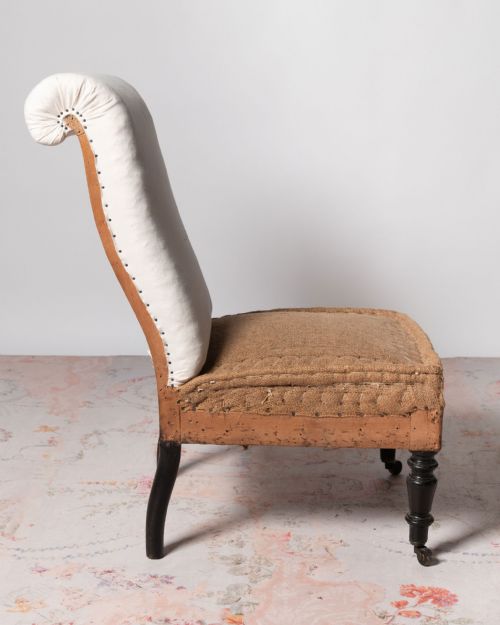
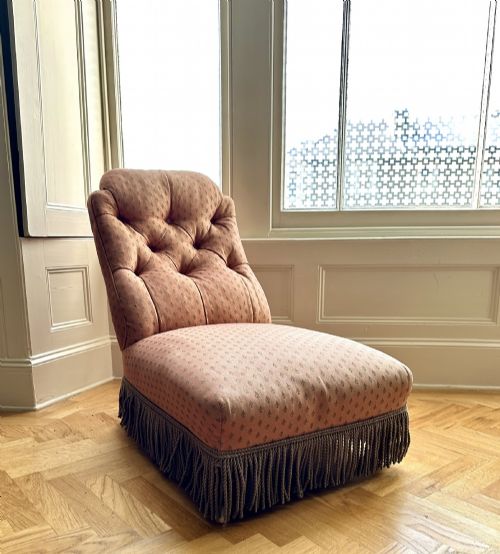


Armless Boudoir Chair
An armless boudoir chair is a low, upholstered seat designed for dressing rooms and bedrooms, offering compact comfort and period elegance.
Armless Boudoir Chair
An armless boudoir chair takes the form of a low-slung, upholstered seat designed for the bedroom or dressing room, often referred to in the evidence as a slipper chair or accent chair. These pieces belong entirely to the nineteenth century, reflecting Victorian and French Napoleon III tastes. They are built without arms to allow comfortable seating while dressing or putting on shoes.
The versions most commonly met on this page are nineteenth century French and Victorian examples, featuring curvaceous silhouettes and low wooden frames. Some items appear ready for fresh upholstery, while others retain historic textiles like fringe, hessian, and calico. Their primary appeal lies in their compact proportions and historic decorative presence.
How they were made
Makers constructed the frames of an armless boudoir chair using timber and mahogany, shaping them into scroll backs and curvaceous lines characteristic of the nineteenth century. Brass details and gilt legs occasionally appear on these frames to add decorative contrast. Traditional upholstery methods relied on foundational materials like hessian and calico beneath the outer textile layer.
The outer finish typically involved decorative fabric, textile, and fringe, creating a soft and inviting appearance suited to private chambers. Frames were built low to the ground, requiring precise woodworking to ensure structural integrity without the support of traditional armrests.
Armless Boudoir Chair Retail Price Guide 2026
Typical asking prices for armless boudoir chair among the pieces listed under this phrase on Sellingantiques today, from the lower quarter to the upper quarter. They describe what is for sale here now, not the wider market.
Materials recorded across the inventory include mahogany, brass, calico, hessian, and various textiles.
What varies in quality
The standard of an armless boudoir chair is judged by the grace of its carved wooden frame and the integrity of its underlying construction. Pieces attributed to notable workshops command attention through refined proportions and superior timber selection. Conversely, simpler or more utilitarian nineteenth century examples rely entirely on their basic silhouette.
Another distinction lies in the survival of original decorative elements, such as gilt legs, brass mounts, and period fringe. Items requiring complete re-upholstery present a different proposition to collectors compared to those retaining historic textile coverings.
Hindley and Sons·Howard and Sons
The Armless Boudoir Chair Glossary
- Slipper chair
- A low-set, armless boudoir chair originally designed for use in a bedroom or dressing room. These seats are traditionally positioned close to the floor.
- Napoleon III
- A French design style spanning the nineteenth century, known for eclectic revivals and curvaceous, ornate forms. Pieces from this origin often feature elaborate scroll backs.
- Hessian
- A coarse woven fabric utilised as traditional internal upholstery webbing and stuffing support. It provides a sturdy foundation beneath the outer textile.
- Calico
- A plain-woven cotton textile historically used as an underlying layer for upholstery before applying the decorative top fabric. It ensures a smooth surface for the final covering.
- Gilt
- A thin layer of gold leaf or gilt paint applied to wooden furniture legs and frames. This finish adds a reflective highlight to nineteenth century seating.
Armless Boudoir Chair: Frequently Asked Questions
What is an armless boudoir chair?
An armless boudoir chair is a low, upholstered seat designed for nineteenth century bedrooms and dressing rooms. These pieces provide compact seating without side restrictions.
They appear in Victorian and French Napoleon III styles, often called slipper chairs or accent chairs in period listings.
Where were these chairs used?
These chairs were traditionally kept in private chambers, dressing rooms, and bedrooms. Their low profile made them practical for sitting while dressing.
Today, they function well as accent seating in living spaces, studies, and modern bedrooms.
What materials are used?
Nineteenth century examples feature timber frames constructed from mahogany and other woods. Brass and gilt accents occasionally decorate the legs.
Upholstery materials include calico, hessian, fringe, and various decorative textiles.
How do I identify a French piece?
French nineteenth century pieces, particularly those from the Napoleon III period, often feature pronounced scroll backs and curvaceous silhouettes. Their frames display distinctive continental cabinet-making traits.
They are frequently found listed alongside English Victorian examples on marketplace pages.