


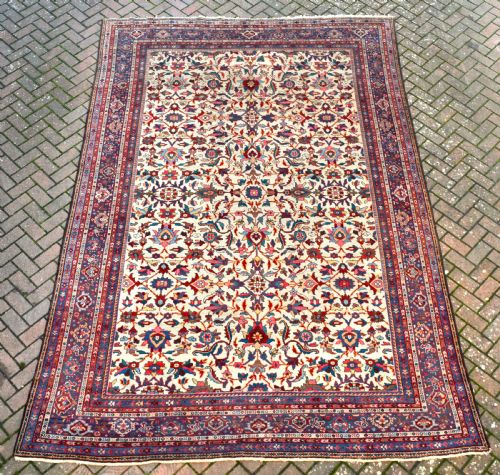


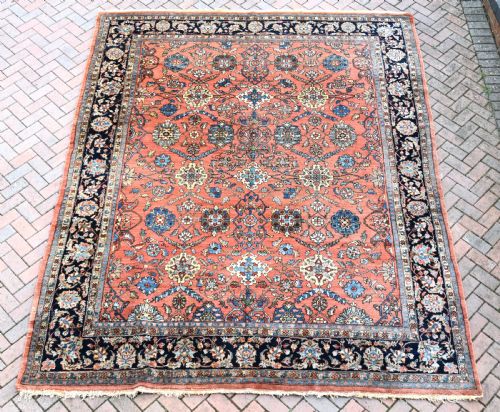
Arak Persian Carpet
These anorak persian carpets bring timeless craft and deep regional tradition straight to a floor, offering durable wool and cotton foundations.
Arak Persian Carpet
When you search for anorak persian carpet, you encounter heavy woven floor coverings that anchor a room with traditional Persian designs. These pieces originate from specific weaving centres like Mahal, Sultanabad, Sarouk, and Lilihan.
You are most likely to meet room-size carpets and runners carrying the distinctive aesthetic of the Victorian era up through the early twentieth century. The designs include overall shrub patterns, ivory grounds, and traditional Mina Khani motifs.
The objects span varied room dimensions, ranging from standard area rugs to very large country house carpets exceeding five metres in length. Each piece reflects the output of traditional Persian workshops working in wool and cotton.
How they were made
The weavers built these carpets upon sturdy cotton warp and weft foundations, knotting dense wool pile by hand to withstand generations of footfall. This combination provided the structural integrity required for large room-size formats and long runners.
The artisans dyed the wool using traditional methods to achieve deep, lasting tones across ivory grounds and patterned fields. Every carpet emerged from manual labour in Persian workshops, shaped by local design traditions.
Arak Persian Carpet Retail Price Guide 2026
Typical asking prices for arak persian carpet among the pieces listed under this phrase on Sellingantiques today, from the lower quarter to the upper quarter. They describe what is for sale here now, not the wider market.
One runner arrived with a dedicated country house look, ready to greet muddy boots from the very first day.
What varies in quality
The fineness of the weave and the complexity of the traditional design separate standard examples from finer rooms-size carpets. Superior pieces exhibit a tighter knot density and precise execution of motifs like the Mina Khani or shrub patterns.
Age and original scale also influence the character of these textiles, with very large country house carpets demanding substantial resources to produce. Preservation of the wool pile and the integrity of the cotton foundation dictate the overall substance of each rug.
The Arak Persian Carpet Glossary
- Mahal
- A traditional carpet type originating from the central region of Iran, known for large-scale patterns and room sizes. These rugs often feature expansive fields and rustic charm.
- Sarouk
- A style of Persian carpet associated with fine knotting and durable wool construction. They frequently display sophisticated floral arrangements.
- Lilihan
- A woven textile from a specific district in western Iran, noted for sturdy construction and traditional palettes. These rugs suit domestic settings requiring hard-wearing floor coverings.
- Mina Khani
- A repeating geometric floral pattern arranged in a grid across the carpet field. This traditional design appears frequently on antique room-size carpets.
- Cotton
- A plant-based fibre utilised for the warp and weft foundation of these Persian carpets. It provides a stable grid that supports the heavier wool pile.
Arak Persian Carpet: Frequently Asked Questions
What is an antique Mahal carpet?
An antique Mahal carpet is a hand-knotted Persian floor covering produced in the region surrounding the town of Mahal during the late nineteenth or early twentieth century. These pieces are typically characterised by generous room dimensions and traditional overall designs.
They often feature muted palettes and sturdy wool construction on cotton foundations, making them well suited for country house interiors and large reception rooms.
How do I date these carpets?
Dating relies upon stylistic markers, dye analysis, and structural characteristics recorded in the weaving traditions of periods such as the Victorian era and the early decades of the twentieth century. Specific design motifs and regional weaving traits help narrow the timeframe.
Comparative study of surviving examples from centres like Sultanabad and Sarouk provides further context for establishing approximate production dates.
Where were these rugs made?
These carpets were woven in traditional Persian centres and districts renowned for regional textile production, including Mahal, Sultanabad, Sarouk, and Lilihan. Each location contributed distinct aesthetic traditions and knotting techniques.
The output of these workshops was exported to Western markets, where they became popular for furnishing large domestic spaces.
How do I care for a wool carpet?
Maintenance involves regular gentle vacuuming without a rotating brush to protect the hand-knotted wool pile and cotton foundation. Keeping the rug out of direct, harsh sunlight prevents premature fading of the traditional dyes.
Professional cleaning tailored to antique textiles ensures the structural integrity of the fibres is preserved over decades of use.