





Antique Workbox on Legs
An antique workbox on legs brings neat storage and fine timber to a corner, giving a room a settled, purposeful air.
Antique Workbox on Legs
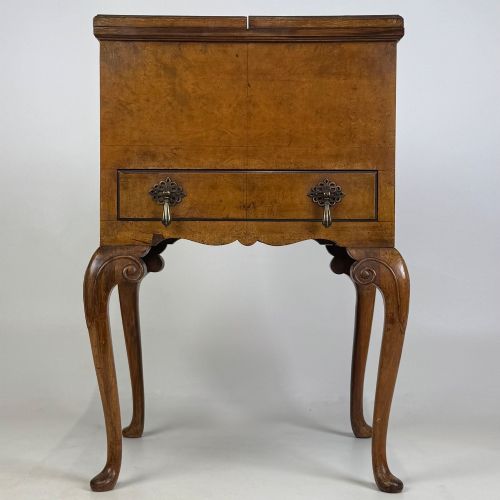
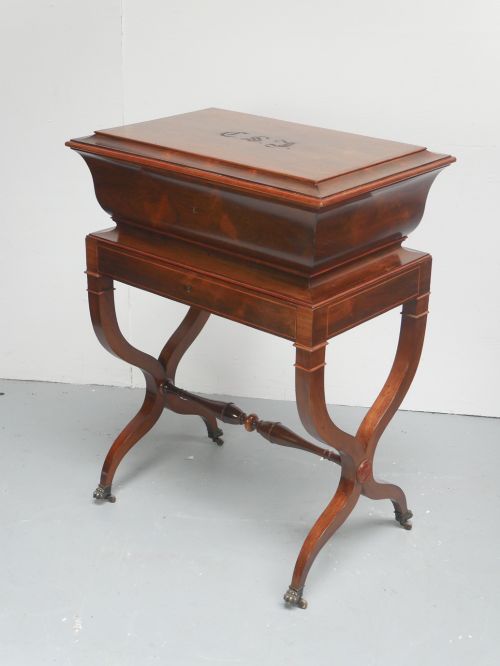
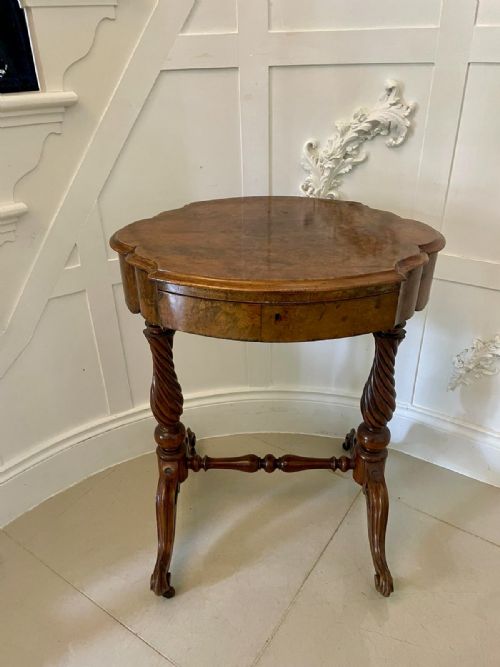
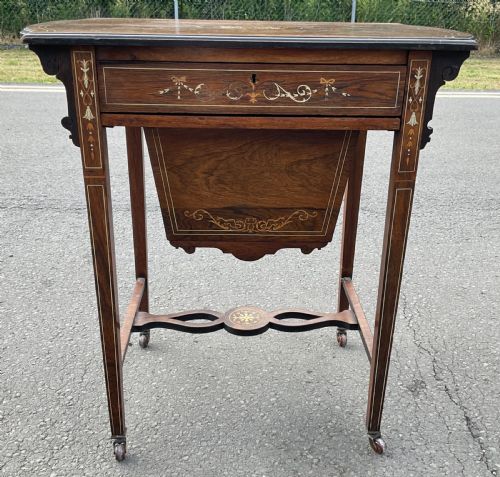
An antique workbox on legs combines a fitted storage container for needlework with a raised support structure, taking the form of sewing tables, side tables, cabinets, and occasional tables. Buyers searching this phrase encounter refined furniture designed to hold threads, fabrics, and small personal items within easy reach.
The examples recorded here span the Regency, Victorian, and Edwardian eras, alongside pieces from the mid nineteenth century up to nineteen twenty. Formats range from burr walnut cabinets and rosewood boxes on stands to mahogany work tables and oak sewing boxes.
Origins include standard British cabinet-making as well as continental pieces in French Restoration and French Rococo Revival styles. Buyers are most likely to meet walnut and rosewood versions fitted with delicate compartments and supported on slender legs.
How they were made
Cabinet-makers utilised dense hardwoods such as mahogany, walnut, and rosewood, often selecting burr walnut veneers for rich figuring across the lids and surfaces. Boxwood and brass provided contrasting inlay work and subtle stringing to outline panels and borders.
Internal compartments required meticulous joinery to create fitted trays and boxes for sewing tools, while turned or tapering legs elevated the main body. Surviving pieces frequently retain fabric linings and brass fittings that reflect the precise hand skills of the workshop.
Many a Victorian needlewoman relied on these hidden compartments to keep her stray pins permanently out of reach of visiting children.
What varies in quality
The choice of timber sets the baseline for quality, moving from simple oak and mahogany up to highly figured burr walnut and richly grained rosewood. Finer pieces demonstrate superior control in timber selection, matching grain patterns symmetrically across the lid and sides.
Execution of detail defines the upper tier, seen in crisp brass inlay, precise boxwood stringing, and well-executed French styles. The complexity of the internal fittings, from sliding trays to dedicated needle compartments, also separates standard utility pieces from high-status examples.
The Antique Workbox on Legs Glossary
- Burr walnut
- Timber taken from the gnarled growths of a walnut tree, prized for its swirling, highly decorative grain patterns. Makers applied it as a veneer to prominent surfaces.
- Stringing
- Thin lines of contrasting wood, such as boxwood, inlaid into furniture surfaces to create geometric borders. It highlights the edges of panels and tabletops.
- French Restoration
- A design period spanning the early nineteenth century characterised by restrained classical proportions and rich veneers. Pieces from this style often display elegant dark woods.
- Occasional table
- A small, versatile table designed for specific minor tasks or general placement around a room. In this context, it often doubles as a sewing stand.
Antique Workbox on Legs: Frequently Asked Questions
What is an antique workbox on legs?
An antique workbox on legs is a raised storage piece designed primarily for sewing materials, threads, and small valuables. These items combine a lidded compartment with a supportive base, functioning as both a decorative table and a practical container.
They appear in various woods like mahogany, walnut, and rosewood, reflecting the domestic habits of the nineteenth and early twentieth centuries.
How were these tables used originally?
These tables served ladies of the household for holding needlework, embroidery supplies, and personal trinkets while sitting in a parlour or drawing room. The internal trays kept spools, pins, and small tools organised and concealed beneath a closed lid.
Many designs also functioned as general lamp tables or occasional side tables when sewing was not underway.
How do I identify a Regency period piece?
Regency pieces often display classical restraint, dark rosewood timbers, and precise brass inlay work reflecting early nineteenth-century taste. They frequently incorporate French influences or formal geometric lines.
Makers of this era focused on clean architectural forms contrasted with rich grain patterns and metallic details.
Where should I place one in a modern home?
These compact pieces fit naturally beside an armchair, beside a sofa as an occasional table, or in a hallway as a small surface. Their internal storage makes them useful for hiding clutter while adding period character to a room.
Avoid placing them in areas of direct sunlight or heavy moisture to protect the delicate veneers and fabric linings.