


Antique Whitby Landscape
An antique whitby landscape captures the enduring maritime character and dramatic Yorkshire scenery of this historic coastal town through the eyes of earlier artists.
Antique Whitby Landscape
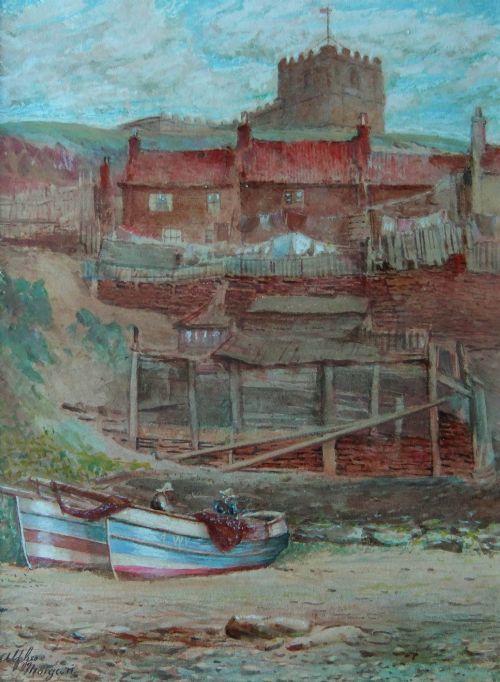
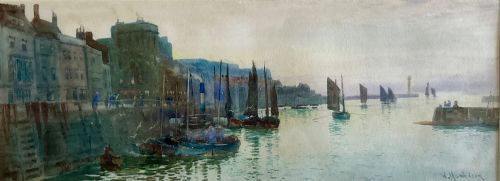
An antique whitby landscape focuses on the distinctive Yorkshire coastal geography, featuring the iconic abbey ruins, harbour scenes, and narrow town streets. These works capture the changing light over the North Sea and the River Esk estuary, documenting the maritime and domestic life of the region.
The watercolours and oil paintings span from the nineteenth century into the interwar decades, reflecting evolving artistic interpretations of the British coastline. The typical format presents a framed view of the harbour, piers, or surrounding countryside, executed with keen attention to local topography.
Collectors encounter watercolours most frequently on this page, though oil paintings on canvas, board, and card also appear alongside rarer diptychs. These pieces range from detailed architectural studies of the abbey and St Mary's Church to broader depictions of fishing boats and moorland edges.
How They Were Made
Artists built these watercolours using pigment applied to paper, often layering washes to render atmospheric effects of sea mist, evening light, and moonlit water. Pen and pencil underdrawings frequently anchor the composition before the application of colour.
Oil paintings on canvas, board, and card utilise thick pigment and brushwork to capture the texture of rough seas, moored vessels, and weathered stone buildings. Gilt wood frames traditionally enclose these works, complementing the tonal quality of the painted surface.
Watercolour pigment on paper predominates among these listings, supplemented by oil paintings on canvas, board, and card.
What Varies in Quality
The distinction between standard works and superior examples lies in the artist's command of atmospheric light and topographical precision. Stronger compositions convey the specific coastal atmosphere of Yorkshire rather than relying on formulaic renderings of the harbour and abbey.
Condition and preservation significantly influence the standing of an individual piece, particularly with works on paper exposed to light over decades. Original framing and clear artist attribution further elevate the standing of a painting within this genre.
Alfred G. Morgan·William Matthison·Tom Clough·George Weatherill·Frederick William Booty·Albert Robert Quinton·William Samuel Horton·Rowland Henry Hill
The Antique Whitby Landscape Glossary
- Diptych
- A painting comprising two separate panels hinged or displayed together to form a single combined artwork. This format occasionally appears in topographical watercolours to present paired views of local landmarks.
- Estuary
- The tidal mouth of a large river where the tide meets the stream, frequently depicted in scenes along the River Esk. Artists utilised these transitional waterways to frame views of boats and distant bridges.
- Impressionism
- An artistic movement characterised by relatively small, thin, yet visible brush strokes and an emphasis on accurate depiction of light. British interpretations of this style appear across several maritime and landscape paintings.
Antique Whitby Landscape: Frequently Asked Questions
What subjects feature in these paintings?
The works primarily depict the harbour, the abbey ruins, local piers, and nearby Yorkshire villages. Artists focused heavily on maritime activity, fishing vessels, and the distinctive coastal topography.
Scenes also extend inland along the River Esk and out toward the surrounding moors, capturing rural life alongside the bustling port.
How do I date these artworks?
Dating relies on artist signatures, period framing styles, and written inscriptions on the reverse of the pieces. Many watercolours and oils carry explicit dates or reflect the distinct aesthetic trends of their decade of creation.
Victorian and Edwardian examples often display specific stylistic markers in costume, shipping types, and architectural details.
How should I frame and display them?
These works require conservation-grade mounting behind appropriate glazing to protect paper and pigment from ultraviolet degradation. Keeping them away from direct sunlight preserves the original watercolour washes and oil tones.
Traditional wood frames suit the historical character of the pieces while providing necessary structural support for the canvas or paper support.
Where were the artists based?
Many painters travelled to the Yorkshire coast specifically to capture the dramatic light, shipping trade, and historic architecture of the port. Some practitioners maintained local connections or documented the region extensively over prolonged periods.
Their outputs reflect both visiting artists recording picturesque scenes and regionally established painters embedded in the local landscape.