


Antique Velvet Armchair Castors
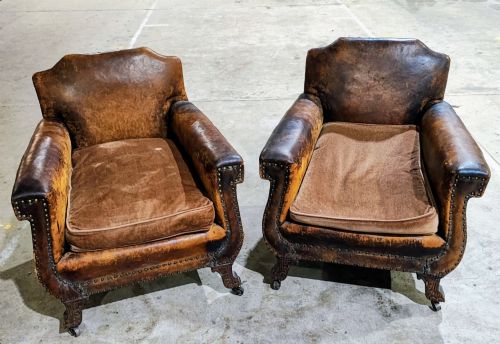
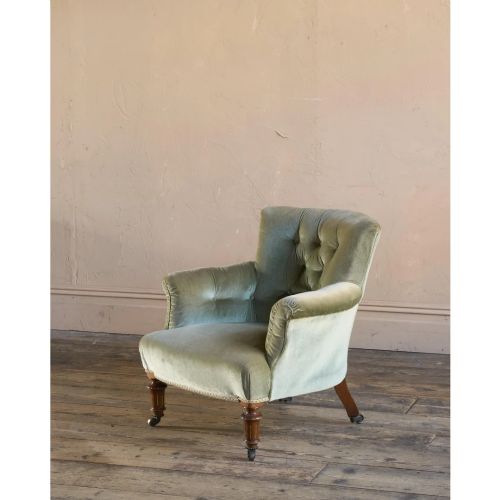
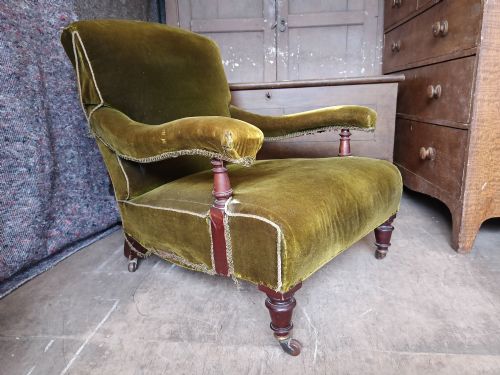
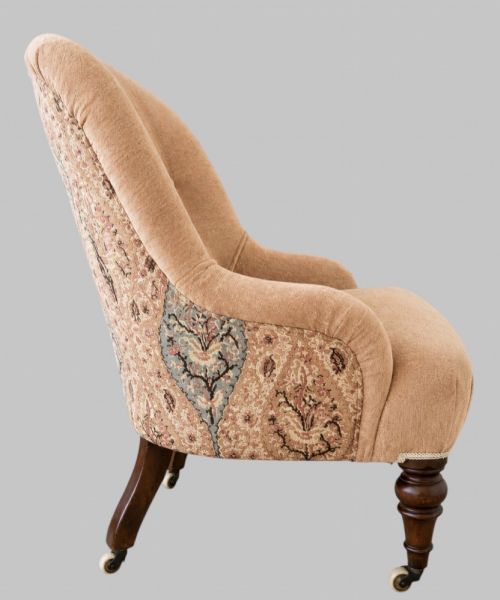
These antique velvet armchair castors support low-slung seating from the nineteenth and early twentieth centuries, offering both mobility and period character.
Antique Velvet Armchair Castors
When searching for antique velvet armchair castors, collectors examine the union of upholstered seating forms and mobile wheel fittings from periods spanning the Regency era to the Edwardian years. The evidence shows these functional supports beneath various chair types, including nursing chairs, library chairs, and gentleman's open armchairs.
The most common examples on this page date from the nineteenth century, particularly the Victorian period, frequently combining walnut, mahogany, or hardwood frames with rich fabric upholstery. These seating options range from diminutive bedroom chairs to large country house armchairs resting upon small metal or ceramic wheels.
Makers such as Gillows and Howard and Sons appear among the titles, alongside pieces featuring stamped initials like CVS. The structural integration of the castor beneath the chair leg determines how these pieces move across nineteenth-century and early twentieth-century floor coverings.
Materials and construction methods
Frames are constructed from dense timbers such as mahogany, walnut, rosewood, and general hardwood, providing the necessary weight and stability for heavy upholstered bodies. These wooden structures are turned, carved, or assembled into forms like X-frames, barrel backs, and bergere designs.
Castors are typically fashioned from brass, often paired with ceramic components, and fixed securely to the base of the legs to allow smooth rotation and movement. Velvet upholstery is then applied over traditional stuffing, sometimes complemented by button backs, piping, or specific designer fabrics.
Periods represented across the items run from the Regency era through Victorian times to Edwardian and Art Deco dates.
Assessing quality in frames and mobility
The distinction between standard production and superior work rests on the integrity of the timber framing and the precision of the joinery beneath the velvet upholstery. Finer examples exhibit crisp carving on woods like walnut or mahogany, alongside robust internal webbing and springs.
The attachment of the brass or ceramic castors dictates the mechanical grade of the piece, where secure fittings ensure the chair moves evenly without straining the lower leg structure. Maker attributions, such as stamps by recognised firms, further elevate the standing of an individual armchair.
Gillows·Hampton and sons·Miles and Edwards·William Birch·Howard and Sons
The Antique Velvet Armchair Castors Glossary
- Castor
- A small wheel fixed to the base of a leg to allow easy movement of furniture across floors. These fittings often incorporate brass sockets and ceramic rollers.
- Bergere
- An enclosed armchair with an upholstered seat and woven cane or fabric sides. This style appears frequently across Regency and nineteenth-century listings.
- Button back
- An upholstery method where depressions are formed in the padding by sewing through to the frame with buttons. This technique provides distinct surface texture on Victorian chairs.
- X-frame
- A structural design where the supports cross beneath the seat in the shape of an X. It is commonly observed on library chairs from the Regency period.
- Library chair
- A sturdy, comfortable seating form designed for reading rooms and studies during the nineteenth century. These chairs often feature generous armrests and supportive backs.
Antique Velvet Armchair Castors: Frequently Asked Questions
How do I identify a Regency armchair?
Regency armchairs often feature characteristic frames such as X-shapes or bergere designs, reflecting the neoclassical tastes of the early nineteenth century.
Examining the turning of the woodwork and the specific configuration of the brass castors helps confirm this period.
What is a nursing chair?
Nursing chairs are low-seated armchairs traditionally designed for comfort and ease of access in domestic bedchambers during the Victorian era.
They frequently appear with velvet upholstery and integrated castors for simple repositioning.
How do castors attach to old chairs?
Castors on these pieces are usually fitted directly into the base of the wooden legs using metal stems, sockets, or plates.
This hardware allows the heavy timber and upholstered frame to roll smoothly across carpets and wooden floors.
Are these chairs suitable for daily use?
Many nineteenth-century and Edwardian armchairs retain robust hardwood frames and resilient upholstery that suit contemporary living spaces.
Buyers should ensure the internal webbing and the mobility of the castors remain structurally sound for regular seating.