

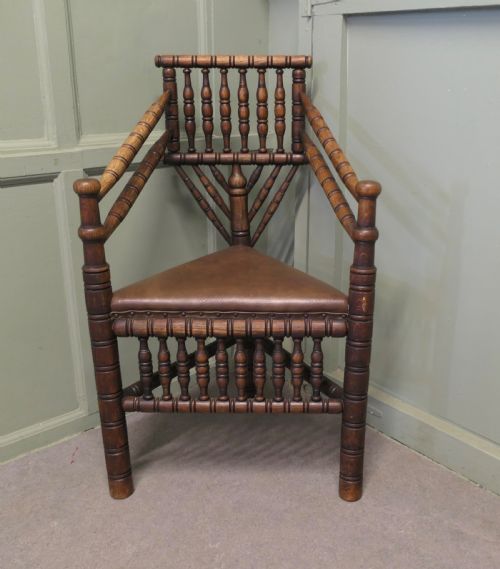


Antique Triangular Chair
An antique triangular chair offers a clever, compact footprint built on three turned legs, making these historic corner seats both striking to view and practical to place.
Antique Triangular Chair
When you search for an antique triangular chair, you are looking at sturdy three-legged seating forms that include turner's chairs, Old Saxon armchairs, and occasional corner stools. These pieces typically present a triangular seat with a central back corner, supported by three legs joined by low stretchers for stability.
The versions you are most likely to meet on this page date from the Victorian period and the nineteenth century, often reflecting Gothic Revival, Saxon Revival, or English vernacular styles. They appear in forms ranging from elbow armchairs to library armchairs and corner stools.
The historical lineage of these seats draws directly upon earlier seventeenth-century turnery traditions, reinterpreted by nineteenth-century makers using oak, beech, and mahogany. Their distinctive geometry provides a commanding silhouette despite taking up relatively little floor space.
Materials and construction methods
Makers constructed these chairs primarily from solid hardwoods such as English oak and beech, occasionally turning to mahogany for later Victorian corner pieces. These timbers were heavily shaped on a lathe to create the characteristic spindles and uprights that define the turned chair tradition.
Joinery relied heavily on traditional pegged mortise and tenon joints combined with sturdy turned stretchers to brace the three-legged base. Seats were fashioned either from solid shaped timber planks or woven from natural materials like rush, while some later examples incorporated upholstered leather or fabric pads.
Distinguishing quality in construction and material
The distinction between standard examples and finer pieces lies in the crispness and complexity of the wood turning. Superior chairs display deep, well-defined mouldings and balanced proportions across every spindle, whereas lesser examples feature simplified or uniform lathe work.
Material selection also dictates the grade of the piece, with dense English oak and carefully matched grain patterns marking out the better workshop productions. The integrity of the original joints and the survival of undisturbed surface patination further separate honest vernacular pieces from heavily restored ones.
The Antique Triangular Chair Glossary
- Turner's chair
- A sturdy seat constructed entirely from turned wooden spindles and rails, often associated with the sixteenth and seventeenth centuries but widely revived during the Victorian era. These pieces are sometimes referred to as round-about or master's chairs.
- Old Saxon chair
- A nineteenth-century revival term used by makers to describe heavily turned oak armchairs styled after ancient Anglo-Saxon or medieval prototypes. They typically feature a triangular seat and a semi-circular curved back rail.
- Stretcher
- A horizontal wooden rod connecting the legs of a chair to provide structural rigidity and prevent the joints from spreading under weight. In triangular chairs, these are usually arranged in a triangle just above the floor.
- Elbow seat
- A traditional descriptor for an armchair whose arms are low and set well back, designed to accommodate the heavy garments of earlier periods. You will frequently find this term applied to nineteenth-century vernacular seating.
- Corner stool
- A compact stool designed to fit neatly into the corner of a room, sharing the three-legged triangular geometry of its larger armchair counterparts. These often feature padded upholstered tops supported by turned frames.
Antique Triangular Chair: Frequently Asked Questions
What is an antique triangular chair?
An antique triangular chair is a compact seat built on a three-legged frame, featuring a distinctive corner design that sets it apart from standard four-legged seating. These pieces often draw on historical turnery traditions from earlier centuries.
They include styles such as the turner's chair and the Old Saxon armchair, which utilise heavy turned spindles and semicircular back rails.
How were triangular chairs used historically?
Historically, these chairs served as functional seating in studies, libraries, and parlours, where their unusual geometry allowed them to fit snugly into room corners. The sturdy three-legged design also prevented rocking on uneven stone or timber floors.
In domestic settings, they often functioned as authoritative seats for the head of the household or as convenient accent chairs near a fireplace.
How do I live with a triangular chair?
Living with one of these chairs is straightforward because their compact triangular footprint allows them to occupy awkward angles and tight corners where standard square chairs will not fit. They work exceptionally well as standalone accent pieces in hallways or studies.
Care simply involves regular dusting and treating the timber with appropriate wax to maintain the condition of the wood and any leather or rush elements.
How can I tell the period of a turned chair?
Dating these chairs involves examining the tool marks, the choice of timber, and the style of the turnery. Nineteenth-century Victorian revivals often display machine-assisted precision alongside traditional hand-craftsmanship.
Looking closely at the wear patterns, joint construction, and the specific revival style, such as Gothic or Saxon, helps clarify whether a piece dates to the mid or late nineteenth century.