





Antique Tambour Nightstand
An antique tambour nightstand brings ingenious sliding closures and compact storage to the bedside, offering classic timber work for practical daily use.

Antique Tambour Nightstand
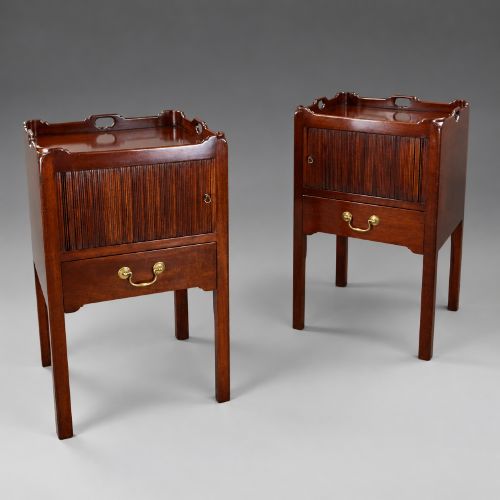
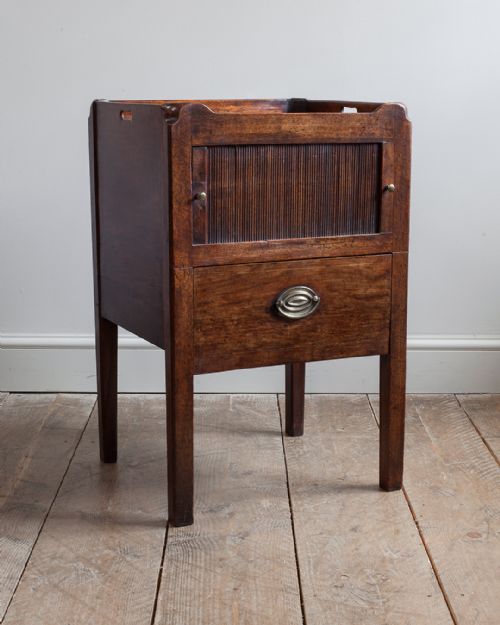
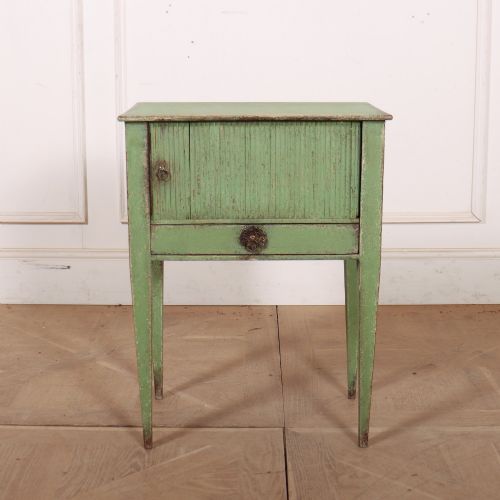
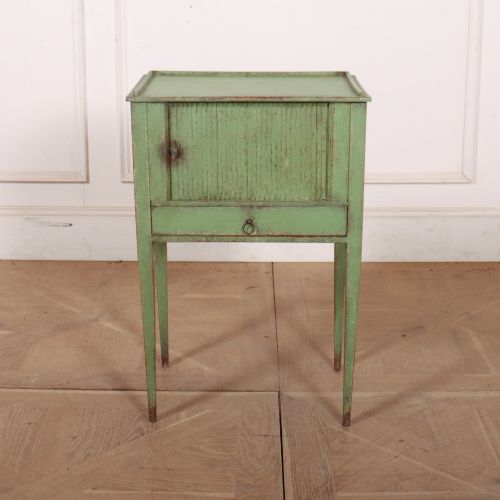
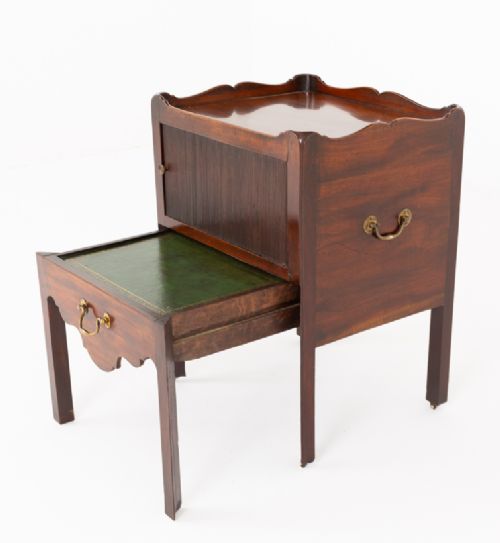
An antique tambour nightstand is a compact bedside piece designed to conceal storage behind a slatted sliding door. These cabinets appear primarily in Georgian and nineteenth-century forms, spanning George III, Regency, and French provincial styles.
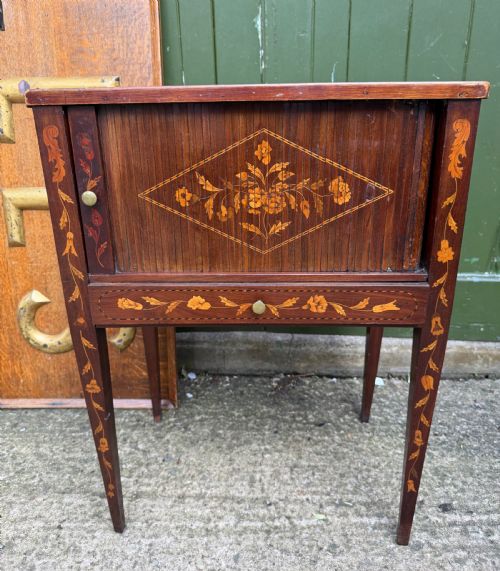
The pieces listed here showcase diverse configurations, including tray tops, serpentine fronts, and corner designs. Mahogany remains the dominant timber, accompanied by walnut, satinwood, and painted finishes from Dutch workshops.
Makers adapted these cabinets for smaller domestic spaces, combining cupboards with pull-out trays and lower drawers. Buyers encounter both single pieces and matched pairs originating from British and continental traditions.
How They Were Made
Cabinetmakers constructed these pieces primarily using solid mahogany and walnut, frequently selecting fine veneers for drawer fronts and cabinet doors. Secondary supports often incorporate softwood, while drawer linings rely on traditional secondary timbers.
The characteristic tambour shutter consists of narrow wooden slats glued to a canvas or linen backing, allowing the curtain to slide smoothly within curved wooden tracks. Craftsmen enhanced these surfaces with boxwood inlay, floral marquetry, and brass hardware.
Surfaces received hand-applied polish or wax finishes that highlighted the natural grain of the wood. Structural joinery utilised dovetailed drawer construction and pegged joints suited to daily domestic demands.
The inventory includes specialised forms such as tray-top commodes, corner cabinets, and Dutch marquetry pieces alongside standard bedside cupboards.
What Varies in Quality
The standard of an antique tambour nightstand depends on the precision of the slatted shutter mechanism and how smoothly it tracks within its groove. Superior examples maintain alignment without binding, reflecting expert initial joinery.
Selection of timber and complexity of form dictate the upper tier of quality, with serpentine fronts, concave shapes, and delicate boxwood stringing marking finer workshop production. Plain carcass work with simpler panelled doors sits lower in the range.
Originality of brass handles, escutcheons, and internal fittings preserves the integrity of the piece. Replacements or alterations to the gallery top or sliding mechanism alter the standing of the cabinet among collectors.
Gillows
The Antique Tambour Nightstand Glossary
- Tambour
- A flexible shutter formed of narrow vertical strips of wood glued to a fabric backing. This allows the door to slide around a curved track to open and close the cabinet.
- Tray top
- A raised rim surrounding the upper surface of a bedside table to prevent items from rolling off. These edges are often shaped or pierced with handgrips.
- Marquetry
- Decorative patterns formed by fitting contrasting veneers into a prepared wooden ground. Floral motifs in boxwood and fruitwood frequently appear on continental pieces.
- Serpentine
- A front contour characterised by a convex centre flanked by concave curves. This undulating shape requires advanced cabinetmaking skill.
- Commode
- A term historically applied to ornamental storage furniture with drawers or doors. In bedroom furniture, it often denotes a bedside cabinet with enclosed storage.
Antique Tambour Nightstand: Frequently Asked Questions
How did people use tambour nightstands?
These cabinets served beside the bed to hold chamber pots, night lights, and personal items. The sliding tambour door kept contents concealed while requiring minimal clearance to open.
Today, they function effectively as compact bedside tables or small accent cabinets in living spaces. Their enclosed storage keeps modern bedside clutter neatly out of sight.
How do I identify a Georgian piece?
Georgian examples typically feature rich mahogany timbers, precise dovetailing, and understated proportions. Details like tray tops, square tapered legs, and subtle stringing help pinpoint this era.
Comparison with nineteenth-century versions reveals sharper carving and heavier construction in earlier pieces. Regional variations, such as Dutch marquetry, introduce distinct decorative treatments to the same basic form.
Are pairs difficult to find?
Matched pairs of bedside cabinets are less common than single pieces because bedroom furniture was often made individually or dispersed over time. Surviving pairs usually command greater interest from collectors.
When pairs do appear, slight variations in timber grain or hardware dimensions reflect hand-crafting methods. These minor differences confirm their period manufacture rather than modern replication.
What maintenance do tambour doors need?
The sliding slats rely on clean tracks and traditional wax lubrication rather than modern oils. Keeping the grooves free of dust ensures the shutter glides smoothly.
Seasonal humidity changes can cause wood to expand slightly, affecting the movement of the door. Proper indoor climate control prevents the fabric backing and wooden slats from warping.