
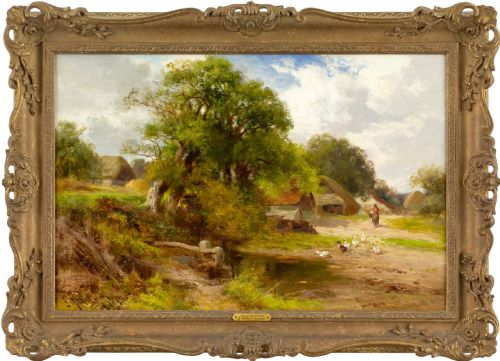


Antique Sussex Painting
These antique sussex painting pieces capture the downland and coastlines of the county through watercolours and oils.
Antique Sussex Painting
When you search for an antique sussex painting, you encounter works recording the landscape, villages and rivers of the county across the eighteenth, nineteenth and twentieth centuries. The selection includes rural scenes, pastoral views, and coastal settings.
The most common examples you meet on this page are nineteenth-century and early twentieth-century watercolours and oil paintings. These depict specific locations such as Arundel, Rye, Steyning and Hastings.
The category also encompasses topographical works and folk art pieces that document local buildings, bridges and rural occupations. These range from intimate watercolour sketches to framed oils on canvas.
Materials and methods
Artists worked primarily in watercolour on paper or oil paint applied to canvas, wood panels or paper supports. These materials were framed behind glass in gilt wood or wooden frames.
Techniques varied from loose watercolour washes and pen outlines to layered oil applications that captured the light of the southern counties. Framing often utilised gilt wood to finish the presentation.
Several sheep make unauthorized appearances in Sussex lanes, faithfully supervised by artists who paused to record them.
Evaluating the work
Quality rests upon the artist's handling of light, atmospheric perspective and topographical accuracy in capturing the Sussex terrain. Stronger pieces display confident brushwork and a clear sense of place rather than generic composition.
The condition of the paper or canvas, the preservation of the pigments, and the presence of period framing influence the overall integrity of the piece.
John Horace Hooper·Charles Gregory·Arthur Winter Shaw·Henry Charles Fox·Harry Pennell·Henry John Kinnaird·Annie L. Lee·William Luker Snr·Yeend King·Walter J. Hall·Oliver Hall·Frank Charles Medworth·Margaret Fisher Prout·Rob Hughes·A Hulk·Arthur Willett·Henry Charles Jarvis·Abraham Hulk Junior
The Antique Sussex Painting Glossary
- Watercolour
- A paint consisting of water-soluble pigments on paper. It allows for transparent washes and delicate tonal gradations.
- Oil on canvas
- Pigments bound in a drying oil applied to a stretched woven fabric support. This technique provides rich colour depth and texture.
- Gilt wood
- Wood coated with a thin layer of gold leaf or gilt finish. It is commonly found on traditional picture frames from the period.
Antique Sussex Painting: Frequently Asked Questions
How do I hang a watercolour painting safely?
Keep watercolours away from direct sunlight to prevent the pigments from fading over time. Glazing with protective glass shields the paper from atmospheric dust and moisture.
Use stable wall fixings suited to the weight of the framed piece. Hang the artwork at eye level on an interior wall where room temperature remains steady.
What subjects appear in these paintings?
The works depict Sussex landscapes, village streets, river bridges, and coastal scenes. Common locations include Arundel, Rye, Steyning, and the South Downs.
Artists recorded rural occupations, sheep pastures, harvest fields, and local architecture. These scenes document the county's appearance across different decades.
How do I tell watercolours from oils?
Watercolours are painted on paper, display translucent washes, and require a glass covering for protection. The texture of the paper often remains visible beneath the pigment.
Oils are applied to canvas, wood panels, or heavy paper, presenting a thicker surface texture with opaque colour layers. They do not strictly require glass.
How should I clean a vintage frame?
Dust the frame gently with a dry, soft cloth or a clean artist brush. Avoid applying water or chemical cleaners to gilt surfaces, as moisture damages the finish.
Check the back of the frame periodically to ensure the backing paper and fixings remain secure. Leave deeper restoration of damaged frames to professionals.