
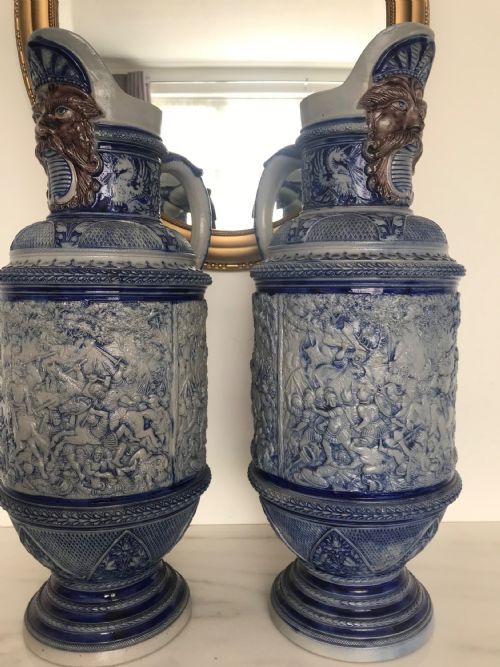


Antique Stoneware Relief Jug
An antique stoneware relief jug brings tactile moulded ornament and robust utility to a table, spanning Georgian, Victorian, and later eras.
Antique Stoneware Relief Jug
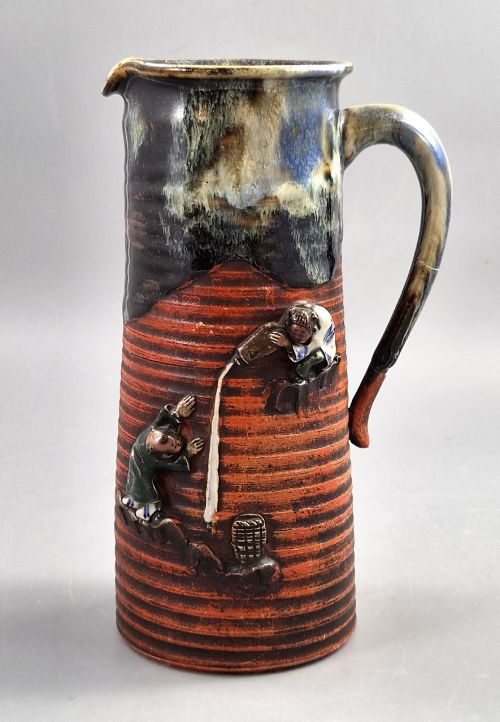
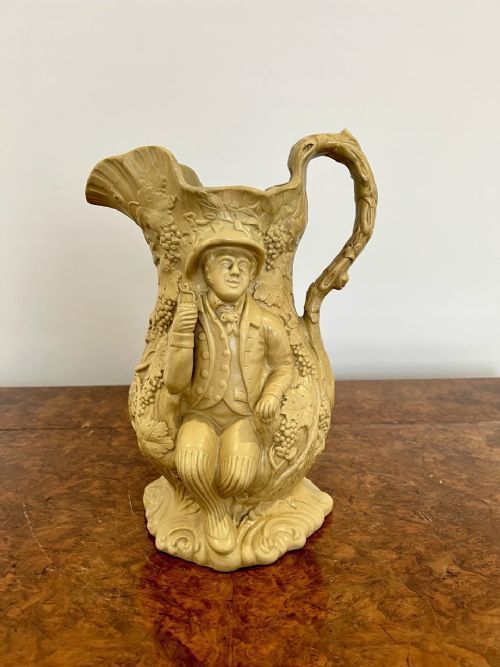
An antique stoneware relief jug presents raised figures, foliage, and narrative scenes pressed or sprigged onto durable vitrified pottery bodies. These pieces emerge predominantly across the nineteenth century, including Georgian and Victorian examples alongside continental German salt glaze and Japanese regional work.
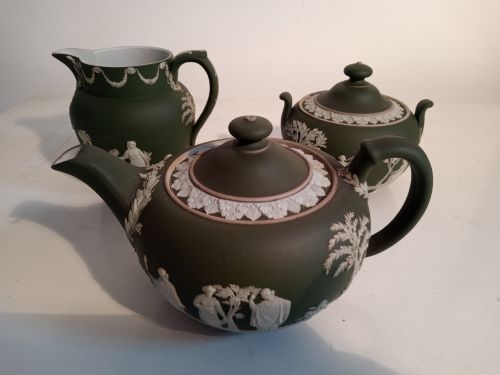
Makers shaped these vessels as pitchers, harvest jugs, ale jugs, and part of larger tea sets or jug and bowl suites. The forms range from small cabinet pieces to large exhibition jugs holding significant volume.
The aesthetic vocabulary shifts from classical bacchanalian dances and hunting scenes to Art Nouveau flora, royal commemorations, and sporting motifs. Collectors encounter both utilitarian tavern vessels and finely decorated parlour items.
Materials and technique
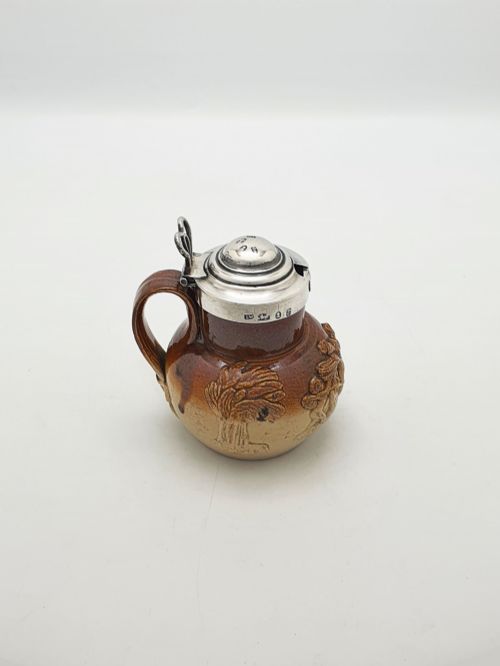
Potters utilised heavy stoneware, earthenware, and salt-glazed bodies capable of holding liquids securely while taking crisp exterior decoration. Salt glazing created an orange-peel texture via salt thrown into the kiln during firing, whilst other wares received smooth ceramic glazes or remained as unglazed bisque parian ware.
Moulded relief decoration relied on pressing clay into intaglio moulds before applying the sprigged motifs to the main vessel body, or casting the entire jug in relief-moulding techniques. Workshops occasionally added contrasting colouration, such as cobalt blue highlights on grey salt-glazed surfaces or olive green and buff body tones.
Many jugs received functional and decorative metal additions, including sterling silver collars and hinged lids fitted to the rim. These mounts reinforced the ceramic edge and provided secure pouring.
Listings feature nineteenth century Victorian and Georgian periods alongside German Westerwald salt glaze and Japanese Meiji works.
Judging execution
Quality rests upon the crispness of the moulded relief work, where sharper detailing on figures and foliage distinguishes superior productions from worn secondary pressings. The depth and clarity of the narrative scenes demonstrate the skill of the modeller and the condition of the production moulds.
Material choice and finishing set individual pieces apart, seen in the subtlety of coloured slips, the evenness of salt glazing, and the integration of precious metal collars. Well-balanced proportions and comfortable handle ergonomics also separate standard utility ware from exhibition pieces.
Simon Peter Gerz·Doulton Lambeth·Charles Meigh·Jones and Walley·Wedgwood·Ridgway and Sons·Emma Shute·Minton·Phillips and Bagster·W Hackwood·Copeland Spode
The Antique Stoneware Relief Jug Glossary
- Stoneware
- A dense, impermeable pottery vitrified at high temperatures. It requires no internal glaze to hold liquids.
- Salt glaze
- A vitreous texture formed by introducing common salt into the kiln at peak temperature. The vapours react with the silica in the clay body.
- Sprigging
- The technique of pressing small moulded clay ornaments in separate dies and applying them to the surface of an unbaked pot with liquid slip.
- Parian ware
- A fine-grained unglazed bisque porcelain resembling white marble. Named after the Parian marble of ancient Greece.
- Puzzle jug
- A vessel featuring perforated necks or hidden channels designed to confound drinkers. Users must cover specific holes with their fingers to drink without spilling.
Antique Stoneware Relief Jug: Frequently Asked Questions
How were stoneware jugs used?
These vessels served practical roles carrying ale, water, milk, and cider at the table or in taverns. Larger examples functioned as storage containers or centrepieces for communal gatherings.
Finer decorative versions sat on parlour sideboards or formed part of matched tea sets. Many pieces also marked historical events, such as royal jubilees.
How do I date a jug?
Makers marks, registry stamps, and stylistic cues provide chronological clues across the nineteenth century. Gothic revival, classical neoclassical, and organic Art Nouveau motifs each align with specific decades.
Associated materials like sterling silver collars often carry hallmarks with exact date letters. Body colours and glaze types also reflect manufacturing fashions of particular periods.
Can I use them daily?
Stoneware bodies are robust and fully vitrified, making them physically capable of holding liquids for modern dining. However, historical metal mounts and delicate handles require careful hand washing.
Most collectors prefer to display these pieces or limit use to gentle serving occasions. Protecting antique silver rims and preventing thermal shock preserves the material integrity.
What is a harvest jug?
Harvest jugs are large stoneware vessels traditionally filled with ale during agricultural harvest celebrations. They frequently feature hunting scenes, rustic figures, or commemorative inscriptions.
Their substantial capacity accommodated communal drinking outdoors. Today, their robust proportions make them prominent decorative display items.