





Antique Spool Leg Table
An antique spool leg table brings tactile character to a room through distinctive turned supports.

Antique Spool Leg Table
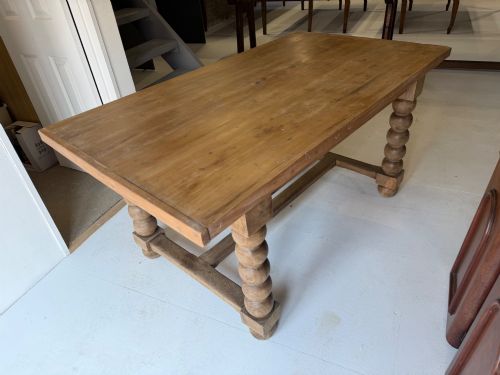
An antique spool leg table is defined by its characteristic turned supports, reminiscent of stacked bobbins or spools, which appear across various historical periods. The examples found here span from the seventeenth century through to the early twentieth century, encompassing both authentic early pieces and later revival works. Buyers will encounter side tables, gateleg tables, hall tables, and occasional tables that showcase this playful yet structural turning.
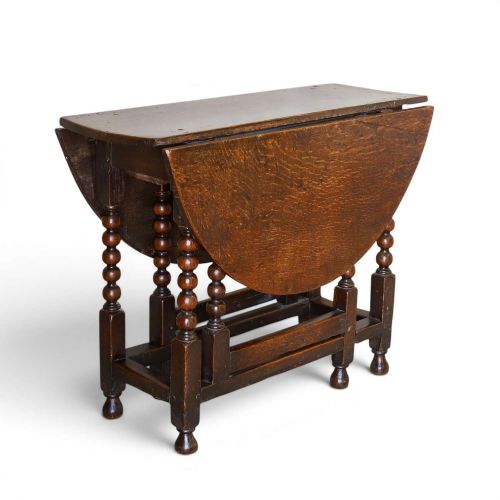
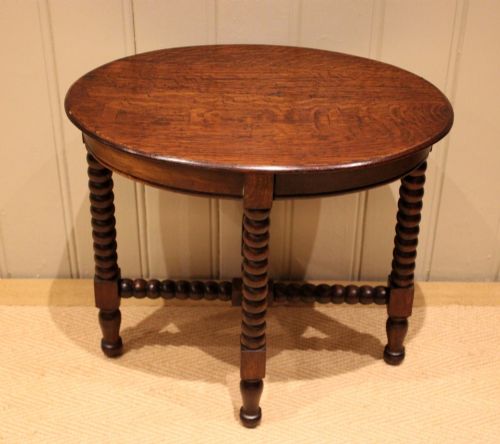
The seventeenth century provides foundational forms like oak gateleg drop-leaf tables and side tables with heavy bobbin turnings. Nineteenth-century examples often revive these earlier styles, introducing pieces such as pine cricket tables, walnut-finished items, and Victorian oak hall tables with bobbin legs. Additionally, more eclectic variations emerge, including gilded occasional tables inset with velvet.
Forms remain practical, functioning as small oval tables, two-drawer side tables, and dining tables suited for compact spaces. The timber choice heavily influences the overall character, ranging from pale beech and solid yew wood to heavy dark oak. Whether seeking a rustic farmhouse aesthetic or a formal Jacobean revival piece, the unifying element remains the spool or bobbin turning of the legs.
Assessing quality in turning and timber
Quality rests in the crispness of the turning along the legs and the integrity of the timber used for the top and frame. Tighter, more uniform spool profiles require greater skill at the lathe compared to simpler, broader shapes. The choice of wood also dictates the grade, with dense yew and seasoned seventeenth-century oak representing different tiers of material selection than softer pine.
Proportion and structural coherence separate ordinary examples from finer ones. The alignment between the turned undercarriage and the top, whether an oval drop-leaf or a rectangular side table, determines the visual balance. Original surfaces and minimal timber replacement preserve the historical integrity that collectors value.
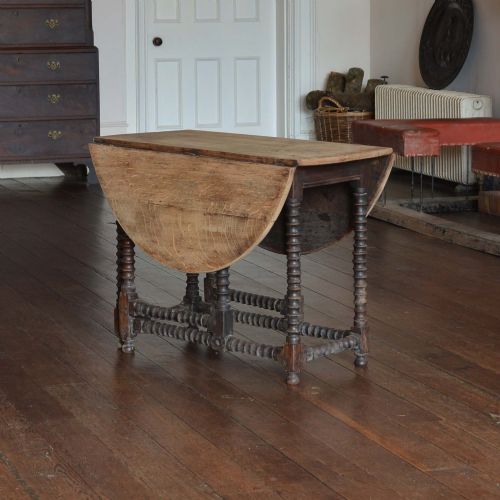
Some tables combine utilitarian oak with unexpected flourishes like bright red velvet and gilded frames.
The Antique Spool Leg Table Glossary
- Bobbin turning
- A form of woodturning that creates a series of rounded, spool-like shapes along the length of a leg or stretcher. This technique was popular in seventeenth-century furniture and revived during the Victorian era.
- Gateleg table
- A table with hinged drop leaves supported by legs that swing outward like a gate. This design allows the table to expand for dining or fold down for compact storage.
- Cricket table
- A small, lightweight occasional table typically featuring three legs and a circular top. The name derives from its resemblance to a cricket stool used in domestic settings.
- Jacobean revival
- A nineteenth-century style that imitates the heavy, dark furniture of the early seventeenth century. Pieces in this style frequently incorporate spool legs and geometric mouldings.
- Drop-leaf
- A table top configuration featuring a fixed centre section with hinged flaps on either side. These flaps can be raised and supported when surface area is required.
Antique Spool Leg Table: Frequently Asked Questions
What is a spool leg table?
A spool leg table is a piece of furniture featuring legs shaped on a lathe to resemble a stack of bobbins or spools. These tables appear in various forms, including side tables, gateleg tables, and hall tables.
The style spans multiple centuries, originating in the seventeenth century and returning during nineteenth-century revival periods. The turned legs provide a decorative texture that distinguishes these tables from plain-legged furniture.
How do I date an antique spool table?
Dating requires examining the timber species, construction joints, and the overall style of the piece. Seventeenth-century examples typically feature heavy oak with traditional pegged joinery, while nineteenth-century revival pieces may use pine, beech, or lighter oak construction.
The uniformity and sharpness of the bobbin turning can also offer clues, as hand-lathed early pieces differ subtly from later mechanized production methods. Comparing the hardware and secondary woods helps confirm the likely period of manufacture.
Where were spool leg tables used?
These tables served various practical functions in historic homes, acting as side tables, occasional tables, or dining surfaces. Smaller versions functioned as hall tables or bedside stands in domestic interiors.
Gateleg variants provided flexible dining solutions in smaller rooms, folding down against a wall when not in use. Their compact footprints made them versatile additions to both formal reception rooms and casual living spaces.
Are spool legs strong?
The structural strength of spool legs depends on the timber used and the quality of the turning. Hardwoods like oak, yew, and beech provide robust support for daily use.
However, the narrow points between the turned bobbins represent potential stress areas if subjected to excessive lateral force. Proper placement and avoiding heavy loads ensure these tables remain stable over time.
How do I care for an antique wood table?
Maintaining an antique wood table involves protecting the surface from excessive moisture, direct sunlight, and extreme temperature fluctuations. Regular dusting with a soft cloth preserves the finish without abrasive buildup.
Applying appropriate waxes or conditioners helps keep historic timber from drying out, depending on whether the piece has an original polish or an untreated finish. Gentle handling prevents unnecessary wear on the turned joints and drop-leaf mechanisms.