


Antique Plant Illustration
These antique plant illustration pieces bring centuries of botanical study into a room.
Antique Plant Illustration
When you search for antique plant illustration, you are looking at works on paper that record botanical specimens with scientific precision and artistic care. The pieces available here span from the eighteenth century to the early twentieth century, encompassing framed prints, botanical prints, paintings, and wall art.
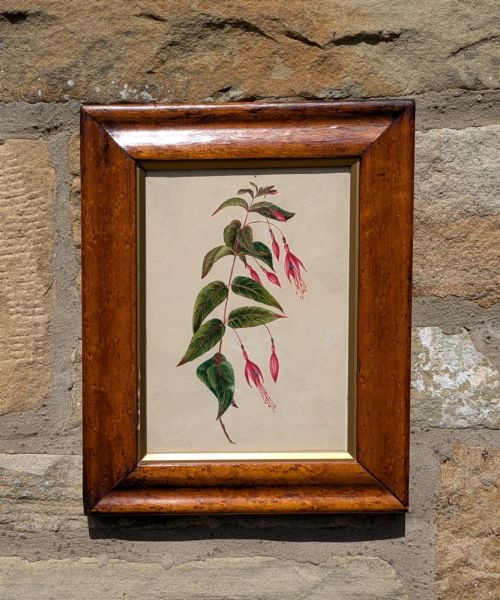
You are most likely to meet nineteenth-century English and French examples, alongside eighteenth-century works. These appear singly, in pairs, or in sets, ranging from delicate watercolours of fuchsias and pelargoniums to detailed engravings featuring insects alongside plants.
The origins of these works reflect European natural history traditions, including plates sourced from historic publications like Herbier Général de l'Amateur and Plantae Selectae. Whether presented as individual paintings or grouped sets of engravings, they offer a direct window into historical plant taxonomy and illustration.
How they were made
The creation of these works relies fundamentally on paper as a durable medium for delicate pigments and fine lines. Artists and publishers utilised watercolour, gouache, ink, and pencil to capture the exact structure and colour of botanical subjects.
Many examples combine copperplate engraving with subsequent hand-colouring, allowing for sharp printed outlines filled with subtle washes of pigment. Framed pieces are often housed behind glass within wood or terracotta-toned settings that protect the fragile paper beneath.
The listings span multiple centuries, incorporating works produced in 1750, 1800, 1850, 1870, and 1910.
What varies in quality
Quality in these works is defined by the precision of the botanical observation and the skill of the hand-colouring. Works derived from authoritative publications by known figures display a fidelity to plant anatomy that distinguishes them from more generic decorative prints.
The vibrancy and preservation of the watercolour, gouache, or ink further separate pieces, alongside the crispness of the original engraving lines on the paper. Complete sets and matched pairs also carry distinct merit compared to dispersed individual sheets.
Pancrace Bessa·John Curtis·Annie Mary Youngman·Georg Wolfgang Knorr·George Dionysius Ehert
The Antique Plant Illustration Glossary
- Engraving
- A printmaking technique where an image is incised into a metal plate, holding ink to produce fine, crisp lines on paper. This method allows for exact botanical details to be replicated across multiple impressions.
- Gouache
- An opaque water-based paint that provides solid, flat areas of colour with a matte finish. It is often combined with watercolour and pencil in these studies to build depth.
- Hand-coloured
- A print finished with applied washes of watercolour or other pigments by hand after the initial impression. This technique adds naturalistic colour to engraved botanical plates.
- Watercolour
- A transparent medium where pigments are suspended in a water-based solution, applied to paper to create luminous botanical studies. It forms the primary medium for original paintings in this category.
Antique Plant Illustration: Frequently Asked Questions
What is an antique plant illustration?
An antique plant illustration is a historical work on paper depicting botanical subjects, created through painting, drawing, or printmaking techniques. These pieces served both scientific documentation and aesthetic purposes in past centuries.
They range from original watercolours of single flower species to published engravings featuring plants and insects together.
How were these botanical prints used historically?
Historically, these prints and paintings were produced for scientific publications, florilegia, and natural history books to document newly discovered or cultivated plant species. Naturalists, botanists, and horticulturists relied on them for accurate identification and study.
Over time, many plates were separated from their original volumes to be framed and displayed as wall art in homes and studies.
How should I frame and care for paper works?
Paper works require protection from direct sunlight and moisture to prevent the watercolour pigments and paper support from fading or degrading. Framing them behind glass with acid-free mounts helps preserve the delicate condition of the paper.
Keeping them away from damp environments ensures the paper and any accompanying ink or gouache remain stable over time.
How can I tell the age of a botanical print?
The age of a botanical piece is often indicated by the paper type, printing technique, and stylistic markers characteristic of periods like the eighteenth or nineteenth century. Reference to known publications or named artists helps establish a reliable timeframe.
Inscriptions, plate marks, and typography associated with historical horticultural works also provide clear clues to the date of origin.