

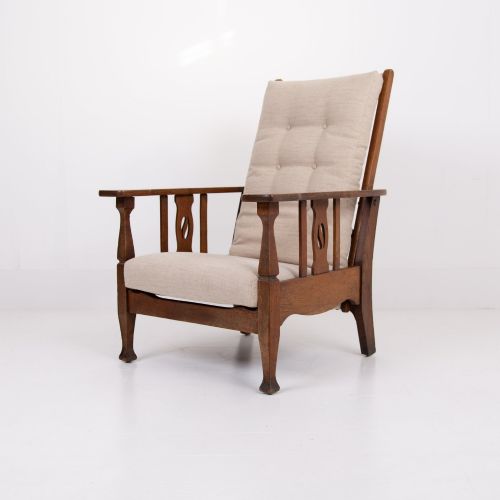
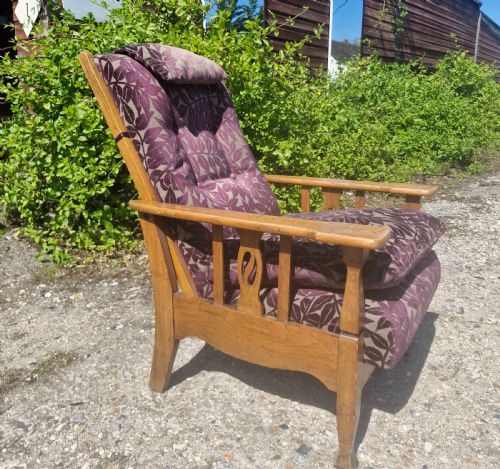


Antique Oak Recliner
An antique oak recliner is a substantial adjustable armchair built for comfort, and you will find examples here spanning from the Edwardian era through to the First World War.
Antique Oak Recliner
When you search for an antique oak recliner, you are looking at early twentieth-century adjustable armchairs designed primarily for relaxation and recovery. The versions you are most likely to meet on this page date from the 1900s to the 1920s, reflecting the domestic and campaign needs of the period.
The selection ranges from classic Arts and Crafts designs and Jacobean Revival frames to French First World War campaign or invalid chairs. You will also find solid oak children's armchairs and upholstered pieces equipped with adjustable mechanisms.
Many of these armchairs show strong stylistic links to prominent London retailers and makers of the period, particularly the aesthetic associated with Liberty's and Heals. Their forms prioritise functional movement alongside traditional timber framing.
How they were made
The primary material across these pieces is solid oak, sometimes supported by secondary timbers like beech or paired with iron metalwork for the reclining mechanisms. Frames are constructed to handle the stress of adjustment.
Upholstery materials vary significantly, incorporating fabric, linen, cane, and tan leather to provide seat and back support. These materials are fixed to the heavy wooden armframes using traditional upholstery techniques suited to adjustable seating.
Antique Oak Recliner Retail Price Guide 2026
Typical asking prices for oak recliner among the pieces listed under this phrase on Sellingantiques today, from the lower quarter to the upper quarter. They describe what is for sale here now, not the wider market.
Listings in this category span the first two decades of the twentieth century, focusing primarily on 1910 and 1920 production dates.
What varies in quality
The distinction between standard production and superior craftsmanship lies in the refinement of the adjustable mechanism and the execution of the woodwork. Finer examples display more considered joinery and integrated movement that operates smoothly within the oak frame.
Quality is also apparent in the selection of secondary materials, such as the grade of tan leather, the tightness of the cane work, or the durability of the upholstery fabric. Pieces associated with notable design houses tend to exhibit more resolved proportions and detailing.
Foot & Sons·Liberty's·Heals of London
The Antique Oak Recliner Glossary
- Arts & Crafts
- A design movement valuing handcraft and honest construction over industrial mass production. This style influences many of the plain oak frames seen in this category.
- Campaign chair
- Portable furniture designed for military officers or medical use during wartime. These pieces often feature folding or multi-position reclining frames.
- Jacobean Revival
- A nineteenth and early twentieth-century historicist style reviving seventeenth-century motifs. It frequently appears on heavy oak frames with turned supports.
- Cane
- Woven rattan material used for seat panels and backs. It provides a flexible yet sturdy surface that complements the open oak framework.
Antique Oak Recliner: Frequently Asked Questions
How do the reclining mechanisms work?
Most of these chairs utilise manual adjustment systems integrated into the arms or back supports. Users reposition the backrest to various fixed angles.
Mechanisms often include metal ratchets or pivoting wooden struts that lock the seat into the desired posture.
Are these chairs suitable for daily use?
These armchairs are built from solid oak and sturdy hardware designed for everyday seating. Their durable construction supports regular habitation.
Buyers should verify the condition of the internal webbing and upholstery before committing to heavy daily lounging.
How do I identify an Arts and Crafts recliner?
Arts and Crafts examples typically feature exposed oak framing, straight lines, and minimal ornamentation. The focus remains on visible construction and simple joinery.
They often lack the heavy carving found in Jacobean Revival styles, prioritising honest utility instead.
What is a campaign or invalid chair?
These specialised chairs were produced during the First World War for military campaigns or medical convalescence. They incorporate adaptable frames for resting.
Such pieces emphasise portability, multi-position adjustment, and robust materials capable of field or hospital use.