



Antique Moorish Chair
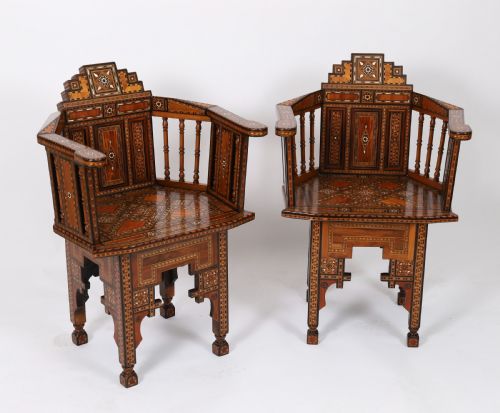
An antique moorish chair brings geometric intricacy and architectural presence to a room through dense woodcarving and inlaid panels.
Antique Moorish Chair
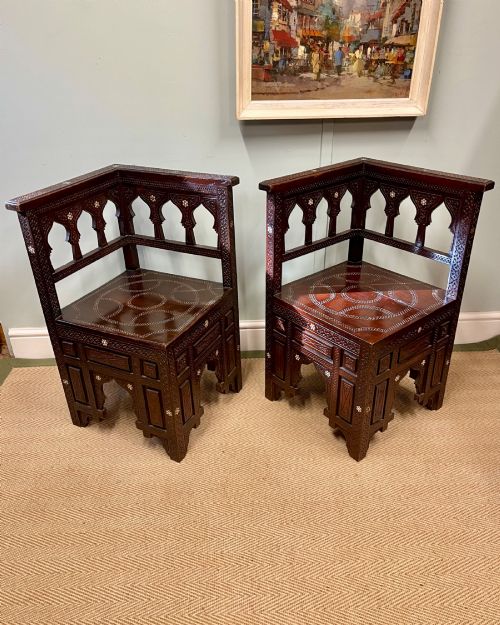
An antique moorish chair draws on the design traditions of Islamic Spain, North Africa, and the Levant, emerging in various forms during the nineteenth and early twentieth centuries. These pieces encompass armchairs, corner chairs, folding seats, and conversation suites created in styles such as Moorish Revival, Ottoman, and Anglo-Moorish.
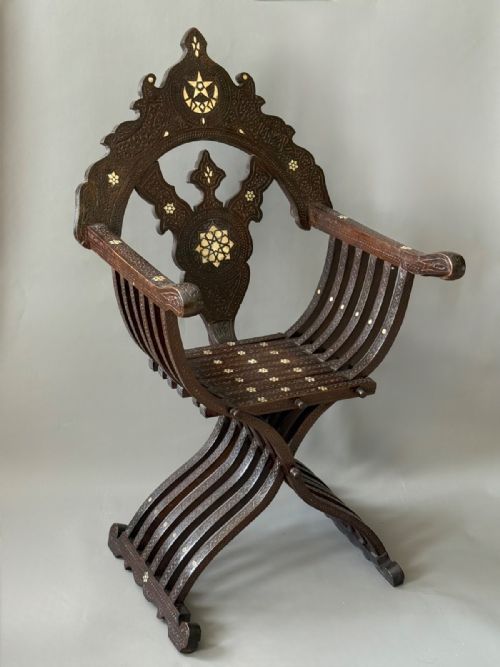
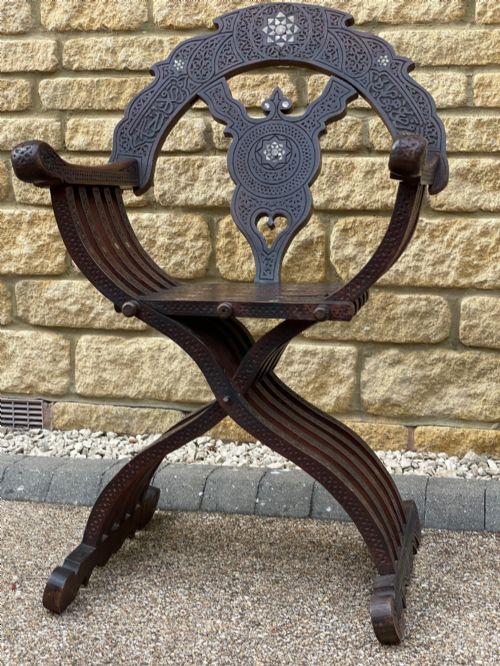
The most common examples encountered here date from the nineteenth century and the Edwardian era, often featuring regional characteristics from Damascus, Syria, Morocco, and Andalusia. Buyers frequently find folding X-frames, rigid armchairs, and side seating displaying traditional joinery and carved architectural motifs.
Materials and construction methods
Carpenters built an antique moorish chair using dense timbers such as walnut and various hardwoods, providing a stable foundation for complex surface decoration. These frames often incorporate turned spindle work, pierced mashrabiya panels, and interlocking wooden elements that form rigid structures without standard upholstery.
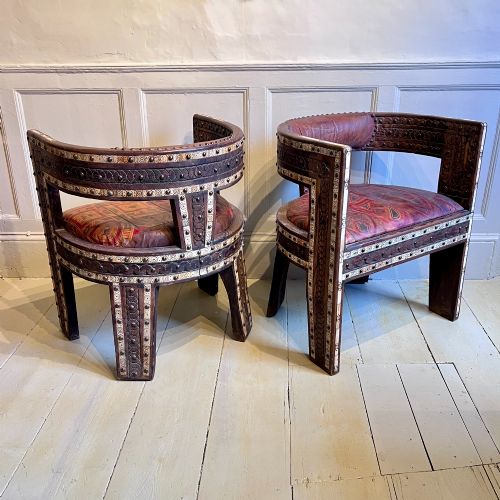
Artisans embellished the wooden surfaces by pressing in pieces of mother-of-pearl and bone inlay to create geometric mosaic patterns. Some versions also utilise painted decoration, parquetry, and fitted panels of leather or velvet.
Antique Moorish Chair Retail Price Guide 2026
Typical asking prices for moorish chair among the pieces listed under this phrase on Sellingantiques today, from the lower quarter to the upper quarter. They describe what is for sale here now, not the wider market.
Listings feature walnut, hardwood, mother-of-pearl, and bone inlay across multiple periods spanning the nineteenth century into the Edwardian era.
Assessing craftsmanship and detail
The distinction between standard and superior pieces rests upon the precision of the woodwork and the density of the inlay work. Master artisans executed tight geometric tessellations with minimal filler around the mother-of-pearl and bone elements, whereas simpler examples rely on broader carved surfaces with sparse embellishment.
Structural complexity further separates the output, with folding X-frames and pieces incorporating intricate mashrabiya lattice panels demanding a higher degree of joinery skill than plain panelled frames.
Liberty and Co
The Antique Moorish Chair Glossary
- Mashrabiya
- A type of projecting oriel window enclosed by carved wood latticework, which translated into furniture panels of interlocking turned wooden spindles. This technique creates intricate geometric screens across the backrests and sides of seating.
- Mother-of-Pearl
- The iridescent inner layer of mollusc shells, harvested to cut into tiny polygonal tiles. Craftsmen set these pieces directly into carved channels within the hardwood to form shimmering geometric stars and borders.
- X-Frame
- A folding chair construction method utilising intersecting diagonal wooden members that cross to form an X shape. This form dates back to ancient precedents and reappears frequently in nineteenth-century folding seats.
- Parquetry
- A mosaic of geometric wooden pieces arranged to form decorative patterns across a flat surface. In these chairs, contrasting timber tones create complex multi-sided designs on armrests and seats.
- Anglo-Moorish
- A design style developed in Britain during the late nineteenth century that combined Moorish surface decoration with domestic furniture forms. Retailers such as Liberty and Co popularized this aesthetic for Western interiors.
Antique Moorish Chair: Frequently Asked Questions
What defines an antique moorish chair?
An antique moorish chair is a nineteenth or early twentieth-century seat characterised by Islamic and North African design influences, including geometric woodcarving, turned spindles, and inlaid mosaic patterns.
These pieces reflect global design revivals popular in Europe and the Levant, utilising traditional regional construction methods adapted for domestic interiors.
Where were these chairs made?
Production locations span Damascus in Syria, Morocco, Andalusia, and various centres across the Ottoman Empire, alongside British interpretations produced during the late nineteenth century.
Craftsmen in these regions utilised local hardwoods and workshop traditions to build distinct regional variations, from folding X-frames to rigid armchairs.
How do I incorporate one into a room?
An antique moorish chair functions effectively as an accent piece in a study, hallway, or living space where its detailed surface patterns can stand out against plain walls.
The distinct geometric woodwork and inlaid shell provide strong visual texture that complements both contemporary and traditional interior schemes.
How can I tell the period?
Dating relies on timber selection, the style of the revival movement, and construction markers such as nineteenth-century joinery techniques versus later twentieth-century production methods.
Design influences shifting from nineteenth-century Ottoman and Levantine traditions toward Edwardian interpretations help narrow the timeline of individual pieces.