


Antique Moonstone Necklace
An antique moonstone necklace brings together soft adularescent stones and precious metals, offering a distinct piece of historic jewellery.
Antique Moonstone Necklace
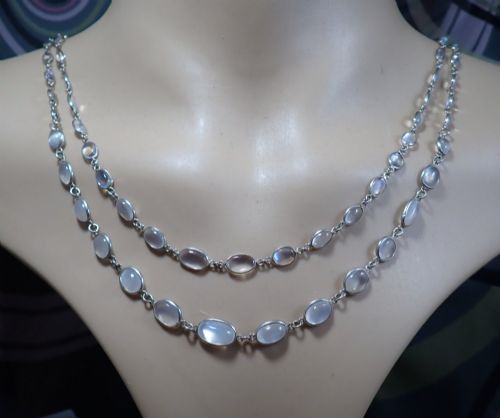
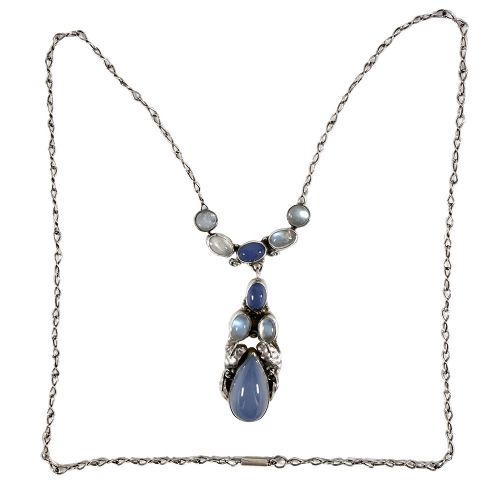
When searching for an antique moonstone necklace, buyers encounter pieces spanning the Edwardian era through the Art Deco and Art Nouveau periods, alongside substantial Arts and Crafts examples. These jewels frequently combine polished moonstones with sterling silver or various carats of gold, often incorporating supplementary gems like chalcedony, pearl, sapphire, and garnet.
The most common formats on this page are pendants and necklaces utilising silver settings, characteristic of the early twentieth century. Designs range from botanical motifs and butterfly shapes to structured festoon arrangements and simple drop pendants.
How they were made
The construction of these pieces relies heavily on sterling silver and 9ct or 15ct gold work typical of the Edwardian and Arts and Crafts movements. Metalsmiths shaped wire and sheet metal to form bezels and intricate wirework settings that cradled the moonstones and associated gems.
Makers integrated natural moonstones alongside materials such as chalcedony, pearls, and sapphires, securing them with traditional hand-fabricated bezel or prong settings. Surface finishes often display the hand-worked textures favoured by early twentieth-century independent craftspeople and commercial workshops.
Listings feature items from the Edwardian period alongside the 1900, 1910, 1920, and 1930 decades, utilising silver, gold, moonstone, chalcedony, and pearl.
What varies in quality
Quality in these jewels rests on the visual depth and adularescence of the moonstones themselves, paired with the refinement of the metalwork. Stones showing a strong, floating blue sheen command greater appreciation than duller specimens.
The distinction between standard commercial production and superior work often lies in the attribution to known designers and the complexity of the secondary stones, such as pearls, sapphires, or diamonds integrated into the design.
Mary Thew·Knoll and Pregizer·George Hunt·John Paul Cooper·Dorrie Nossiter·Amy Sandheim
The Antique Moonstone Necklace Glossary
- Adularescence
- The optical phenomenon where a milky or bluish light appears to billow across a moonstone. This internal light play is the primary visual characteristic that defines the stone.
- Edwardian
- A period covering the early twentieth century noted for delicate platinum and gold work, lace-like motifs, and the use of pearls and diamonds. Jewellery from this era tends towards light, refined proportions.
- Art Deco
- A later style characterised by geometric precision, stylized forms, and symmetrical arrangements. It represents a shift away from the flowing organic lines of preceding decades.
- Festoon
- A necklace design featuring draped chains or swags of metal and gemstones that sit across the collarbone. This format allows multiple drops or stations of moonstones and pearls to hang in balanced intervals.
Antique Moonstone Necklace: Frequently Asked Questions
What periods do these necklaces come from?
The pieces originate primarily from the early twentieth century, spanning the Edwardian era, the 1900s, 1910s, 1920s, and 1930s.
Design characteristics align closely with the prevailing artistic movements of those decades, including Arts and Crafts, Art Nouveau, and Art Deco.
What metals are typically used?
Settings are constructed from sterling silver or gold ranging from 9ct to 18ct yellow gold.
Silver is particularly prevalent in pieces associated with the Arts and Crafts movement, while gold appears across Edwardian lavallieres and Art Nouveau botanical designs.
What other stones accompany the moonstones?
Makers frequently paired moonstones with chalcedony, pearls, blister pearls, sapphires, garnets, amethyst, coral, and occasionally diamonds.
These secondary gems were chosen to complement the soft sheen of the central moonstones within drop pendants and multi-stone necklaces.
How do Arts and Crafts examples differ?
Arts and Crafts necklaces emphasise hand-wrought silver settings and individual artistic expression rather than mass-produced uniformity.
Many of these pieces are linked to specific makers or workshops and incorporate varied stones like chalcedony and garnets in prominent bezel settings.
Are these pieces supplied with chains?
Surviving items include both pendant drops designed for separate chains and complete necklaces with integrated chain links.
Lengths and chain styles vary according to the original Edwardian or later twentieth-century configuration of each individual piece.