


Vintage Moonstone Necklace
A vintage moonstone necklace brings together soft adularescent gem stones and period metalwork, offering a luminous focal point for any collection.
Vintage Moonstone Necklace
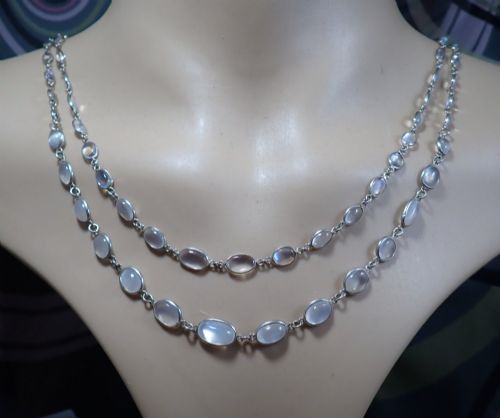
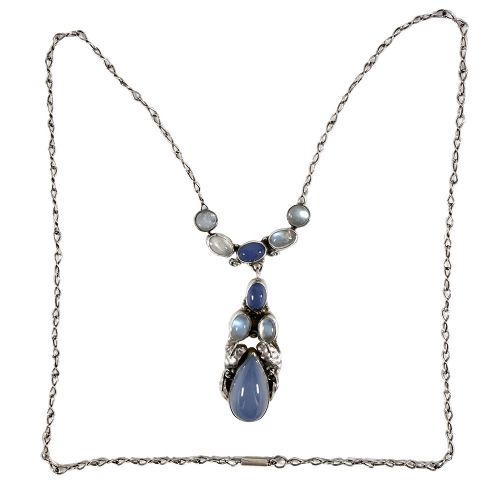
A vintage moonstone necklace captures the luminous appeal of these distinctive gem stones within settings ranging from the Edwardian era through to the modernist period. When you search for a vintage moonstone necklace, you encounter varied designs spanning Arts and Crafts handwrought silver, Art Deco geometric arrangements, and Edwardian gold work.
The pieces on this page appear most frequently in silver and gold, often taking the form of drop pendants, festoon arrangements, or lavaliere necklaces. Makers frequently combined moonstones with supporting gems such as chalcedony, pearls, sapphire, garnet, amethyst, and coral to enhance the central stones.
Dating ranges from the early twentieth century through to the mid-century, capturing stylistic shifts from organic Art Nouveau curves to structured modernist geometry. Each configuration highlights the natural adulescence of the gem, whether mounted simply in sterling silver or set into complex nine carat or fifteen carat gold frameworks.
Materials and construction methods
Makers utilised sterling silver and various grades of gold, notably nine carat, fifteen carat, and eighteen carat alloys, to house the moonstones. Metalwork techniques range from hand-beaten silver sheets characteristic of the Arts and Crafts movement to delicate wirework in Edwardian lavalieres.
Gem stones are secured using traditional bezel settings and fine claw mounts, often complemented by secondary materials like seed pearls, chalcedony, and sapphires. Craftspeople incorporated organic motifs such as acorns, crosses, and butterflies, soldering intricate details onto the main necklace structure.
Materials appearing alongside moonstone across the inventory include chalcedony, pearl, sapphire, garnet, amethyst, and coral.
Distinguishing quality in period pieces
The quality of a piece depends heavily on the optical clarity and blue adulescence of the moonstones themselves, alongside the crispness of the surrounding metalwork. Superior examples display stones with a strong floating light effect coupled with substantial gauge metal that resists bending.
Attribution to documented makers or workshops elevates a piece, as does the integration of supplementary stones like natural pearls, diamonds, or high-grade sapphires. The finesse of hand-hammered textures and secure stone settings separates standard production items from exceptional studio output.
Mary Thew·Knoll and Pregizer·John Paul Cooper·Dorrie Nossiter·Amy Sandheim
The Vintage Moonstone Necklace Glossary
- Adularescence
- The optical phenomenon where light billows across a gem stone, creating a glowing, moon-like sheen characteristic of high-grade moonstones. This floating blue light is the defining visual trait collectors seek.
- Lavaliere
- A pendant necklace featuring a central drop suspended from a chain, popular during the Edwardian period. These designs often incorporate symmetrical or flowing ornamentation above the main stone.
- Festoon necklace
- A necklace style featuring draped chains or swags of metal connected across the collarbone, frequently punctuated by gems and drops. This format allows multiple stones to sit across the chest.
- Bezel setting
- A method of mounting a gem stone where a thin metal collar wraps entirely around the stone's perimeter to hold it securely in place. It provides a clean, protective border common in period silverwork.
Vintage Moonstone Necklace: Frequently Asked Questions
How do I date a vintage moonstone necklace?
Dating relies on stylistic markers, metal types, and construction methods associated with specific decades. Arts and Crafts pieces typically feature hand-beaten silver, whereas Edwardian items often use high-carat gold and delicate wirework.
Examining any maker marks or clasps provides further clues to the manufacturing period, distinguishing early twentieth-century work from later mid-century examples.
What metals are commonly used?
Makers predominantly employed sterling silver and various purities of gold, including nine carat, fifteen carat, and eighteen carat alloys. Silver appears frequently in Arts and Crafts and modernist designs.
Gold is more typical in Edwardian and Art Nouveau creations, sometimes paired with yellow or white gold variations to complement the stones.
How should I care for my necklace?
Protect the moonstones from harsh chemicals, ultrasonic cleaners, and sudden temperature shifts, as these stones have a specific cleavage that requires gentle handling. Store the necklace flat in a lined box to prevent scratching from other jewellery.
Clean the metal and stones periodically using a soft, damp cloth without abrasive polishes.
What stones accompany moonstones?
Period pieces frequently pair moonstones with chalcedony, pearls, sapphires, garnets, amethysts, and coral. These secondary gems add colour contrast and textural variety to the overall design.
In some examples, small diamonds or seed pearls frame the primary moonstone to accentuate its glow.