




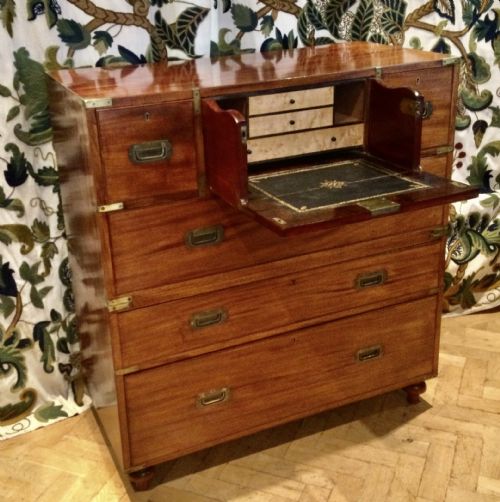


Antique Military Secretaire
An antique military secretaire combines fitted writing compartments with the robust two-part construction built for officers on the move.
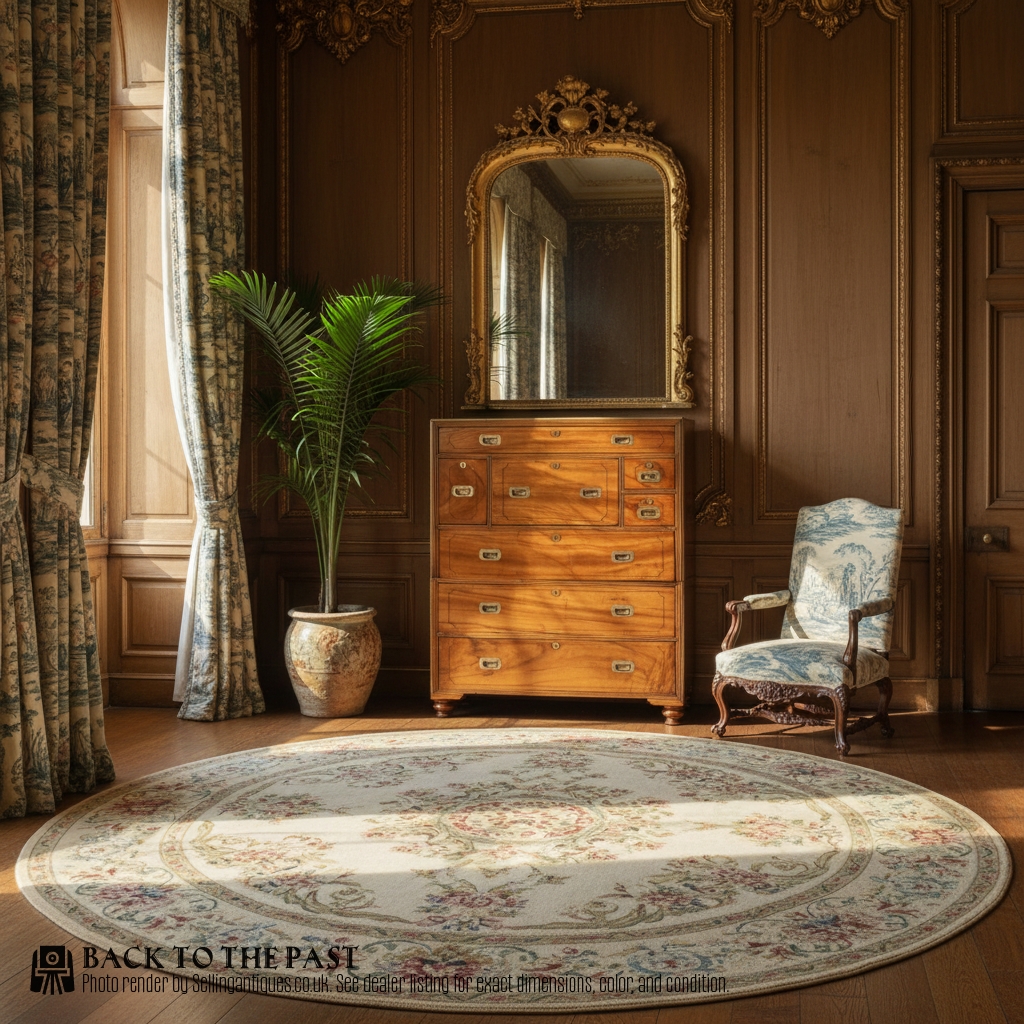
Antique Military Secretaire
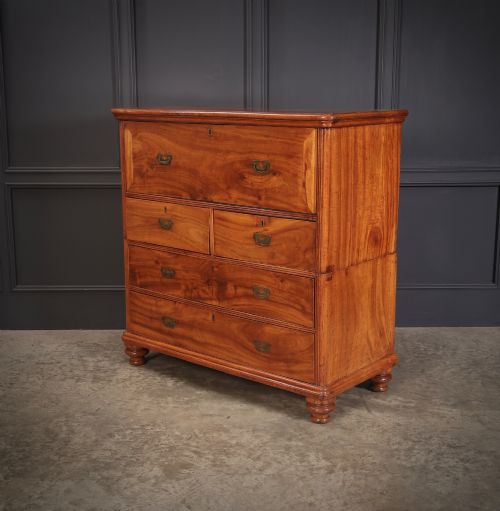
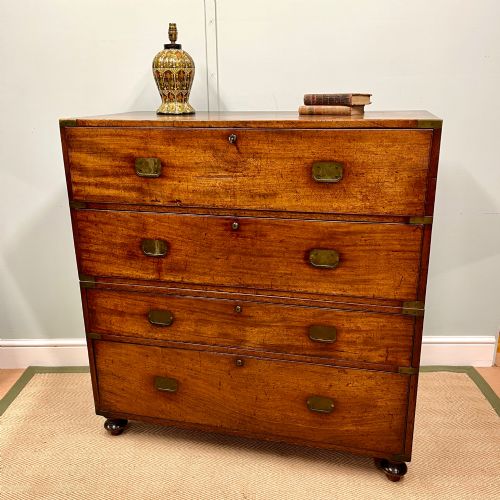
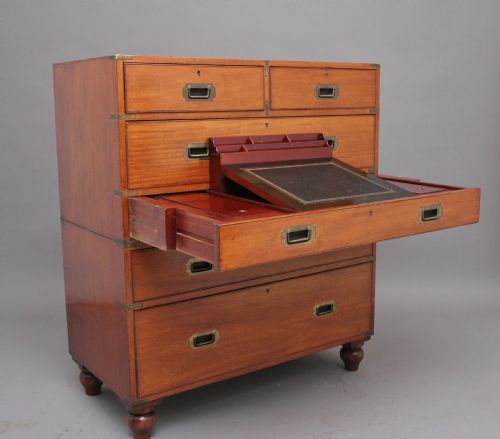
An antique military secretaire is primarily a chest of drawers engineered in two distinct sections for easy transport during nineteenth-century campaigns. The most common form met here is the secretaire chest, where the top drawer pulls down and unfolds to reveal a fitted writing surface and small pigeonholes.
These items originate predominantly from the Victorian period, appearing alongside British Colonial and Anglo-Indian variants. Makers constructed them from sturdy timbers capable of surviving long sea voyages and rough overland journeys.
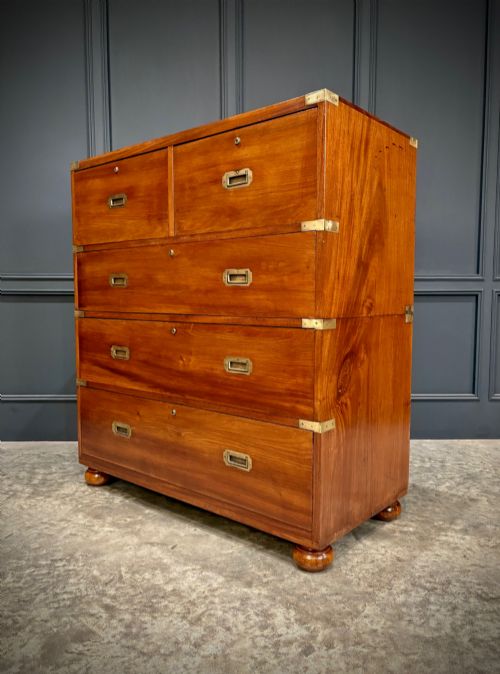
Examples typically divide horizontally at the middle, allowing officers to move their working papers and personal effects without dismantling the main storage compartments. Brass corners and flush-fitting handles protect the edges from impacts during transit.
Materials and construction
Cabinet makers built these pieces using dense, durable timbers such as mahogany, teak, and camphor wood that resisted tropical humidity and warping. Camphor wood variants provided the added benefit of naturally deterring insects from stored documents and uniforms.
Brass corners, straps, and flush-fitting inset handles reinforced every vulnerable joint while eliminating protruding hardware that could snag on ropes or canvas. Many specimens also incorporated cast iron carrying handles on the side panels to assist heavy lifting.
Antique Military Secretaire Retail Price Guide 2026
Typical asking prices for military secretaire among the pieces listed under this phrase on Sellingantiques today, from the lower quarter to the upper quarter. They describe what is for sale here now, not the wider market.
Listings feature pieces spanning the nineteenth century, including specific dates from 1830 through the Victorian period and into the early twentieth century.
Distinctions in quality
Superior examples display meticulous dovetail joinery hidden within the drawer construction and secret compartments fitted with polished leather writing surfaces. The choice of secondary timbers and the precision of the brass reinforcement indicate the standard of workshop output.
Finer specimens integrate secret locking mechanisms, high-grade burl veneers, and uniform grain matching across the sectional halves. Lesser versions rely on simpler utility construction intended strictly for field service rather than domestic elegance.
The Antique Military Secretaire Glossary
- Secretaire drawer
- A hinged top drawer that drops forward to reveal a writing desk fitted with small drawers and pigeonholes. This clever design saved space inside crowded officer quarters.
- Campaign chest
- A modular piece of furniture built in two stackable sections with removable feet and recessed carrying handles. Designed for military officers who needed to pack their belongings quickly.
- Flush handle
- A metal pull inset directly into the wood surface so it does not protrude. This prevented damage during transport and kept the sides smooth.
- Dovetail
- An interlocking joint formed by interlocking wedge-shaped fingers of wood. It provides exceptional tensile strength for drawer construction.
- Pigeonhole
- A small compartment within a desk used for sorting letters and papers. They often sit behind the drop-front lid of a writing drawer.
Antique Military Secretaire: Frequently Asked Questions
How do you use a military secretaire?
The upper drawer pulls outward and drops down on hinges to create a writing desk with built-in pigeonholes for stationary and documents.
Beneath this writing surface, standard drawers provide enclosed storage for personal belongings and uniform items.
Why are they built in two parts?
Splitting the carcase horizontally into two separate sections allowed soldiers and transport crews to carry heavy loads more easily.
Each half could be strapped independently onto pack animals or loaded securely into the back of transport wagons.
What timbers were used for campaign furniture?
Cabinet makers relied heavily on dense tropical hardwoods like teak, mahogany, and camphor wood to withstand harsh climates.
Camphor wood was especially popular for its insect-repellent properties, protecting documents and uniforms during long colonial deployments.
How can I date an antique secretaire?
Examining the secondary timbers, brass hardware styles, and construction techniques helps narrow down the manufacturing decade.
Most surviving examples date from the Victorian era and the mid-nineteenth century when campaign furniture production peaked.