



Antique Marine Timepiece
An antique marine timepiece brings the heavy brass and precise engineering of the sea directly into a room.
Antique Marine Timepiece
An antique marine timepiece encompasses navigational instruments and bulkhead clocks built to keep accurate time in demanding maritime conditions. When searching for an antique marine timepiece, buyers encounter a range of forms from heavy brass bulkhead clocks to portable deck watches and chronometers.
The pieces on this page span the Victorian era, the Edwardian period, and the twentieth century, reflecting both utilitarian naval equipment and refined domestic interpretations. Wall-mounted ships clocks and mantel clock variations appear alongside specialised pocket watches and desk instruments.
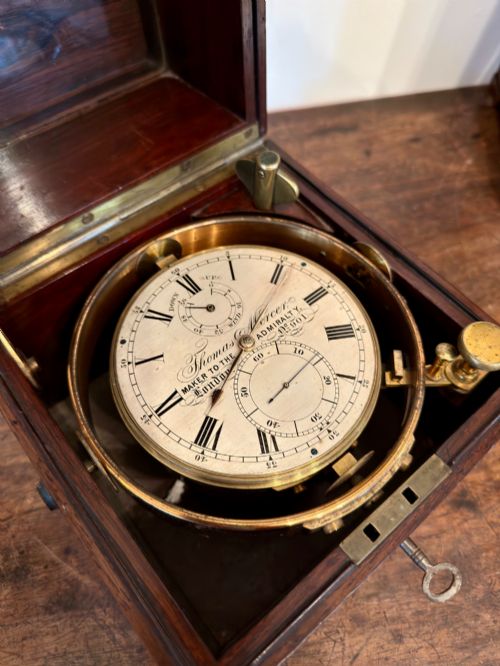
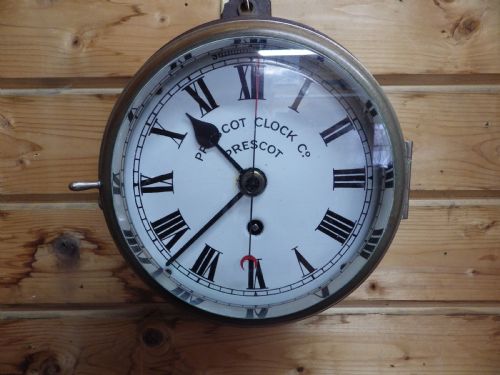
Makers and retailers such as Mercer of London, the Prescot Clock Co, and Gay Vicarino demonstrate the professional standards applied to these instruments. Materials like brass, mahogany, and silvered metal dominate the selection, showing the robust construction required for use at sea.
How they were made
Makers constructed these timepieces using heavy brass housings designed to resist corrosive marine environments and damp conditions. Heavy glass bezels protect the enamel dials and silvered metal faces, keeping salt air away from the delicate mechanisms within.
Many of these instruments utilise fusee movements to maintain consistent tension and accuracy as the mainspring winds down. Mahogany surrounds and marble bases appear on domestic adaptations, while bulkhead models rely purely on substantial cast brass cases screwed directly to wooden backing blocks.
Antique Marine Timepiece Retail Price Guide 2026
Typical asking prices for marine timepiece among the pieces listed under this phrase on Sellingantiques today, from the lower quarter to the upper quarter. They describe what is for sale here now, not the wider market.
Listings feature periods from the Victorian era up to the mid-twentieth century, with materials spanning brass, mahogany, glass, and marble.
What varies in quality
The precision of the movement separates standard utility instruments from high-grade chronometers built for professional navigation. Mercer of London and other specialist makers invested greater skill into regulating mechanisms to ensure stability under constant motion.
The thickness and casting quality of the brass case, along with the clarity of the silvered metal dial, indicate the original purpose and expense of the piece. Crisp engraving on the dial and robust fusee chains reflect superior craftsmanship compared to simpler spring-driven alternatives.
Mercer of London·Prescot Clock Co·Gay Vicarino·Pascall Atkey of Cowes·Smiths Empire·Tissot
The Antique Marine Timepiece Glossary
- Fusee movement
- A conical pulley device connected to the mainspring by a chain or cord. This mechanism equalises the torque of the mainspring as it unwinds, ensuring steady timekeeping.
- Bulkhead clock
- A heavy timekeeper designed to be mounted securely to the interior wall of a ship cabin. These clocks typically feature hinged bezels with screw or toggle locks to withstand vibration.
- Marine chronometer
- A highly accurate portable timekeeper used at longitude for navigation at sea. These instruments are traditionally mounted in gimbals to keep the dial level despite the rolling of a vessel.
- Silvered metal
- A brass or copper dial plate treated with a silver compound to produce a bright, matte finish. Numerals and maker details are usually engraved into the surface and filled with dark wax.
- Deck watch
- A portable precision timekeeper carried on deck or used by navigators for timing observations. These watches bridge the gap between pocket watches and full-sized chronometers.
Antique Marine Timepiece: Frequently Asked Questions
What is a marine timepiece?
A marine timepiece is a clock or watch specifically built to operate reliably in the damp and moving environment of a ship. These range from bulkhead clocks mounted on walls to portable chronometers and deck watches.
They combine robust brass construction with precise movements designed to maintain accuracy despite constant motion and changing temperatures.
Where were bulkhead clocks mounted?
Bulkhead clocks were mounted directly onto the interior partition walls or bulkheads of a ship cabin, chartroom, or bridge. Their heavy brass cases protected the mechanism from sea spray and damp air.
Today, owners often mount them in studies or hallways using the original fixing holes provided in the cast brass flange.
How do I date an antique ships clock?
Dating an antique ships clock involves examining the style of the brass case, the font used for the numerals on the enamel or silvered dial, and any maker inscriptions. Victorian and Edwardian examples often feature cast bezels and specific winding arbors.
Internal movement components and patent marks stamped onto the backplate also provide clues to the decade of manufacture.