
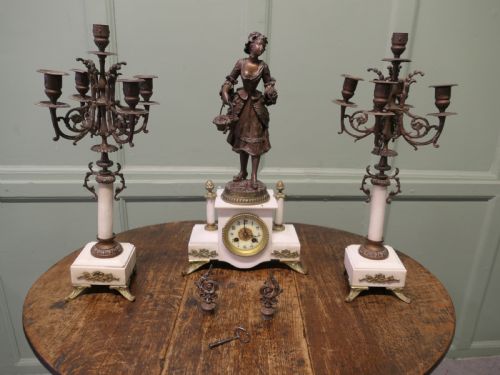


Antique Mantle Clock Candelabra
An antique mantle clock candelabra set brings paired matching light and timekeeping together on the mantelpiece, offering a complete decorative scheme.
Antique Mantle Clock Candelabra
When you search for antique mantle clock candelabra, you are looking at matched sets of a central timepiece flanked by matching candleholders, often referred to as garnitures. These groupings emerged principally across the nineteenth century, reflecting periods such as the Victorian, Edwardian, and Napoleon III eras.
The versions most commonly met on this page are French in origin, often manifesting in Revival styles like Louis XV, Louis XVI, and Rococo. They integrate timepieces with corresponding candelabras designed to sit harmoniously upon a mantelpiece or sideboard.
Forms vary from grand porcelain and gilded metal ensembles to petite marble pieces and architectural cathedral designs under original glass domes. Each set demonstrates the nineteenth-century preference for symmetrical interior decoration.
Materials and construction
Maker workshops utilised metals such as gilt bronze, ormolu, brass, and patinated bronze, often casting and chiselling intricate mounts and figural details. These metal elements were frequently paired with porcelain panels or enamel clock dials.
Natural stones formed substantial bodies and bases, with white marble, siena marble, and green onyx appearing across the pieces. Stonework was shaped, polished, and combined with metal mounts to create structured garnitures.
Movements within the central clocks were engineered to strike over eight-day periods, housed alongside decorative garniture components that required both foundry work and fine assembly.
Several sets feature cheeky cherubs holding up candle branches, keeping an eye on the time while holding the light.
Assessing quality and execution
The distinction between tiers of quality lies in the crispness of the casting and the depth of the gilding or ormolu work. Finer examples show sharp chisel work on bronze mounts and carefully painted enamel dials.
Material selection and scale drive the division between standard production and ambitious works. Substantial stone bodies, such as siena marble or green onyx, paired with detailed figural bronzes or Meissen porcelain, mark out more ambitious commissions.
Meissen·Ferdinand Barbedienne
The Antique Mantle Clock Candelabra Glossary
- Garniture
- A set of matching decorative objects designed to be displayed together, typically comprising a central clock and two flanking candelabras.
- Ormolu
- Finely ground high-carat gold mercury-gilded onto a bronze object, frequently utilised in French nineteenth-century decorative arts.
- Candelabra
- A multi-branched candleholder designed to hold several candles simultaneously, forming the matching sidepieces of a clock set.
- Enamel
- A glassy substance fused to metal surfaces through firing, commonly used to create crisp white clock dials with painted numerals.
Antique Mantle Clock Candelabra: Frequently Asked Questions
What is an antique mantle clock candelabra?
An antique mantle clock candelabra is a matched three-piece ensemble featuring a central timekeeping clock accompanied by two matching candleholders. These sets were designed to create a balanced display on a mantelpiece.
They combine functional time measurement with ornamental lighting accessories, cast in materials like bronze, marble, and porcelain during the nineteenth century.
How do you style a clock garniture?
Styling a clock garniture involves placing the central clock in the middle of a mantelpiece, sideboard, or console table, with the matching candelabras positioned symmetrically on either side. This arrangement creates a unified focal point in a room.
Because the pieces share materials and decorative motifs, they provide a balanced composition without requiring additional ornaments.
What periods do these clock sets come from?
These clock sets originate primarily from the nineteenth century, spanning Victorian, Edwardian, and Napoleon III periods. Many draw stylistic inspiration from earlier French aesthetics, including Louis XV and Louis XVI revivals.
Makers utilised popular nineteenth-century materials such as gilt bronze, siena marble, and green onyx to build these decorative ensembles.
How do you wind an antique clock?
Antique clocks in these sets generally feature mechanical movements that require manual winding using a dedicated key. The winding holes on the dial correspond to the timekeeping train and the striking mechanism.
Care must be taken not to over-wind the springs, ensuring the movement continues to keep accurate time across its striking cycle.