


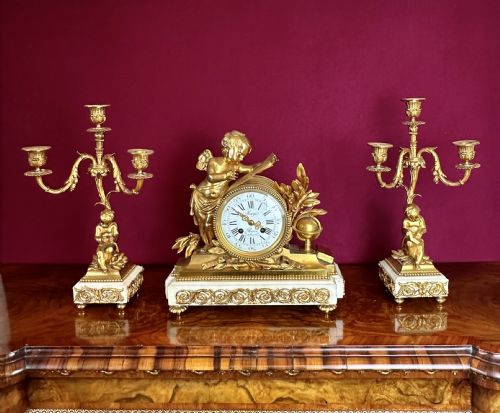


Empire Style Mantel Garniture
These empire style mantel garniture sets bring architectural bronze and marble to a chimneypiece.
Empire Style Mantel Garniture
An empire style mantel garniture combines a central clock with matching sidepieces such as urns or candelabra, arranged together on a fireplace. The examples on this page are principally nineteenth-century French creations drawing on Regency, Napoleon III, and Neoclassical influences.
Most entries pair heavy natural stone bases with cast metal components. Collectors encounter matching sets of three comprising a clock flanked by decorative urns or candlesticks.
The aesthetic stems from classical antiquity and nineteenth-century revivals. Pieces range from straightforward marble urns to elaborate figural clock sets incorporating gilt bronze.
How they were made
Maker workshops cast bronze or brass components before applying thick gold gilding known as ormolu. This metalwork was combined with carved marble, onyx, or siena stone to form heavy, substantial objects.
Clock movements rely on nineteenth-century mechanical engineering, housing eight-day striking movements behind enamel dials. Stonework was turned and polished by hand to support the metal mounts.
Materials appearing in current inventory include ormolu, gilt bronze, siena marble, onyx, and glass.
What varies in quality
The crispness of the cast ornamentation dictates the standard of the metalwork. Sharply chased details on gilt bronze or ormolu separate superior sets from softer, simpler castings.
The choice of stone heavily influences the character of a garniture. Richly figured siena marble, onyx, or porphyry denote higher ambition than plain materials.
VINCENTI of PARIS
The Empire Style Mantel Garniture Glossary
- Ormolu
- Gilded bronze produced by applying a mercury-gilding amalgam to cast metal. The technique creates a warm, dull-gold surface finish characteristic of nineteenth-century decorative arts.
- Garniture
- A set of matching ornamental objects designed to be displayed together on a mantelpiece or sideboard. Typically comprises a central clock accompanied by two side urns or candelabra.
- Siena Marble
- A yellow decorative limestone quarried in Italy, featuring dark grey or purple veining. It was frequently utilised in nineteenth-century French clock sets.
- Candelabra
- Branched lighting fixtures designed to hold multiple candles. In garniture sets, they mirror the decorative motifs of the central clock.
Empire Style Mantel Garniture: Frequently Asked Questions
What is an empire style mantel garniture?
An empire style mantel garniture is a matched decorative set designed for a fireplace, consisting of a central clock and two flanking urns or candlesticks.
These collections utilise materials like gilt bronze, ormolu, and marble to create a unified classical display.
How do I date an empire style mantel garniture?
Dating relies on examining the materials, movement types, and stylistic influences recorded in nineteenth-century manufacturing.
Clocks often feature eight-day striking movements and enamel dials characteristic of the Victorian and Napoleon III periods.
Where should I place a garniture set?
Garniture sets are traditionally arranged across a mantelpiece, placing the central clock in the middle with the side urns or candelabra balancing each side.
They also function effectively on deep sideboards or console tables where the matched group remains visible.
What materials are typical for these sets?
The listings show a frequent combination of cast metals and polished stone. Gilt bronze and ormolu provide the golden metallic elements.
Marble, onyx, and porphyry form the heavy structural bases and body of the urns and clock cases.