





Antique Mantelpiece Clock Garniture
An antique mantelpiece clock garniture brings together a central timekeeper and matching side pieces to anchor a room with architectural weight.
Antique Mantelpiece Clock Garniture
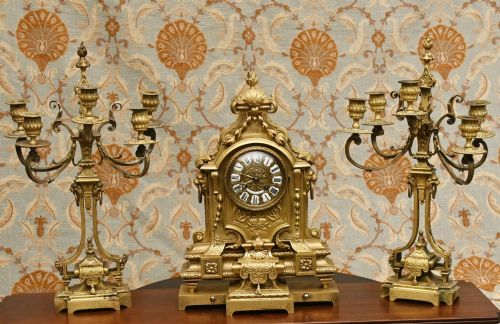
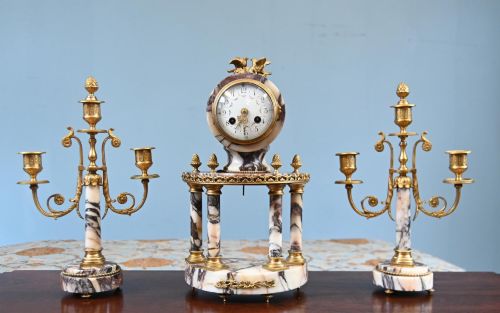
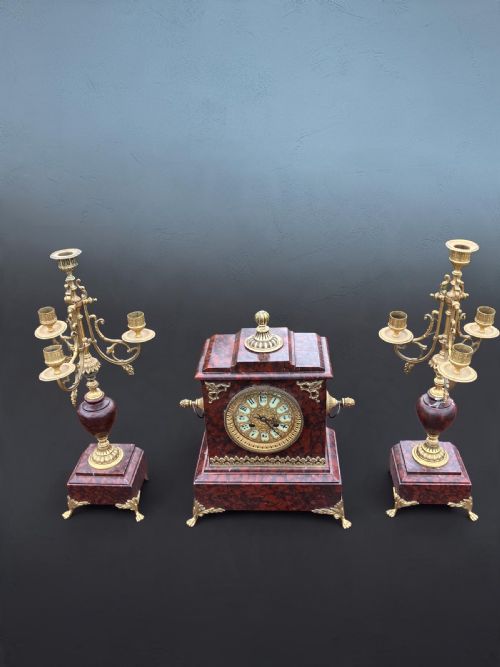
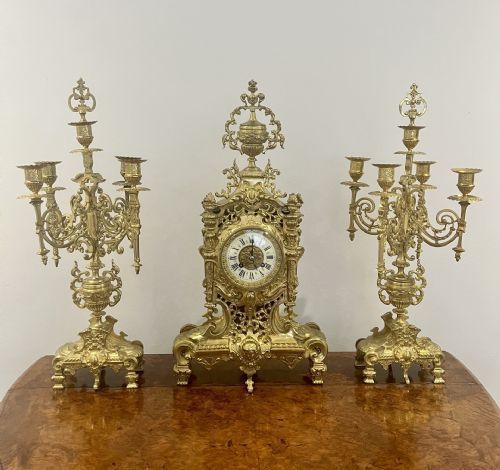
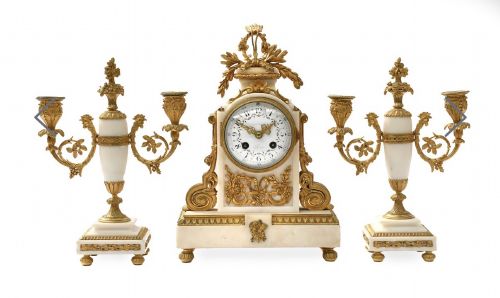
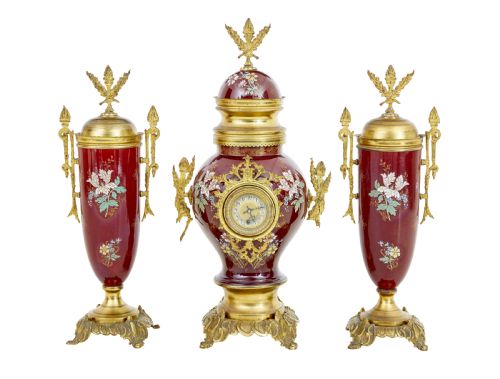
An antique mantelpiece clock garniture comprises a main clock flanked by matching side ornaments such as candelabras or urns, designed to sit together on a fireplace ledge. The version most frequently met on this page is the French multi-piece set, often incorporating matching side pieces in the Louis XVI style, Empire taste or Art Deco design.
The objects span the nineteenth century and the early twentieth century, taking forms from portico clocks to ornate architectural arrangements. Makers and retailers such as Japy Freres and Finnigan Manchester contributed to a tradition where symmetry dictates the presentation on a mantel or sideboard.
Materials range from red, white, green and Sienna marble to gilt bronze, ormolu, porcelain and enamel. The matched sets create a unified decorative scheme that served as the focal point of a Victorian or Edwardian interior.
Materials and construction methods
Foundries and workshops shaped these sets using cast metals including brass, bronze and ormolu, often fire-gilding the surfaces to achieve a durable golden lustre. Marble bases and columns were hand-turned and polished, while porcelain components, including Sevres and Imari styles, were painted and glazed before being mounted into metal mounts.
Clock dials utilised enamel with painted numerals, sometimes paired with visible pendulums or specialised complications like penny moon phases. Alabaster, onyx, glass and toleware further expanded the material vocabulary utilised by period artisans to construct the multi-piece garniture assemblies.
Antique Mantelpiece Clock Garniture Retail Price Guide 2026
Typical asking prices for mantelpiece clock garniture among the pieces listed under this phrase on Sellingantiques today, from the lower quarter to the upper quarter. They describe what is for sale here now, not the wider market.
Materials recorded span Enamel, Gilt Bronze, Brass, Ormolu, Marble, Glass, Porcelain, and White Marble.
Distinctions in quality
The standard of chasing and fire-gilding on the bronze or ormolu mounts determines the crispness of leaf scrolls, cherubs and architectural details. Weaker examples show soft, shallow casting marks, whereas superior pieces display hand-chased depth and sharp relief.
The choice and integrity of the stone body set the baseline for value, with solid Sienna, red or green marble outperforming lesser materials. Coherence across the entire set, ensuring the clock and side pieces share identical patination and matching mounts, separates composite groupings from original ensembles.
Japy Freres·Finnigan Manchester
The Antique Mantelpiece Clock Garniture Glossary
- Garniture
- A set of matching decorative objects designed to be displayed together, typically comprising a central clock and two flanking candelabras or urns.
- Ormolu
- Gilt bronze created by applying a mixture of finely ground gold and mercury to a bronze base, then heating it to drive off the mercury.
- Portico clock
- A mantel clock featuring a architectural case supported by four or more columns, often housing a pendulum swinging in the open space between them.
- Toleware
- Painted or japanned sheet metal items produced for domestic utility and ornament during the eighteenth and nineteenth centuries.
- Cloisonne
- An ancient technique for decorating metalwork objects with coloured material held in place by thin metal strips soldered to the base.
Antique Mantelpiece Clock Garniture: Frequently Asked Questions
What is a clock garniture?
A clock garniture is a matched suite of ornaments designed for display on a mantelpiece, consisting of a central clock accompanied by two side pieces such as urns or candelabras.
These sets were conceived as a unified decorative scheme to provide symmetry and visual balance across a fireplace or large sideboard.
How do I date a French clock garniture?
Dating relies on stylistic clues, such as the neoclassical symmetry of Louis XVI revivals, the heavy gilt bronze of Napoleon III periods, or the geometric lines of Art Deco pieces.
Maker marks on the movement backplate and specific material combinations also help narrow down the decade of production.
Where were these clocks placed?
They were positioned centrally on the mantelpiece above a fireplace, flanked by their matching candelabras or urns to create an imposing architectural focal point in the principal reception rooms.
Their substantial weight and reflective gilt surfaces also suited them for display on large console tables or pier glasses.
How do I maintain an antique clock movement?
Mechanical clock movements require periodic cleaning and oiling by a qualified horologist to prevent wear on the brass gears and escapement components.
Keeping the clock level and handling the pendulum with care during setting will ensure accurate timekeeping and protect the suspension spring.